
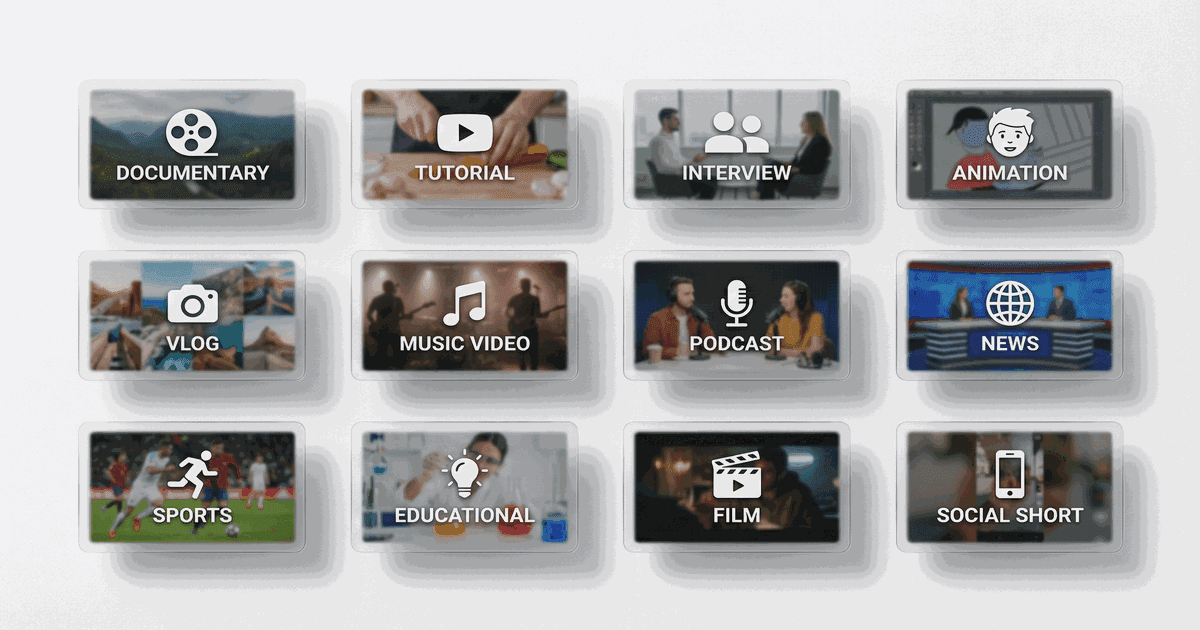
There are 12 types of video content used regularly in commercial marketing. Each format has a different cost structure, different performance benchmarks, and different positions in the buyer journey. Using the wrong type in the wrong context wastes production budget. Using the right type at the right stage multiplies returns.
This guide covers all 12 with specific data: median cost per video (Clutch 2025 Video Production Pricing Survey), engagement and conversion benchmarks (Wistia 2025 State of Video Report, Vidyard 2025 Video in Business Report), and the funnel stage where each type performs best.
Every Type Of Short Form Video Format, Explained
Key takeaways
- Explainer videos have the highest conversion influence: 93% of consumers say an explainer video influenced their purchase decision (Wyzowl 2025)
- Training videos achieve the highest completion rate at 78%, while promotional ads have the lowest at 35%
- UGC-style ads on Meta deliver 29% higher CTR and 23% lower CPA than professionally produced ads
- Most brands over-invest in awareness video and under-invest in decision video - 73% of B2B buyers say testimonials and case studies are the most useful purchase evaluation content
- Cost ranges span $0 (organic UGC) to $100,000+ (documentary), with the most common formats in the $2,000-$15,000 range
- Start with an explainer video for your homepage: landing pages with video increase conversions by up to 86%
- Short-form social video gets the highest engagement: TikTok at 5.69%, Instagram Reels at 2.80%, YouTube Shorts at 1.90%
- Webinars convert 52% of registrants into qualified leads, the highest lead generation rate of any video type
Marketers used to treat video like their marketing dessert. We all loved it, but we'd only have it once in a while for a special occasion. In 2026, we're going to see more companies starting their strategy with video, treating it more as the main course.
Quick comparison: all 12 video content types
| Video type | Typical cost | Funnel stage | Avg. completion rate | Best platform |
|---|---|---|---|---|
| Explainer | $3,000-$15,000 | Awareness/consideration | 68% | Website, YouTube |
| Product demo | $2,000-$10,000 | Consideration/decision | 65% | Website, sales deck |
| Customer testimonial | $2,000-$8,000 | Decision | 72% | Website, LinkedIn |
| Brand film | $10,000-$50,000+ | Awareness | 58% | YouTube, TV, cinema |
| Corporate/company video | $5,000-$25,000 | Awareness/trust | 55% | Website, LinkedIn |
| Social media (short-form) | $500-$5,000 | Awareness | 45% | TikTok, Reels, Shorts |
| Training/onboarding | $2,000-$12,000 | Retention | 78% | LMS, internal |
| Webinar/live stream | $1,000-$5,000 | Consideration | 42% | YouTube, LinkedIn, Zoom |
| Promotional/ad | $1,000-$20,000 | Awareness/conversion | 35% | Meta, YouTube, TV |
| Documentary | $15,000-$100,000+ | Awareness/authority | 62% | YouTube, streaming |
| Event video | $3,000-$15,000 | Awareness | 48% | Social, website |
| User-generated content | $0-$2,000 | Trust/conversion | 52% | Social, ads |
Source: Clutch 2025 pricing survey (cost), Wistia 2025 (completion rates), Vidyard 2025 (platform data).
1. Explainer videos
Explainer videos break down a product, service, or concept in 60-120 seconds. They answer the question "what does this do and why should I care?" Most are animated (2D or motion graphics), though some use live action with animated overlays.
Cost: $3,000-$15,000. Animated explainers cost $3,000-$10,000 for simple motion graphics, $8,000-$15,000 for character-driven 2D animation. Live action explainers with animated overlays cost $5,000-$12,000.
Performance data: Explainer videos have the highest conversion influence of any video type. According to Wyzowl's 2025 State of Video Marketing Report, 93% of consumers report that an explainer video influenced their purchase decision. Wistia's 2025 data shows a 68% average completion rate for explainers under 2 minutes.
Best use cases:
- Homepage or landing page hero video
- SaaS product onboarding
- Sales enablement (send before or after a demo call)
- Social media ad creative (cut to 15-30 seconds for paid distribution)
Real example: Crazy Egg's animated explainer video (produced for roughly $12,000 in 2009) generated an additional $21,000 per month in revenue, according to founder Neil Patel. The video converted an estimated 64% of visitors who watched it.
We produce more explainer videos than any other format at Green Frog Labs. Most clients come to us for a brand film, but when we look at their funnel data together, the explainer almost always has a higher impact per dollar spent.
2. Product demos
Product demos show a product in action - how it works, what it looks like, and how it solves a specific problem. For software demo videos, this typically means screen recordings with voiceover and animated annotations. For physical products, this means live-action footage of the product being used.
Cost: $2,000-$10,000. Screen-recorded software demos with professional editing cost $2,000-$5,000. Physical product demos requiring a shoot location and talent cost $5,000-$10,000.
Performance data: According to Vidyard's 2025 report, product demo videos have the highest influence on purchasing decisions in B2B sales. Sales reps who send personalized demo videos close deals 41% faster than those who rely on text-based follow-ups. Completion rate averages 65%.
Best use cases:
- Sales follow-up (recorded after discovery call with prospect-specific details)
- Product pages on e-commerce sites
- Trade show and conference booth displays
- Feature launch announcements
Real example: Shopify's product demo videos on merchant pages show real merchants using the platform. According to Shopify's 2025 Commerce Trends report, product pages with video demonstration convert at 1.8x the rate of pages with static images alone.
Need video content built for your specific use case?
Corporate, demo, testimonial, product - we'll match the format to your goals.
Book a Discovery Call3. Customer testimonials
Testimonial videos feature real customers describing their experience with a product or service. The format is typically interview-style: a customer on camera answering questions about the problem they faced, why they chose the product, and the results they achieved. See our video testimonial examples for seven formats with conversion data and production playbooks.
Cost: $2,000-$8,000. Remote testimonials (filmed by the customer or via high-quality video call) cost $2,000-$3,000. On-location professional shoots cost $5,000-$8,000 per testimonial.
Performance data: Testimonial videos have the highest completion rate of any commercial video type at 72% (Wistia, 2025). A 2025 study by the USC Annenberg School found viewers trust real human faces 2.1x more than animated characters for product recommendations. According to a 2025 Stackla/Nosto survey, 79% of people say user-generated content and testimonials affect their purchasing decisions.
Best use cases:
- Dedicated case study pages on your website
- Sales deck inserts (embed 30-second clips in presentations)
- Retargeting ads (show testimonials to people who visited your site but did not convert)
- LinkedIn organic posts (B2B buyers consume testimonials on LinkedIn more than any other platform)
When using testimonials in paid campaigns, testimonial advertising strategies can generate 4x higher click-through rates than brand-produced creative.
Being authentic! With the rise of AI, it will be important for brands to stay authentic. People want to hear from other people. Testimonials from clients are your strongest way to sell your product.
4. Brand films
Brand films are the most cinematic format in commercial video. They tell a story about what a brand stands for, typically through narrative filmmaking rather than direct product promotion. The goal is emotional connection, not immediate conversion.
Cost: $10,000-$50,000+. Single-day shoots with modest production value start at $10,000. Multi-day shoots with professional talent, location work, and cinematic post-production exceed $50,000.
Performance data: Brand films have the lowest direct conversion rate but the highest impact on brand recall. According to a 2024 Kantar brand lift study, brand films increase unaided brand recall by 42% and purchase intent by 15% over a 90-day measurement window. Completion rate averages 58%.
Best use cases:
- YouTube brand channel (flagship content)
- Company "About" pages
- Pre-roll before presentations and keynotes
- Award submissions and industry events
Real example: Dove's "Real Beauty Sketches" (2013) cost $6 million to produce and became the most-viewed online ad in history at the time with 180 million views. It increased Dove's sales by $1.5 billion over the following year, according to Unilever's investor report.
What would a custom video strategy look like for your company?
We'll scope your project, outline the approach, and give you a real timeline.
Get a Free Consultation5. Corporate/company videos
Corporate videos cover the business itself: company overview, culture, leadership messages, investor updates, and recruitment content. Unlike brand films (which are outward-facing and emotional), corporate video serves internal and institutional audiences. For a complete walkthrough of production workflows, see our corporate video production for corporate guide.
Cost: $5,000-$25,000. Single-camera office shoots with executive interviews cost $5,000-$10,000. Multi-location productions with employee interviews and B-roll cost $15,000-$25,000.
Performance data: According to Vidyard's 2025 report, companies that use video on their careers page receive 34% more applications. Completion rate averages 55%, lower than other formats because corporate videos tend to run longer (3-5 minutes).
Best use cases:
- Careers and recruitment pages (culture videos)
- Investor relations and earnings presentations
- Internal all-hands meetings and company updates
- Partner and channel communications
Compare corporate video production approaches to find the right production partner, or explore corporate video ideas for 15 formats organized by business goal.
A lot more companies are going to be doing founder brands, and I think that executives are gonna be doing a lot more video content. It really helps LLMs to have consistent and fresh content. One thing that you can do is get one hour with your executives a month, ask them a bunch of questions, record it on video, and publish it. 2026 is the year of the founder brand.
6. Social media video (short-form)
Short-form social video is content under 60 seconds designed for vertical viewing on TikTok, Instagram Reels, YouTube Shorts, or similar platforms. The format prioritizes immediate attention capture (the first 1-3 seconds), mobile-first framing, and platform-native editing styles.
Cost: $500-$5,000 per video. Phone-shot UGC-style content costs $500-$1,500. Professionally produced short-form with editing, graphics, and sound design costs $2,000-$5,000.
Performance data: Short-form video has the highest engagement rate of any content format on social media. According to Socialinsider's 2025 benchmarks, TikTok's average engagement rate is 5.69%, Instagram Reels averages 2.80%, and YouTube Shorts averages 1.90%. Completion rate averages 45% (lower than other formats because the algorithm serves content to broad audiences, not just followers).
Best use cases:
- Paid social ad creative (Meta, TikTok, YouTube)
- Organic brand building on TikTok and Instagram
- Behind-the-scenes content
- Product teasers and launch countdowns
- Trend participation and cultural moments
Real example: Duolingo's TikTok strategy turned a language-learning app into a cultural phenomenon. By posting daily short-form videos featuring their owl mascot, Duolingo grew from 50,000 to 11+ million TikTok followers between 2021 and 2025 and attributed a measurable portion of their 2024 user growth to TikTok, according to their Q4 2024 earnings call.
It never hurts to repurpose your long-form content into short-form formats (like Instagram Reels, YouTube Shorts, etc.) - and vice versa. By doing so, you can appeal to people who consume information in different ways. It's a timeless technique that stretches the value of your work.
7. Training and onboarding videos
Training videos teach employees, customers, or partners how to use a product, follow a process, or learn a skill. The format prioritizes clarity and retention over entertainment value.
Cost: $2,000-$12,000 per module. Screen-recorded tutorials with professional editing cost $2,000-$4,000. On-location shoots with employees demonstrating processes cost $6,000-$12,000.
Performance data: Training videos have the highest completion rate of any video type at 78% (Wistia, 2025). This is because the audience is captive (employees or customers who need the information) rather than optional. According to a 2024 Forrester study, companies using video for employee training reduce onboarding time by 40% and improve knowledge retention by 65% compared to text-based training.
Best use cases:
- New employee onboarding
- Product training for customer success teams
- Partner and channel training
- Compliance and safety training
- Customer onboarding sequences
A meet the team video can complement onboarding content by introducing new hires to the people they will work with, building trust before day one.
8. Webinars and live streams
Webinars are long-form video events (typically 30-60 minutes) broadcast live or recorded for on-demand viewing. Live streams are real-time broadcasts on social platforms with audience interaction.
Cost: $1,000-$5,000 per event. Basic webinar using Zoom or StreamYard with slide presentation costs $1,000-$2,000. Multi-camera studio webinar with professional production costs $3,000-$5,000.
Performance data: Webinars have the highest lead generation rate of any video type. According to ON24's 2025 Webinar Benchmark Report, the average webinar converts 52% of registrants into qualified leads. Live webinars average 42% completion rate; on-demand recordings average 28%. Average attendee engagement time is 57 minutes.
Best use cases:
- Lead generation (gated registration captures contact information)
- Thought leadership and industry positioning
- Product launches and feature announcements
- Customer education and community building
- Panel discussions with industry experts
Ready to start your next video project?
From brief to final cut - we'll handle production so you can focus on your business.
Get Started9. Promotional and advertising videos
Promotional videos are paid advertising content - TV commercials, pre-roll ads, social media ads, and sponsored content. The format optimizes for a specific conversion action (click, purchase, signup) rather than education or entertainment. See our product advertisement examples for 11 campaigns with performance data across six creative techniques.
Cost: $1,000-$20,000+ per ad. Social media ad creative costs $1,000-$5,000. Professional TV-quality commercial production costs $10,000-$20,000+. National broadcast campaigns exceed $50,000 before media buying.
Performance data: According to Meta's 2025 Creative Best Practices report, video ads have 48% lower cost-per-acquisition than static image ads. Video ads on YouTube average a 35% completion rate for 15-second pre-roll and 22% for 30-second pre-roll (Google Ads 2025 benchmarks).
Best use cases:
- Paid social campaigns (Meta, TikTok, LinkedIn)
- YouTube pre-roll and in-stream ads
- Connected TV and streaming platforms
- Retargeting campaigns
For mobile apps specifically, an app promo video can increase app store conversion rates by 25-30%.
10. Documentary-style videos
Documentary videos use long-form narrative to explore a topic, tell a customer's story, or investigate an industry issue in depth. Longer than testimonials (typically 5-30 minutes), documentaries provide the depth required to establish authority.
Cost: $15,000-$100,000+. Simple documentary with interview footage and stock B-roll costs $15,000-$30,000. Multi-location documentary with original footage, professional narration, and cinematic post-production costs $50,000-$100,000+.
Performance data: Documentary videos have a 62% average completion rate despite their length, higher than most formats. This is because audiences self-select into documentaries they care about. According to a 2024 Content Marketing Institute study, 71% of B2B buyers say long-form video content (over 5 minutes) has more influence on their purchase decisions than short-form content.
Best use cases:
- Customer story deep-dives (more credible than short testimonials)
- Industry thought leadership
- Cause marketing and social impact
- Internal culture and recruiting for senior roles
11. Event videos
Event videos capture conferences, trade shows, product launches, company events, or community gatherings. The category includes pre-event promotional teasers, live event coverage, and post-event highlight reels.
Cost: $3,000-$15,000. Single-camera event coverage with highlight reel costs $3,000-$6,000. Multi-camera coverage with same-day or next-day turnaround costs $8,000-$15,000.
Performance data: Event highlight reels have a 48% average completion rate. According to Bizzabo's 2025 Event Marketing Report, companies that produce professional event recap videos see 3x more social media engagement in the month following an event compared to companies that share only photos.
Best use cases:
- Post-event marketing and social media content
- Event registration promotion for future events
- Speaker and session highlights for content repurposing
- Sponsor deliverables (branded event recaps)
12. User-generated content (UGC)
UGC videos are created by customers, fans, or creators rather than the brand itself. The brand either curates organic UGC or commissions creators to produce content in UGC style (authentic, phone-shot, unpolished).
Cost: $0-$2,000. Organic UGC is free but unpredictable. Commissioned UGC from creators costs $200-$2,000 per video depending on creator following and usage rights.
Performance data: According to a 2025 Stackla/Nosto survey, consumers are 2.4x more likely to perceive UGC as authentic compared to brand-produced content. UGC-style ads on Meta have 29% higher click-through rates and 23% lower cost-per-acquisition than professionally produced ads, according to Meta's 2025 Creative Best Practices report.
Best use cases:
- Social media ad creative (highest-performing format for paid social)
- Product review compilation pages
- Community building and brand advocacy
- Social proof on product and landing pages
Real example: GoPro built its entire brand on UGC. The company's YouTube channel (12+ million subscribers) consists primarily of customer-submitted footage. According to GoPro's 2024 investor report, UGC content generates 6x more engagement than brand-produced content on their channels.
The funnel map: which video type goes where
| Funnel stage | Primary video types | Goal |
|---|---|---|
| Awareness | Brand film, social (short-form), promotional ad | Reach, impressions, brand recall |
| Consideration | Explainer, product demo, webinar, documentary | Education, engagement, lead capture |
| Decision | Testimonial, case study, UGC, product demo | Trust, objection handling, conversion |
| Retention | Training, corporate, onboarding | Activation, satisfaction, expansion |
| Advocacy | UGC, event, testimonial | Referral, community, social proof |
Most brands over-invest in awareness video (brand films and social content) and under-invest in decision video (testimonials and demos). According to Demand Gen Report's 2025 B2B Buyers Survey, 73% of buyers say testimonial and case study videos are the most useful content when evaluating a purchase. For direct-response conversion on landing pages, a video sales letter (VSL) converts at 2-3x the rate of text-based sales pages.
In 2026, content marketers should be prepared to shift toward content that relates to a more human level, sharing real stories and testimonials. Marketers should prepare their content strategy with authenticity in mind: think conversational and relatable content, not overly polished 'corporate' content. Video has been king and will remain that way as we see a shift from people not only watching video but also expecting it.
How to allocate video budget across content types
A simple framework based on your marketing maturity:
Early stage (budget under $20,000/year):
- 50% on one explainer video (website hero)
- 30% on 3-5 short-form social videos
- 20% on 2-3 customer testimonials
Growth stage (budget $20,000-$100,000/year):
- 25% on explainer + product demos
- 25% on testimonials + case studies
- 25% on short-form social content (ongoing)
- 25% on training + onboarding
Scale stage (budget $100,000+/year):
- 20% brand film or documentary
- 20% testimonials + case studies (ongoing program)
- 20% short-form social (weekly production)
- 20% product demos + explainers (per feature/launch)
- 10% events
- 10% webinars + thought leadership
AI video production tools can accelerate timelines by 40-60% across most of these formats, while AI video generators handle specific tasks like B-roll generation, voiceover, and rough cut assembly.
Frequently asked questions
What are the main types of video content?
The 12 main types are: explainer videos, product demos, customer testimonials, brand films, corporate/company videos, social media short-form, training/onboarding videos, webinars/live streams, promotional ads, documentary-style videos, event videos, and user-generated content. Each serves a different position in the marketing funnel and has different cost and performance characteristics.
Which type of video content has the best ROI?
Explainer videos and customer testimonials consistently rank highest for ROI. Explainer videos influence 93% of purchase decisions (Wyzowl, 2025) and have generated documented returns of 10-20x production cost for companies like Crazy Egg and Dropbox. Customer testimonials have the highest completion rate (72%) and are cited by 73% of B2B buyers as the most useful purchase evaluation content (Demand Gen Report, 2025).
How much does video content cost to produce?
Costs range from $0 (organic UGC) to $100,000+ (documentary and brand film productions). The most common commercial formats fall in the $2,000-$15,000 range: explainers ($3,000-$15,000), product demos ($2,000-$10,000), testimonials ($2,000-$8,000), and social media content ($500-$5,000). These ranges reflect Clutch's 2025 pricing survey of 500 production companies.
What type of video content works best on social media?
Short-form video (under 60 seconds) gets the highest engagement on social platforms. TikTok leads with a 5.69% average engagement rate, followed by Instagram Reels at 2.80% and YouTube Shorts at 1.90% (Socialinsider, 2025). UGC-style content outperforms polished brand content on paid social, with 29% higher CTR and 23% lower CPA on Meta (Meta Creative Best Practices, 2025).
What video content should a new business make first?
Start with one explainer video for your homepage or main landing page. Explainer videos have the broadest impact: they educate visitors, reduce bounce rates, and increase conversions by up to 86% on landing pages (EyeView Digital, 2024). After the explainer, produce 2-3 customer testimonials (even short ones filmed remotely) and start creating weekly short-form social content.
How many types of video should a brand use?
Most brands need 3-5 types in active rotation. At minimum, you need an explainer (education), testimonials (trust), and social content (reach). As budget grows, add product demos, training videos, and webinars. Using all 12 types is rare and only makes sense for brands with $100,000+ annual video budgets and dedicated production resources.
Match the format to the job
Each video type exists because it solves a specific communication problem better than the alternatives. Explainers educate. Testimonials build trust. Social content builds reach. Product demos close deals. Promotional ads drive action.
Start with the funnel map above. Identify where your biggest drop-off happens (awareness, consideration, or decision), and invest your video budget in the format designed for that stage. One well-placed testimonial on your pricing page will outperform a $50,000 brand film that lives only on YouTube.
External sources:
- Forbes: Dominating The Digital Landscape Videos Undeniable Reign (2024)
- Wyzowl 2025 State of Video Marketing Survey
- Vidyard 2025 Business Video Benchmark Report
Not sure which video format fits your brand?
We'll map the right formats to your funnel, audience, and budget. No commitment.
Book a Free Strategy CallRelated articles:
- Understand the broader business case with our benefits of video marketing guide - PILLAR article covering 12 data-backed benefits with expert quotes, comparison tables, and ROI benchmarks across all video types.
- See these formats in action with our curated video marketing examples - brand case studies across 8 video types with performance data, budget ranges, and strategic takeaways.
- Quantify the SEO benefits with our complete video SEO statistics guide - 30 named stats organized by category (rankings, engagement, conversions, platform data) with source links and methodology notes.
- Apply video types to paid campaigns with our creative video ads framework - platform-specific formats, performance data, and thumb-stopping creative strategies for promotional and social video.
- Navigate the production process with our corporate video production guide - vendor selection, timeline management, and stakeholder alignment for company video projects.
- Explore short-form execution with our short-form video examples collection - platform-native viral patterns across TikTok, Reels, and Shorts with performance analysis.
- Understand animation format options in our types of animation guide - 2D, 3D, motion graphics, whiteboard, and hybrid approaches with cost and timeline comparisons for animated video types.