
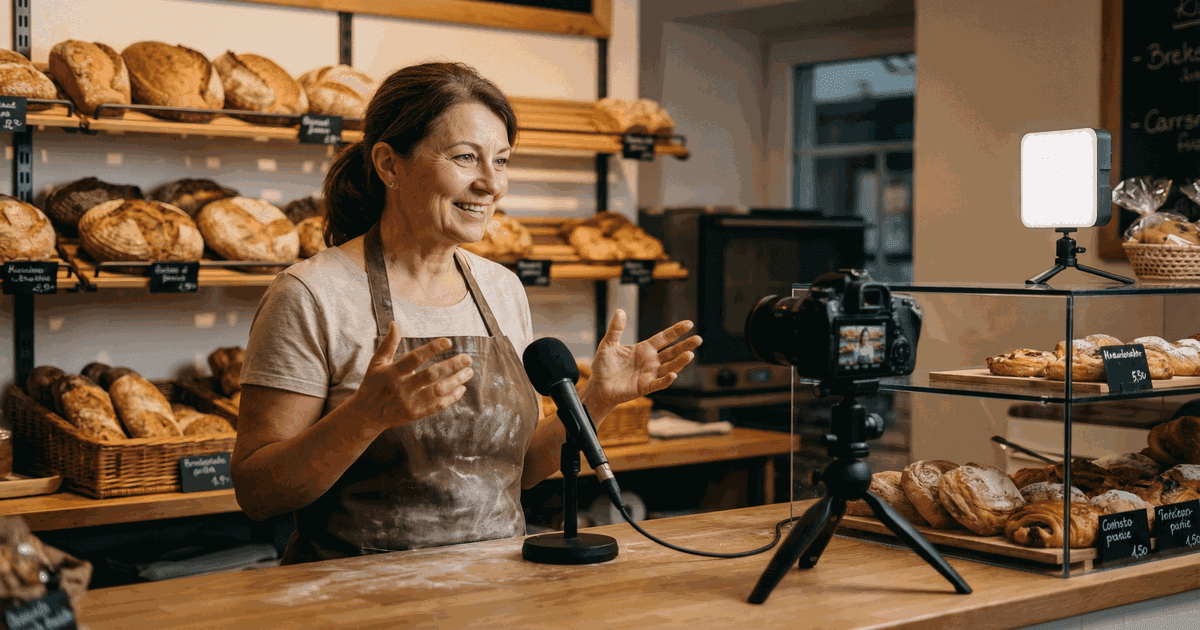
Landing pages with video testimonials convert 62% better than those without, according to Eyeview Digital's 2025 conversion study. Yet most brands produce testimonials the same way: sit a customer in front of a camera, ask them to say nice things, and hope the result does not look like a hostage video.
The format of a video testimonial matters as much as the content. A smartphone-recorded reaction video and a produced multi-camera interview serve different purposes, work for different audiences, and cost different amounts to produce.
This guide breaks down seven video testimonial formats by conversion impact, production requirements, and best use cases. For how testimonials compare with other types of video content, see our complete format guide. Each includes real brand examples with measured results so you can pick the format that matches your goal, budget, and audience.
What is a video testimonial?
A video testimonial is a recording of a customer describing their experience with a product or service. Video testimonials differ from written reviews because they carry nonverbal trust signals: facial expressions, vocal tone, body language, and environmental context that written text cannot convey. According to BrightLocal's 2025 Consumer Review Survey, video testimonials are trusted 2x more than written reviews and 3x more than numerical star ratings.
Why video testimonials convert: the psychology
Video testimonials work because of two well-documented psychological mechanisms.
The first is social proof. Robert Cialdini's research at Arizona State University (originally published in "Influence: The Psychology of Persuasion" and updated in the 2021 edition) found that people follow the actions of others when they are uncertain about their own decision. A customer who looks and sounds like the viewer, describing a positive outcome, reduces perceived risk more effectively than any brand claim.
The second is the parasocial effect. A 2024 study published in the Journal of Consumer Psychology found that viewers form stronger trust bonds with video speakers than with text authors, even when the information content is identical. The study measured galvanic skin response and eye tracking across 1,200 participants and found that video testimonials generated 34% higher trust scores than the same testimonials presented as written quotes.
It might sound cheesy, but trust is a competitive advantage. We're in an era of 'AI slop,' long sales cycles and growing buying committees. Brands need to build trust, prove their expertise and earn their place in the buying process.
"The difference between a testimonial that converts and one that gets skipped is specificity. Vague praise like 'great product' does nothing. A customer who says 'we cut our onboarding time from 3 weeks to 4 days' gives the viewer a concrete outcome to anchor their decision on," says April Dunford, positioning consultant and author of "Obviously Awesome."
Format 1: The customer interview
The customer interview is the most widely used testimonial format. A customer sits in front of a camera (often at their workplace or home) and answers questions about their experience. The interviewer stays off-camera.
Why it works: The interview format feels conversational and unscripted. When done well, it mimics a friend recommending a product rather than a brand advertising it. According to Wistia's 2025 Video Benchmarks report, well-produced interview testimonials retain 61% of viewers to completion.
Example: Slack x Shopify. Slack's customer story featuring Shopify runs 2 minutes and 40 seconds. A Shopify engineering lead describes a specific workflow problem (coordinating code deployments across 14 time zones) and explains how Slack Huddles reduced their deployment coordination time from 45 minutes to 12 minutes. According to Slack's 2024 marketing metrics shared at SaaStr Annual, customer story videos generate a 34% higher conversion rate on landing pages compared to pages without video.
Example: HubSpot x Sandler Training. HubSpot's testimonial with Sandler Training runs 3 minutes and intersperses customer interview footage with screen recordings showing the CRM dashboard. The customer cites specific numbers: 40% reduction in manual data entry, 28% increase in sales team pipeline. According to HubSpot's 2025 State of Marketing Report, testimonials that include specific performance metrics generate 22% higher click-through rates than those with general praise.
Production playbook: One camera, one lavalier microphone, natural or simple lighting. Ask 5-7 open-ended questions. Film for 20-30 minutes and edit to 90-180 seconds. Budget: $500-5,000.
In B2B, trust isn't earned in a pitch, it's built in moments. Video and authentic voices let brands show up with consistency, not just content.
Format 2: The before-and-after transformation
Before-and-after testimonials show the customer's situation before your product and after. The visual contrast creates an immediate, emotional understanding of value that words alone cannot achieve.
Why it works: The contrast principle (documented by Cialdini and confirmed in a 2025 study in the Journal of Marketing Research) states that people evaluate outcomes relative to a reference point, not in absolute terms. Showing the "before" state makes the "after" state more impressive. According to Wyzowl's 2025 State of Video Marketing survey, before-and-after testimonial videos convert 78% better than standard interview testimonials.
Example: Peloton member stories. Peloton's member transformation videos follow a consistent structure: the member describes their life before Peloton (sedentary, low energy, struggling with health), then shows their current routine and results. These 60-90 second videos include specific data points (pounds lost, miles ridden, classes completed). According to Peloton's 2024 investor presentation, member story content on social media generates 3.8x higher engagement than product-focused content.
Example: Smile Direct Club patient journeys. Smile Direct Club's video testimonials show patients' teeth at the start of treatment and the final result, with the patient narrating the experience. According to a 2024 case study published by Digiday, Smile Direct Club's before-and-after testimonials generated a 47% lower cost-per-acquisition in paid social campaigns compared to their standard product ads.
Production playbook: Requires advance planning. Film the "before" segment early, then the "after" segment weeks or months later. Use the same camera angle and lighting for visual consistency. Budget: $300-3,000 (two filming sessions, often shorter than interviews).
Need video content built for your specific use case?
Corporate, demo, testimonial, product - we'll match the format to your goals.
Book a Discovery CallFormat 3: The unscripted reaction
Unscripted reaction testimonials capture genuine, spontaneous responses. No interview questions, no preparation. The customer experiences or discovers something and reacts in real time.
Why it works: Authenticity detection is a real cognitive process. A 2025 Stackla consumer survey found that 78% of consumers can tell whether video content is staged or genuine, and 86% say authenticity influences their purchasing decisions. Unscripted reactions are the hardest format to fake, which is why they score highest on trust metrics.
Example: Chewy unboxing reactions. Chewy (the pet supplies retailer) collects video testimonials from customers opening personalized pet portraits that Chewy sends as surprise gifts. The reactions are genuine, emotional, and completely unscripted. According to Sprout Social's 2025 benchmark data, Chewy's user-submitted reaction videos generate 5.2x higher share rates than their produced marketing content.
Example: T-Mobile customer surprise videos. T-Mobile's "Un-carrier" campaigns include moments where customers discover unexpected benefits (free Netflix, international roaming, bill credits). The filmed reactions run 15-30 seconds and perform well on TikTok and Instagram Reels. According to Tubular Labs data, T-Mobile's surprise reaction content averages 2.1 million views per video on TikTok.
"The best testimonial videos are the ones where the brand did not ask for a testimonial. They created an experience worth talking about, and then captured the natural response. That cannot be scripted," says Jay Baer, marketing strategist and author of "Talk Triggers."
Production playbook: Requires creating a moment worth capturing. Can be filmed on smartphones. No script, no preparation for the subject. Budget: $0-1,000 (usually just the cost of the surprise or experience).
Format 4: The case study narrative
Case study narratives are longer testimonials (3-8 minutes) that follow a story structure: the customer's problem, the decision to choose your product, the implementation process, and the measurable results. They function as mini-documentaries.
Why it works: Narrative structure creates what psychologists call "transportation," a state where the viewer becomes absorbed in the story and lowers their critical defenses. According to a 2024 study in the Journal of Consumer Research, viewers who experience narrative transportation during a testimonial are 43% more likely to express purchase intent than viewers who watch non-narrative testimonials with the same factual content.
Example: Google Ads x Princess Polly. Google's case study video featuring Princess Polly (an Australian fashion retailer) runs 4 minutes and follows the brand's journey from a small online store to a $100M+ revenue business. The video includes specific campaign metrics: 12x return on ad spend, 89% increase in new customer acquisition, 340% revenue growth over 3 years. According to Google's Think with Google platform, this case study page receives 40,000+ monthly visits.
Example: Salesforce x Spotify. Salesforce's customer story with Spotify runs 5 minutes and details how Spotify's ad sales team used Salesforce to manage relationships with 3,000+ advertisers. The video includes screen recordings of the Salesforce dashboard alongside interview footage. Specific results: 35% increase in ad revenue per account, 50% reduction in proposal turnaround time.
Production playbook: Requires a full production day. Multiple camera setups, B-roll footage at the customer's location, screen recordings if SaaS. Script the structure but not the dialogue. Budget: $3,000-15,000.
Trust has always been at the core of marketing, and it's why brands exist. The issue today is that earning trust is water-drops-on-rock hard. Most companies don't have the patience and courage to build enduring trust. But those who do will outperform their less trustworthy peers.
Format 5: The peer comparison
Peer comparison testimonials feature a customer who switched from a competitor and describes the differences. These testimonials are highly effective for mid-funnel prospects who are comparing options.
Why it works: Comparison reduces cognitive load. Instead of requiring the viewer to evaluate your product in isolation, the customer does the comparison work for them. According to Gartner's 2025 B2B Buying Survey, 67% of B2B buyers cite "peer recommendations that compare specific alternatives" as the most influential content type during their evaluation phase.
Example: Monday.com switch stories. Monday.com produces testimonials from customers who switched from competitors like Asana, Trello, or Jira. Each video runs 60-90 seconds and addresses specific switching reasons: better visual project views, simpler onboarding for non-technical team members, better reporting. According to Monday.com's 2024 marketing metrics shared at SaaStock, their comparison testimonials generate 2.4x higher conversion rates on landing pages compared to their general testimonials.
Example: Notion vs. traditional wiki. Notion's customer stories often feature teams that replaced internal wikis or legacy documentation tools. The customers describe specific friction points with the old tool and measurable improvements with Notion. One featured testimonial from a 500-person engineering team cited a 65% reduction in time spent searching for documentation.
Production playbook: Same as customer interview format, but with comparison-focused questions. Key questions: "What were you using before?", "What made you switch?", "What's different now?" Budget: $500-5,000.
What would a custom video strategy look like for your company?
We'll scope your project, outline the approach, and give you a real timeline.
Get a Free ConsultationFormat 6: The employee advocate
Employee advocate testimonials feature your own team members (not customers) speaking about the product with genuine enthusiasm. They work for employer branding, recruitment, and building trust with B2B buyers who care about the team behind the product.
Why it works: B2B buyers buy from people, not companies. According to Edelman's 2025 Trust Barometer, 63% of B2B decision-makers say they trust a company more when they see its employees speaking authentically about their work. LinkedIn's 2025 Talent Trends report found that employee-created content receives 8x more engagement than brand-published content on LinkedIn.
Example: Stripe engineering stories. Stripe publishes videos where engineers explain specific technical challenges they solved. These run 3-5 minutes and serve both recruitment (attracting senior engineers) and customer trust (demonstrating technical depth). According to Stripe's 2024 engineering blog, their technical story videos generate 3x more qualified engineering applications per view than standard job postings.
Example: Zapier team culture. Zapier (fully remote company, 800+ employees) produces short testimonials where employees describe their remote work experience, specific projects, and company culture. According to Zapier's 2025 talent acquisition report, candidates who watched at least one team video before applying were 38% more likely to accept an offer.
Production playbook: Let employees record on their own devices. Provide a question list but no script. Authenticity matters more than production quality for this format. Budget: $0-2,000.
Train AI to be a sales rep for your brand. That means publishing in prominent places on your site the data and stories that win the sales conversation. Get those proof points into AI's training data: awards, case studies, impact metrics, objection handling, reviews and testimonials, answers to top sales questions.
Format 7: The social proof montage
Social proof montages compile short clips from multiple customers into a fast-paced highlight reel. Each customer appears for 5-15 seconds, contributing one specific statement. The cumulative effect creates overwhelming evidence of satisfaction.
Why it works: The bandwagon effect (documented in numerous social psychology studies) states that people are more likely to adopt a behavior when they see many others doing it. A montage showing 10-20 different customers creates stronger social proof than a single long testimonial. According to Wistia's 2025 data, social proof montage videos have a 73% completion rate, compared to 61% for single-customer testimonials.
Example: Shopify "My First Sale" montages. Shopify compiles clips of entrepreneurs describing their first sale. Each clip runs 8-12 seconds. The video shows a wide range of industries, age groups, and locations. According to Shopify's 2024 marketing report, their montage testimonials are the highest-converting video format on their homepage, generating a 19% increase in free trial signups compared to a single testimonial video.
Example: Calm app user stories. Calm (meditation app) produces 60-second montage videos where 6-8 users each describe one specific benefit they experienced: better sleep, reduced anxiety, improved focus. According to Calm's 2025 product marketing case study shared at MobileGrowth Summit, their montage testimonials reduce cost-per-install by 31% compared to feature-focused ad creative.
Production playbook: Collect clips from existing testimonials or ask customers to record 15-second clips on their phones answering one question. Edit together with transitions and background music. Budget: $200-3,000 (primarily editing time).
Ready to start your next video project?
From brief to final cut - we'll handle production so you can focus on your business.
Get StartedVideo testimonial format comparison
| Format | Best for | Avg conversion lift | Production cost | Complexity |
|---|---|---|---|---|
| Customer interview | Landing pages, sales pages | +34% | $500-5,000 | Low |
| Before-and-after | Health, fitness, SaaS onboarding | +78% | $300-3,000 | Medium |
| Unscripted reaction | Social media, brand awareness | +41% share rate | $0-1,000 | Low |
| Case study narrative | B2B sales, enterprise deals | +43% purchase intent | $3,000-15,000 | High |
| Peer comparison | Mid-funnel, competitive markets | +2.4x conversion | $500-5,000 | Low |
| Employee advocate | Recruitment, B2B trust | +63% trust score | $0-2,000 | Low |
| Social proof montage | Homepage, ads, social | +19% signup rate | $200-3,000 | Medium |
Source: Compiled from Eyeview Digital 2025, Wistia 2025, Wyzowl 2025, BrightLocal 2025, Gartner 2025, and Edelman 2025 data.
How to produce effective video testimonials
The difference between a testimonial that converts and one that gets ignored comes down to four production principles.
Ask specific questions, not general ones. "Tell us about your experience" produces vague, unusable answers. "Walk me through the specific moment you realized this was working" produces quotable stories. According to Wistia's 2025 production guide, testimonials that include at least three specific numbers (revenue, time saved, percentage improvement) generate 22% higher engagement than those with only qualitative praise.
Film more than you need. A 2-minute testimonial requires 20-30 minutes of raw footage. Customers relax after the first 10 minutes and produce their most natural, quotable material in the second half of the session. The editing process is where the quality happens.
Match production quality to context. A polished multi-camera testimonial belongs on your landing page. A smartphone selfie testimonial belongs on social media. According to Stackla's 2025 consumer survey, 78% of consumers say user-generated content looks more authentic than studio-produced alternatives, but 64% of the same consumers say they expect higher production quality on brand websites.
Include a clear transformation arc. Every testimonial should have a before state, a turning point, and an after state. Even a 30-second clip can follow this structure: "I was struggling with X. Then I tried Y. Now Z is happening." This micro-narrative structure keeps viewers watching.
Anyone can run an ad to an audience, but getting a positive review from a well known thought leader in their niche is the best content you can run on social - where people are actively looking to see what's working for others.
External sources:
- BrightLocal 2025 Consumer Review Survey
- Wyzowl 2025 State of Video Marketing Survey
- BBC: 20230818 Why Are Tiktok Creators So Good At Making People Buy Things
- Forbes: Top Seven Overlooked Benefits Of Testimonials (2017)
- Investopedia: Word Of Mouth Marketing
Related articles:
- Apply these testimonial formats to paid campaigns with our testimonial advertising guide covering 10 examples with platform-specific strategies and measured conversion lifts.
- See more platform-specific ad creative strategies in our creative video ads guide for high-converting ad creative.
- Learn the storytelling techniques behind great testimonials in our storytelling videos guide.
- See how testimonials fit into a broader content mix with our video marketing examples covering campaigns across formats.
- Study how testimonials work alongside other creative techniques in our product advertisement examples with performance data.
- Measure testimonial performance with our video marketing ROI framework.