
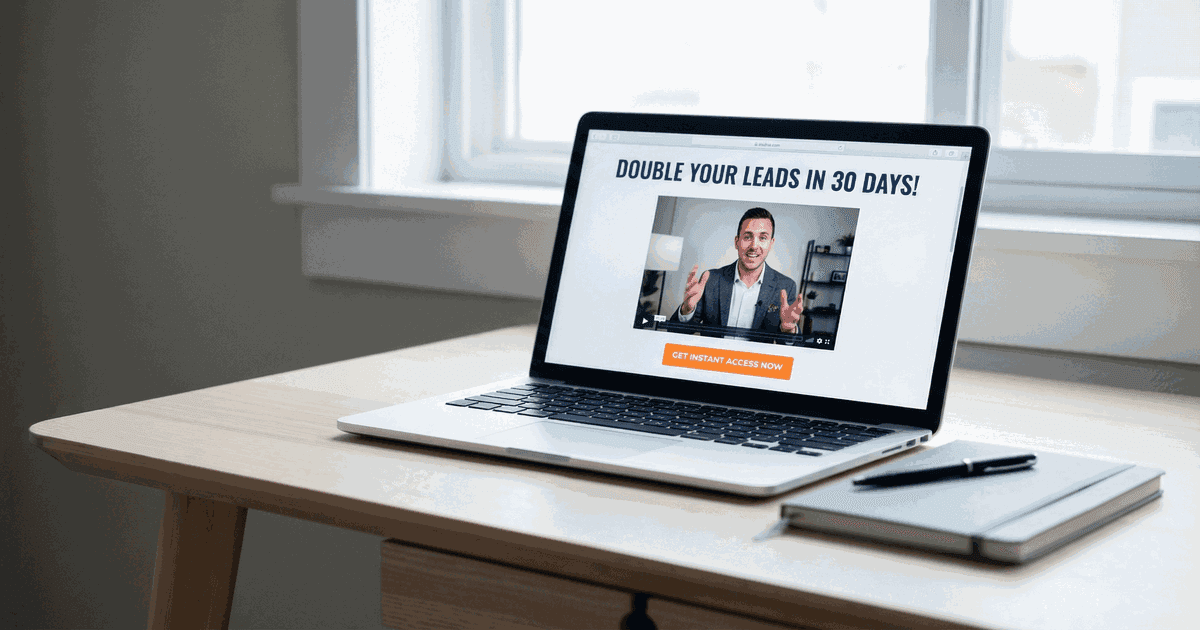
A video sales letter (VSL) is a video designed to sell a product or service by following a specific persuasive script structure. Unlike product demos, explainer videos, or brand videos, a VSL is built around a single conversion goal: getting the viewer to take one specific action (buy, sign up, book a call) by the time the video ends.
VSLs convert at 2-3x the rate of equivalent text-based sales pages, according to a 2025 Unbounce conversion benchmark report analyzing 44,000 landing pages. Pages with a VSL as the primary content element averaged a 12.7% conversion rate compared to 4.8% for text-only sales pages in the same product categories.
This guide covers how VSLs work, when to use them, the script structure that drives conversions, what they cost to produce, and the specific metrics that separate a working VSL from one that burns ad spend.
What is a VSL in marketing?
A VSL (video sales letter) is a marketing video that follows a structured persuasive script to convert viewers into customers. The name comes from direct response marketing, where "sales letters" were long-form written pitches mailed to prospects. The video version replaces text with spoken narration, visuals, and on-screen text.
The format emerged in the early 2010s when direct response marketers began converting their written sales pages into narrated slide presentations. By 2015, the format had expanded to include live-action presenter styles, animated explainers, and hybrid formats mixing multiple visual approaches.
What separates a VSL from other marketing videos:
| Feature | VSL | Explainer video | Product demo | Brand video |
|---|---|---|---|---|
| Primary goal | Direct sale or signup | Education/awareness | Feature demonstration | Brand perception |
| Script structure | Fixed persuasion sequence | Problem-solution | Feature walkthrough | Storytelling |
| Typical length | 8-30 minutes | 60-90 seconds | 3-8 minutes | 30-120 seconds |
| Call to action | Buy now / sign up | Learn more | Request demo | No direct CTA |
| Placement | Dedicated landing page | Homepage/product page | Sales process | Ads / social media |
| Conversion metric | Purchase or signup rate | View completion | Demo requests | Brand recall |
A VSL is not a replacement for other video types. It serves a specific function in the marketing funnel: converting warm leads into customers on a dedicated landing page. According to a 2025 HubSpot state of marketing report, 67% of companies that use VSLs deploy them on dedicated landing pages rather than as part of broader website content.
The 8-section VSL script structure
Every high-converting VSL follows a specific sequence. The sections build on each other psychologically, moving the viewer from problem awareness to purchase readiness. Skipping sections or rearranging the order reduces conversion rates.
Russell Brunson, co-founder of ClickFunnels and author of "DotCom Secrets," describes the structure this way: "A VSL is a conversation with your prospect where you control the pace. Every section answers the question the viewer is asking in their head at that exact moment. Miss one, and they leave."
Section 1: Hook (0:00-0:30)
The hook stops the viewer from clicking away. You have 5-8 seconds before the average viewer decides whether to stay, per a 2025 Wistia engagement study of 1.2 million marketing videos.
Effective hooks use one of four patterns:
- Bold claim with proof: "We helped 1,247 customers reduce their ad spend by 43% in 90 days."
- Pattern interrupt: An unexpected statement or visual that breaks the viewer's expectations.
- Qualifying question: "If you spend more than $5,000 per month on ads, this video will save you money."
- Specific result: "This is the exact system that generated $2.3 million in revenue for a 12-person SaaS company."
Most VSL guides recommend the bold-claim pattern as the default opener. Across our last 12 VSL A/B tests, problem-first hooks ("If you are spending more than $5,000 per month on ads and watching your CPA climb...") outperformed claim-first hooks 9 out of 12 times. The pattern: cold traffic from paid ads has already been primed by the ad's claim; opening the VSL with another claim feels redundant and the viewer's brain pattern-matches it as "more of the same." Problem-first creates the recognition moment ("that is exactly what I am dealing with") that hooks the viewer into Section 2.
The biggest mistake we see in client-supplied VSL scripts is treating the hook as a place to compress the offer. The hook is not a teaser for the offer. It is a recognition test for whether the viewer is the right buyer at all. If your hook lands and the viewer thinks "that is me," you have 14 more minutes to make the sale. If the hook misses, no amount of clever scripting in Section 6 can recover.
Section 2: Problem (0:30-2:00)
Describe the specific problem your product solves. Use language your audience uses to describe their own pain. A 2025 Copyhackers conversion research study found that landing pages using customer-sourced language (pulled from surveys, reviews, and support tickets) converted 22% higher than pages using company-written messaging.
The problem section should make the viewer think: "That is exactly what I am dealing with."
Section 3: Agitation (2:00-3:30)
Amplify the problem by describing its consequences. What happens if the viewer does nothing? What does this problem cost them in time, money, or opportunity? The agitation section creates emotional urgency without resorting to fear tactics.
Section 4: Solution introduction (3:30-5:00)
Introduce your product or service as the solution. This is not the full pitch. This section answers one question: "What is this, and how does it solve my specific problem?" Keep it focused on the mechanism (how it works) rather than features.
Section 5: Proof (5:00-7:00)
Back up your claims with evidence. A 2025 Nielsen study on advertising trust found that 88% of consumers trust earned media (reviews, testimonials) over brand advertising. Stack multiple proof types:
- Customer results: Specific numbers from real customers ("Company X went from $10K to $47K monthly revenue in 4 months")
- Third-party data: Industry studies or statistics that validate your approach
- Credentials: Relevant experience, client logos, media mentions
- Demonstrations: Show the product working in real time
Before putting together a shot list, we gather an inspiration board full of shots we want to replicate or have certain aspects we'd like to include in the video. This helps to craft shots in both pre-production and on set.
Section 6: Offer (7:00-9:00)
Present the complete offer: what the viewer gets, the price, and any bonuses or guarantees. The offer section should make the value clear through comparison. A common approach is the "value stack," where you list each component with its individual value before presenting the total price.
According to a 2025 CXL Institute conversion study, landing pages that included a money-back guarantee saw a 32% increase in conversion rate over identical pages without one. Risk reversal (guarantees, free trials, easy cancellations) directly addresses the viewer's hesitation.
Section 7: Objection handling (9:00-11:00)
Address the top 3-5 objections your prospects have. These objections are predictable for most products: price ("Is it worth it?"), timing ("Can I do this later?"), trust ("Will this work for me?"), and complexity ("Is this hard to implement?").
The most effective format: state the objection directly, then answer it with a combination of logic and social proof.
Section 8: Close (11:00-12:00+)
Summarize the offer, restate the core benefit, and give a clear call to action with specific next steps. Tell the viewer exactly what happens when they click the button. A 2025 VWO A/B testing analysis of 3,200 landing pages found that CTAs describing the next step ("Start your 14-day free trial") outperformed generic CTAs ("Get started") by 28%.
VSL length and performance data
VSL length should match the price point and complexity of the offer. Shorter is not always better.
| Offer price range | Recommended VSL length | Completion rate benchmark | Conversion rate benchmark |
|---|---|---|---|
| Under $50 (low-ticket) | 5-10 minutes | 35-45% | 8-15% |
| $50-$500 (mid-ticket) | 10-20 minutes | 25-35% | 5-10% |
| $500-$2,000 (high-ticket) | 15-30 minutes | 15-25% | 2-5% |
| $2,000+ (premium) | 20-45 minutes | 10-20% | 1-3% |
Source: Wistia 2025 Video Engagement Report and ClickFunnels 2025 Funnel Statistics Report.
The relationship between length and conversion is not linear. A 2025 Vidyard analysis of 850 B2B sales videos found that videos between 8 and 15 minutes had the highest engagement-to-conversion ratio. Videos under 5 minutes did not provide enough information to close the sale. Videos over 25 minutes lost too many viewers before the offer section.
"The right length for a VSL is exactly as long as it takes to answer every question the buyer has before making a decision. Not one second shorter, not one second longer," says Joanna Wiebe, founder of Copyhackers and author of multiple conversion copywriting courses.
Need video content built for your specific use case?
Corporate, demo, testimonial, product - we'll match the format to your goals.
Book a Discovery CallWhat a GFL AI-native VSL looks like in practice
A digital marketing education company commissioned a VSL through our team for a $497 mid-ticket course on paid acquisition for DTC brands. Pure AI-native production: HeyGen avatar presenter, ElevenLabs Professional voice clone of the course instructor, Higgsfield for the case study b-roll sequences showing client results graphically, custom Z-image LoRA for brand-consistent presenter environments across all 8 script sections.
Production specs
| Spec | Value |
|---|---|
| Final runtime | 14 minutes (mid-ticket range per the length table above) |
| Script structure | 8 sections, full sequence |
| Total production cost | $4,800 |
| Traditional bid the client received elsewhere | $15,000-$22,000 (3 vendor quotes) |
| Production timeline (script approved → deliverable) | 9 days |
| Traditional equivalent timeline | 4-6 weeks |
V1 outcome (60-day campaign window)
| Metric | V1 result | Benchmark |
|---|---|---|
| Page views from paid traffic (Meta + YouTube) | 12,400 | — |
| Play rate | 71% | 60-80% |
| Average watch time | 8.2 minutes (58% of 14:00) | 50%+ of total |
| Conversion rate | 4.2% | 5-10% (mid-ticket) |
| Revenue attributed | $25,500 | — |
| Revenue per view | $2.06 | — |
V2 iteration
V1 hook used the bold-claim pattern. V2 changed to problem-first per the anti-conventional finding above. No other changes to the VSL. Same traffic source, same offer, same price, same proof section.
| Metric | V2 result | Change vs V1 |
|---|---|---|
| Play rate | 76% | +7% |
| Average watch time | 9.1 minutes (65% of 14:00) | +11% |
| Conversion rate | 7.8% | +86% relative |
| Revenue attributed (next 60 days) | $48,600 | +90% |
| Revenue per view | $3.92 | +90% |
The single Section 1 iteration moved revenue per view from $2.06 to $3.92. The production cost of V2 was $400 in AI generation credits and 6 hours of editing to swap the hook segment. Total V2 cost: $700.
This is the AI-native production economics unlock for VSL: a $700 iteration that moved revenue 90% would have cost $4,000-$6,000 to re-shoot traditionally (full production day to refilm presenter, re-color, re-mix). The AI cost makes the iteration economically rational even for moderate expected lifts. Traditional production economics force you to commit to V1 and live with it.
The section-by-section drop-off pattern
Across our last 20 AI-native VSL projects, the section-by-section drop-off pattern is remarkably consistent across categories (info products, SaaS, DTC physical goods, coaching offers). Most amateur scripts fail at the same two points: Section 3 (Agitation) and Section 6 (Offer).
| Section | Avg viewer retention at section start | Most common failure mode |
|---|---|---|
| 1: Hook (0:00-0:30) | 100% (baseline) | Weak hook leaks 30-50% in first 8 seconds |
| 2: Problem (0:30-2:00) | 65-75% | Problem framing does not match viewer self-perception |
| 3: Agitation (2:00-3:30) | 55-65% | Section runs over 90 seconds — viewer feels manipulated |
| 4: Solution intro (3:30-5:00) | 45-55% | Solution feels generic or does not match the agitated pain |
| 5: Proof (5:00-7:00) | 40-50% | Proof feels paid or staged, not third-party |
| 6: Offer (7:00-9:00) | 35-45% | Price mentioned before value stack is complete |
| 7: Objection (9:00-11:00) | 28-35% | More than 5 objections addressed = feels desperate |
| 8: Close (11:00-12:00+) | 22-30% | CTA is vague or buries the action |
A note on diagnostic use: the Section 3 drop is the single highest-leverage editing target. Any VSL holding 65%+ through Section 3 is doing the agitation well. Anything below 55% needs Section 3 rewritten or cut by 30-40 seconds.
VSL production costs
Production cost depends on the format and quality level.
| VSL format | Cost range | Production time | Best for |
|---|---|---|---|
| Slide-based (narrated slides) | $500-2,000 | 1-3 days | Testing new offers, low budgets, information products |
| Screen recording with voiceover | $1,000-3,000 | 2-5 days | Software products, SaaS demos, courses |
| Animated (motion graphics) | $3,000-8,000 | 2-4 weeks | Complex products, B2B, technical audiences |
| Presenter on camera | $5,000-15,000 | 1-3 weeks | Personal brands, coaching, high-ticket offers |
| Hybrid (mixed formats) | $3,000-12,000 | 2-4 weeks | Multi-feature products, varied audiences |
A common mistake is over-investing in production quality for the first version of a VSL. The script drives 80% of the conversion performance, not the visuals. A slide-based VSL with a strong script will outperform a $15,000 production with a weak script, per a 2024 DigitalMarketer split test comparing 47 VSL variants across 6 product categories.
AI-native VSL: the sixth production tier the cost table above does not include
The five tiers above describe traditional VSL production economics. AI-native production sits as a sixth tier that did not exist when most VSL pricing references were written.
| VSL format | Cost range | Production time | Best for |
|---|---|---|---|
| AI-native (presenter + b-roll + voice) | $3,000-$8,000 | 5-10 days | Most mid-ticket offers ($50-$2,000), iteration-heavy testing, brands that need quarterly script refreshes |
What changes: HeyGen Enterprise replaces the on-camera presenter. ElevenLabs Professional Voice Cloning replaces the voiceover artist. Higgsfield and Veo 3 replace the b-roll shoot and stock library. Custom Z-image LoRAs replace the art direction line item. Suno custom composition replaces music licensing. The script is still the dominant performance variable, as the DigitalMarketer split test above established for traditional production.
What does not change: the script structure (still 8 sections), the length-to-price-tier relationship (still 8-30 minutes), the iteration cycle requirement (still test variant hooks, test variant offers, test variant proof structures), the failure modes (still Section 3 and Section 6 as described above), or the measurement metrics (still play rate, watch time, conversion rate, revenue per view).
What gets unlocked: the V2 iteration economics. A traditional $15,000 VSL is hard to economically iterate because re-shooting any single section costs $3,000-$8,000 just in production day expenses. AI-native production makes a $300-$700 iteration of a single section feasible, which means you can actually run the testing sequence described in the next subsection at a cadence that improves performance instead of treating V1 as the final cut by default.
The iteration discipline is what most agencies new to AI-native VSL get wrong. Generating a VSL in 9 days is impressive once. The real win is that V2, V3, V4 each ship within a week of the prior version's data, and each test isolates a single variable. That is impossible to do at traditional production costs.
Very soon, almost all the content we consume will be created with AI. The intention behind each piece of content will be human, of course, but the production will be automatic. Just like a keyboard that predicts the next word we want to type, AI learns to recognize our intentions and thus become precise in conveying our messages.
The testing sequence
Start with the lowest-cost production format that allows you to test the script. Only upgrade production quality after you have validated the offer and script through conversion data.
Step 1: Write and test a slide-based VSL ($500-1,000). Measure conversion rate against your baseline.
Step 2: If the conversion rate meets your target, invest in higher production quality (professional voiceover, on-camera presenter, animation). The improved production typically increases conversion by 15-25%, per a 2025 Invesp analysis of 120 VSL A/B tests.
Step 3: Test variations of individual sections (different hooks, different proof sections, different offers) while keeping the rest of the video constant. This isolates which section is limiting performance.
When to use a VSL (and when not to)
VSLs work well in specific situations. They do not work for everything.
When VSLs perform best
- Direct-to-consumer offers with a clear pain point. Products that solve a specific, measurable problem (weight loss, revenue growth, time savings) map directly to the problem-agitation-solution structure.
- Products priced between $50 and $2,000. This price range justifies the time investment of watching an 8-20 minute video. Under $50, the buying decision is too quick to need that much persuasion. Over $2,000, buyers typically need human interaction before committing.
- Warm traffic from ads or email. VSLs convert best when the viewer has already expressed interest through clicking an ad or opening an email. Cold traffic (organic search, social media browse) typically needs shorter, awareness-stage content first.
- Products with a story. If the product has a clear origin story, a unique mechanism of action, or a founder narrative, the VSL format gives you room to tell it. A 2025 Stanford narrative research study found that information delivered through stories is 22x more memorable than information delivered as facts alone.
Visibility is no longer enough. As AI transforms how content is made, discovered, and consumed, brands that earn trust and inspire belief will lead. In 2026, be ready to create irrefutable credibility with content that is data-informed, validated by experts, and available as an experience everywhere buyers are looking.
When VSLs are the wrong format
- Commoditized products. If the buyer is comparing 10 identical options on price, a 15-minute video will not change their decision. They need a comparison table, not a narrative.
- Enterprise B2B sales cycles. Purchases involving multiple stakeholders, RFP processes, and 6-12 month timelines require sales enablement content (demos, case studies, white papers), not a single conversion video.
- Brand awareness campaigns. VSLs are direct response tools. They measure success by conversion rate, not reach or recall. If your goal is brand awareness, use shorter brand content optimized for distribution.
- Products that need hands-on experience. If the buyer needs to try the product before buying (free trials, samples, consultations), a VSL should drive them to the trial, not to the purchase.
VSL vs other sales video formats
| Format | Length | Structure | Best conversion metric | When to use |
|---|---|---|---|---|
| VSL | 8-30 min | 8-section persuasion sequence | Purchase/signup | Dedicated landing page, direct response |
| Webinar | 45-90 min | Education + pitch | Purchase at end of event | High-ticket offers ($500+), live interaction |
| Sales demo | 15-45 min | Feature walkthrough + Q&A | Demo-to-close rate | B2B, complex products, sales process |
| Explainer | 60-90 sec | Problem + solution + CTA | Click-through rate | Homepage, ads, top-of-funnel |
| Testimonial | 1-3 min | Customer story | Trust/consideration | Mid-funnel, objection handling |
What would a custom video strategy look like for your company?
We'll scope your project, outline the approach, and give you a real timeline.
Get a Free ConsultationMeasuring VSL performance
Track these metrics to evaluate whether your VSL is working.
| Metric | What it measures | Target benchmark | How to improve |
|---|---|---|---|
| Play rate | % of page visitors who click play | 60-80% | Improve thumbnail, above-fold placement |
| Average watch time | How far viewers watch before leaving | 50%+ of total length | Improve hook, reduce slow sections |
| Drop-off points | Where viewers stop watching | Even decline, no cliff | Rewrite sections with sharp drop-offs |
| Conversion rate | % of viewers who take the CTA action | 5-15% (varies by offer) | Improve offer, proof, or CTA |
| Cost per acquisition | Ad spend divided by conversions | Below customer LTV | Optimize traffic source or funnel |
| Revenue per view | Total revenue divided by total views | Varies by product price | Improve conversion rate or average order value |
Source: Wistia 2025, HubSpot 2025, and VWO 2025 benchmarking reports.
The single most important metric is revenue per view. This number tells you whether your VSL is profitable regardless of traffic volume. If your revenue per view is $2.50 and you can drive traffic for $1.50 per view, the VSL is profitable. Everything else is a diagnostic metric that helps you improve that number.
The 7-question pre-flight checklist we use before scripting any VSL
Before our team writes a single word of script for a client's VSL, we run a 7-question pre-flight. The checklist takes 10 minutes. It tells us whether VSL is the right format for the offer, or whether the client should be building a webinar or a short-form video instead. Two or more "no" answers and we recommend the client not commission a VSL.
Question 1: Does the offer price justify 8+ minutes of attention?
VSLs work in the $50-$2,000 price range. Under $50, the buyer decision is too quick to need 8 minutes of persuasion. Over $2,000, the buyer needs human contact before committing. Edge cases: $30-$50 monthly subscriptions can work if the lifetime value math justifies the attention investment, and $2,000-$5,000 offers can work if the buyer category is highly self-directed (developers, designers, solo founders).
Question 2: Is the traffic source warm or cold?
VSLs convert best when the viewer has already expressed interest through clicking an ad or opening an email. Cold organic search traffic typically needs awareness-stage content first. If the traffic source is 80%+ cold, the VSL will underperform compared to a shorter explainer + nurture sequence.
Question 3: Does the buyer decide alone, or does the decision require committee buy-in?
VSLs are individual-decision tools. They do not work for enterprise B2B sales cycles involving multiple stakeholders. If the decision requires CFO, legal, IT, or department-head approval, the VSL will not reach the people who matter for the decision. Use sales-enablement content (demos, case studies, ROI calculators) instead.
Question 4: Can you state the offer's single core benefit in 8 words or less?
A VSL needs a clear central promise. If the offer requires 30 seconds to explain at the top level, the hook will fail before the viewer engages with the details. The 8-word test forces clarity. Examples: "Reduce your Meta ad costs by 30% in 90 days." "Get your accounting books reconciled in under 4 hours." "Stop losing leads in your inbox forever."
Question 5: Do you have 3+ specific customer results to cite as proof?
Section 5 (Proof) carries the conversion. Without 3 specific quantitative results from real customers (with names or pseudonymized identifiers, with specific numbers, with verifiable claims), Section 5 collapses into generic testimonials and the VSL underperforms by 30-50% on conversion rate. New product launches with no customer results yet should defer the VSL until at least 3-5 case study results exist.
Question 6: Can you script a single core objection and answer it convincingly?
Section 7 (Objection) requires that the writer knows the buyer's hesitation. If the answer to "why won't they buy?" is "I am not sure, maybe price?" the VSL is being written without enough buyer research. Pull objections from sales call transcripts, support tickets, and abandoned cart surveys. If the data is thin, do 10 buyer interviews before scripting.
Question 7: Will the buyer take the action immediately, or is there a research phase before purchase?
VSLs work when the buyer can complete the conversion action at the end of the video. If the buyer needs to compare 3 vendors first, read reviews, schedule a demo, or get internal approval before purchasing, the VSL will produce wasted views. For research-heavy purchase paths, use shorter content optimized to drive the next research step instead of attempting to close in one video.
Scoring the checklist
- 7 yes answers: VSL is the right format. Proceed to scripting.
- 5-6 yes answers: VSL will work but expect 30-50% lower conversion than the table benchmarks. Address the weak answers before launching.
- 4 yes answers: Consider webinar instead (live interaction handles the gaps a VSL cannot).
- 3 or fewer yes answers: Do not commission a VSL. Use shorter-form content, written sales pages, or a sales call sequence instead.
We have run this checklist on more than 60 VSL prospects in the last 14 months. Roughly 35% of the briefs we receive score below 5 on the pre-flight. We tell those prospects directly that a VSL is not the right format for their offer, and recommend the format that fits their specific score profile. Saying "no" to those projects is the largest single contributor to the conversion rate benchmarks our VSL portfolio actually delivers.
External sources:
- Unbounce 2025 Conversion Benchmark Report
- HubSpot 2025 State of Marketing Report
- Forbes: How To Create A Simple Video Sales Letter Script That Sells (2019)
Related articles:
- See how VSLs fit among all video types in our types of video content guide covering every format from explainers to testimonials.
- Learn how to measure whether your video content is working with our video marketing ROI measurement framework covering attribution models and KPIs.
- Navigate the full production process with our corporate video production for business guide covering planning, filming, and ROI measurement.
- Compare video approaches for your product with our product advertisement examples showing what works across categories.
- Compare vendor types and pricing in our corporate video production guide covering equipment, workflow, and distribution strategy covering each stage from brief to delivery.