
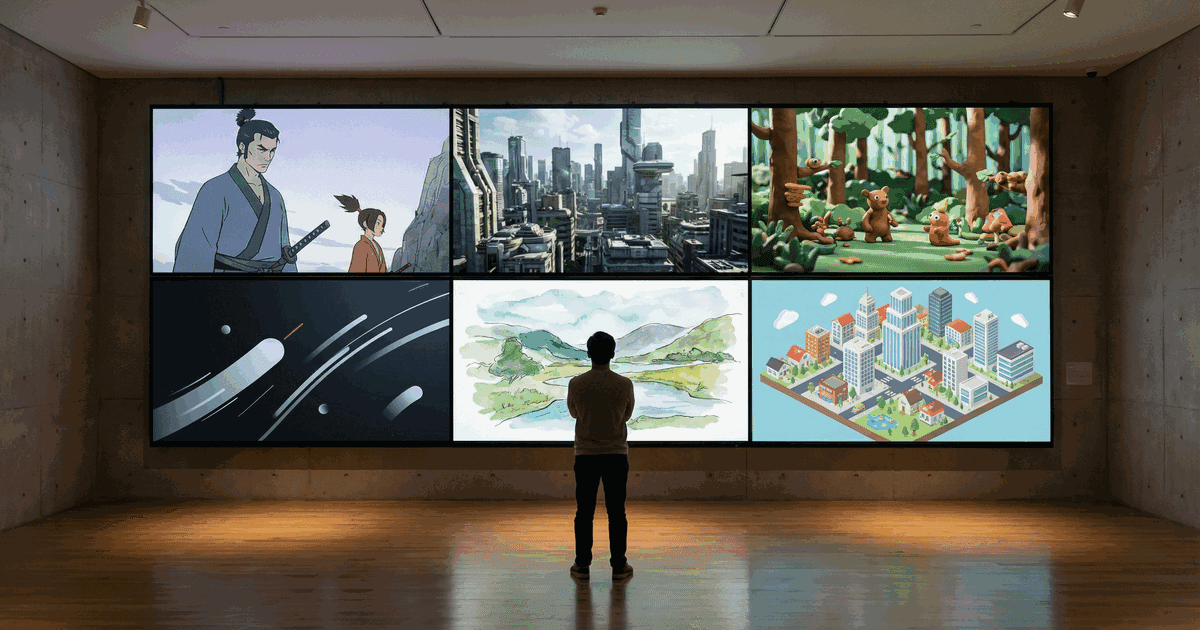
There are 10 distinct animation types used in commercial video production. Each one has different cost structures, production timelines, and use cases where it outperforms the alternatives. Picking the wrong type wastes budget and production time. Picking the right one amplifies your message.
This guide covers all 10 with specific cost ranges per finished minute (based on Clutch's 2025 Video Production Pricing Survey of 500 production companies), median production timelines (Vidyard 2025 Video in Business Report), and the business scenarios where each type performs best.
Key takeaways
- 10 distinct animation types serve commercial production, ranging from $800/minute (whiteboard) to $50,000+/minute (frame-by-frame)
- Motion graphics offers the best cost-to-versatility ratio at $1,500-$10,000/minute with the shortest timeline (3-5 weeks)
- AI reduces costs 20-40% for motion graphics and simple 2D animation but has minimal impact on stop motion, claymation, and frame-by-frame pricing
- Explainer videos (typically 2D or motion graphics) have the highest conversion influence, with 93% of consumers reporting purchase impact (Wyzowl 2025)
- Dropbox's simple 2D explainer cost ~$50,000 and contributed to converting 10% of 100 million users - demonstrating animation's ROI at scale
- 3D animation has the longest pipeline (10-20 weeks) due to sequential phases: modeling, texturing, rigging, animation, lighting, rendering
- Budget under $2,000? Default to whiteboard or typography animation. Need frequent updates? Choose motion graphics or whiteboard (cheapest to re-render)
- Hybrid live action + animation videos achieve 23% higher completion rates than single-format videos of the same length (Vidyard 2025)
There’s a significant gap between where animation is watched and how it is financed - and no clear solution for bridging that gap as of yet. This creates challenging times for both producers and creators, but it also opens up a chance to rethink and reinvent the entire model.
Quick comparison: all 10 animation types
| Animation type | Cost per minute | Timeline | Best for | Difficulty to produce |
|---|---|---|---|---|
| 2D animation | $2,000-$25,000 | 4-14 weeks | Explainers, ads, brand stories | Medium |
| 3D animation | $8,000-$50,000+ | 10-20 weeks | Product demos, architecture, gaming | High |
| Motion graphics | $1,500-$10,000 | 3-5 weeks | Data visualization, UI demos, social ads | Low-Medium |
| Stop motion | $5,000-$30,000 | 6-16 weeks | Brand storytelling, product reveals | High |
| Whiteboard | $800-$5,000 | 2-4 weeks | Education, training, onboarding | Low |
| Claymation | $8,000-$40,000 | 8-20 weeks | Brand personality, entertainment | Very high |
| Rotoscope | $6,000-$25,000 | 6-12 weeks | Music videos, artistic brand films | High |
| Typography/kinetic | $1,000-$6,000 | 2-4 weeks | Social ads, title sequences, promos | Low |
| Live action + animation | $5,000-$30,000 | 6-14 weeks | Product launches, hybrid explainers | Medium-High |
| Frame-by-frame | $10,000-$50,000+ | 8-24 weeks | Premium brand films, character animation | Very high |
Source: Clutch 2025 Video Production Pricing Survey (cost), Vidyard 2025 Video in Business Report (timeline).
1. 2D animation
2D animation creates movement on a flat plane using hand-drawn or digitally illustrated frames. Characters and environments exist in two dimensions with no depth or perspective rotation.
Cost range: $2,000-$25,000 per finished minute. Simple character animation with flat colors and limited movement sits at the low end. Character-driven narratives with detailed backgrounds, lip-syncing, and complex choreography push toward $25,000.
Production timeline: 4-14 weeks from approved brief to final delivery. Simple 2D runs 4-8 weeks. Character-driven pieces with custom illustration require 8-14 weeks.
Where it works best:
- SaaS explainer videos (the single most common use case for 2D animation in commercial production)
- Brand story videos where live action would be too expensive or impractical
- Educational content that needs to visualize abstract concepts
- Social media ad campaigns that need multiple variations from one asset set
Real example: Dropbox's 2012 explainer video used simple 2D animation to explain cloud storage to a non-technical audience. The video cost roughly $50,000 to produce and contributed to converting 10% of Dropbox's 100 million users, according to a Drew Houston interview at the 2013 Startup School conference.
When to avoid it: When the product is physical and needs to be shown in three dimensions. When photorealism is required. When the brand identity demands a premium, cinematic feel that flat illustration cannot deliver.
2. 3D animation
3D animation uses computer-generated imagery to create objects and environments with depth, perspective, and realistic lighting. Models exist in virtual three-dimensional space and can be rotated, lit, and textured to simulate real-world appearance.
Cost range: $8,000-$50,000+ per finished minute. Product visualization with simple backgrounds starts at $8,000. Fully rendered environments with character animation and photorealistic textures exceed $50,000.
Production timeline: 10-20 weeks. 3D has the longest pipeline of any animation type because it requires separate phases for modeling, texturing, rigging, animation, lighting, and rendering. Each phase is sequential.
3D within 2D motion design is gaining a lot of notoriety. Computing power has also increased drastically in the past 10 years.
Where it works best:
- Product visualization for physical goods (electronics, automotive, architecture)
- Medical and scientific visualization where anatomical accuracy matters
- Real estate and architecture walkthroughs
- Gaming and entertainment content
- Technical demonstrations of internal product mechanics (cutaway views, exploded diagrams)
Real example: Apple uses 3D animation extensively in product launch videos. The iPhone 15 Pro launch video (September 2023) used photorealistic 3D renders to show the titanium frame, camera system internals, and the A17 Pro chip architecture - visuals impossible to capture with a physical camera.
When to avoid it: When budget is under $8,000 (the result will look amateur). When the concept is abstract and does not benefit from three-dimensional representation. When turnaround is under 8 weeks.
Curious which animation style fits your brand?
From 2D to motion graphics - we'll match the format to your goals and budget.
Book a Discovery Call3. Motion graphics
Motion graphics animate text, shapes, icons, charts, and other graphic elements. Unlike character animation, motion graphics focus on information design rather than storytelling through characters.
Cost range: $1,500-$10,000 per finished minute. Motion graphics is the most cost-effective animation type for commercial production. Template-based work with stock elements costs $1,500-$3,000. Custom-designed motion graphics with brand-specific assets run $4,000-$10,000.
Production timeline: 3-5 weeks. Motion graphics has the shortest timeline of any animation type because it does not require character design, rigging, or complex scene construction.
Where it works best:
- Data visualization and infographics (the primary commercial use case)
- Software UI demonstrations and feature tours
- Social media ads that need fast iteration and A/B testing
- Corporate presentations and investor decks
- Title sequences and lower thirds for video content
Real example: Spotify Wrapped uses motion graphics to transform user listening data into shareable animated stories. The 2024 campaign generated 200+ million shares across social platforms, according to Spotify's Q4 2024 earnings call. The animation style - bold typography, gradient backgrounds, simple shape transitions - is pure motion graphics at scale.
When to avoid it: When the audience needs emotional connection (motion graphics do not trigger empathy the way character animation does). When the brand story requires narrative with characters. When the content is meant for entertainment.
4. Stop motion
Stop motion animates physical objects by photographing them one frame at a time, moving them slightly between each shot. The result is a tangible, handcrafted quality that no digital technique can replicate.
Cost range: $5,000-$30,000 per finished minute. The high floor reflects the labor intensity - a 30-second stop motion piece requires 360-720 individual photographs (at 12-24 frames per second). Set construction, puppet fabrication, and lighting setup add to cost.
Production timeline: 6-16 weeks. Pre-production (set building, puppet creation) often takes as long as the animation itself.
Where it works best:
- Brand storytelling where handcrafted quality reinforces brand values (food brands, artisanal products, craft businesses)
- Product reveals for physical goods
- Social media content that needs to stand out from digital-looking feeds
- Children's content and entertainment
Real example: Wes Anderson's 2018 film "Isle of Dogs" demonstrated stop motion at its highest production quality. In commercial contexts, PES (the director Adam Pesapane) created stop motion ads for Honda, Western Sizzlin, and Bacardi that won multiple advertising awards. His Honda "Paper" ad earned 8 million YouTube views and a 2015 Emmy nomination.
When to avoid it: When budget is tight (stop motion has the worst cost-to-duration ratio of any animation type). When turnaround is fast. When the content needs frequent updates (reshooting stop motion is expensive).
5. Whiteboard animation
Whiteboard animation simulates a hand drawing illustrations and text on a white surface in real time. The audience watches concepts appear as they are "drawn," creating a visual explanation that mirrors how a teacher draws on a board.
Cost range: $800-$5,000 per finished minute. Whiteboard is the cheapest animation type. Template-based whiteboard using tools like Doodly or VideoScribe costs $800-$1,500. Custom-illustrated whiteboard with professional voiceover runs $2,000-$5,000.
Production timeline: 2-4 weeks. The fastest animation type to produce.
Where it works best:
- Training and onboarding content
- Educational explainers for complex topics
- Internal communications
- Low-budget marketing for startups and small businesses
- Content that needs frequent updates (easy and cheap to re-render)
Real example: RSA Animate produced a series of whiteboard animations of academic lectures that collectively received over 500 million YouTube views. The most watched, "Drive: The Surprising Truth About What Motivates Us" by Dan Pink, has 24+ million views and demonstrated that whiteboard animation could turn dry academic content into viral video.
When to avoid it: When the brand positioning is premium (whiteboard reads as budget). When visual richness or emotional impact is the goal. When the content will appear on large screens (whiteboard's simplicity looks thin on big displays).
Want to see what animation can do for your brand?
We'll walk you through styles, timelines, and what to expect.
Talk to Our Team6. Claymation
Claymation is a subset of stop motion that uses clay or plasticine models as the primary characters and props. Animators sculpt, photograph, reshape, and re-photograph the clay figures frame by frame.
Cost range: $8,000-$40,000 per finished minute. Claymation costs more than standard stop motion because clay characters require constant reshaping and are more fragile than rigid puppets.
Production timeline: 8-20 weeks. The longest timeline of any stop motion variant.
Where it works best:
- Brand personality campaigns where warmth and humor are priorities
- Food and beverage advertising (clay has a texture that works well with food-adjacent products)
- Children's content and family entertainment
- Award-submission campaigns (claymation receives disproportionate attention from awards juries because of its craft intensity)
Real example: Aardman Animations (the studio behind Wallace & Gromit and Shaun the Sheep) has produced claymation commercials for Lurpak, Timotei, and Electricity Board. Their "Creature Comforts" campaign for Heat Electric won the 1990 Academy Award for Best Animated Short and drove measurable increases in product awareness. In 2024, the new Wallace & Gromit film "Vengeance Most Fowl" streamed on Netflix and reached #1 in 28 countries within its first week.
When to avoid it: When speed matters (claymation is the slowest animation format). When photorealism is required. When the budget is under $8,000.
7. Rotoscope
Rotoscope traces over live-action footage frame by frame, converting real human movement into animated form. The result is animation with realistic motion but a stylized, illustrated appearance.
Cost range: $6,000-$25,000 per finished minute. Rotoscope requires both a live-action shoot (for the reference footage) and frame-by-frame illustration, making it more expensive than standard 2D animation.
Production timeline: 6-12 weeks. Requires live-action filming as a first phase, followed by the illustration and tracing phase.
Where it works best:
- Music videos (the most common commercial application of rotoscope since A-ha's "Take On Me" in 1985)
- Artistic brand films where the line between reality and illustration is the creative concept
- Documentary-style animation where real people's movements need to be preserved
- Sensitive subjects where real faces should be anonymized but real body language maintained
Real example: The 2021 Amazon Studios documentary "Flee" used rotoscope animation to tell the true story of a refugee. The technique protected the identity of the subject while preserving the emotional authenticity of his movements and gestures. The film was nominated for three Academy Awards.
When to avoid it: When the concept does not benefit from the reality-to-illustration transition. When budget is the primary constraint (rotoscope is rarely the most cost-effective option). When photorealism is the goal (rotoscope always looks stylized).
8. Typography / kinetic animation
Typography animation (also called kinetic typography) makes text the primary visual element, animating words, letters, and numbers with movement, scale changes, and transitions.
Cost range: $1,000-$6,000 per finished minute. One of the most affordable animation types, second only to whiteboard.
Production timeline: 2-4 weeks. Comparable to whiteboard animation in speed.
Where it works best:
- Social media ads, especially Instagram Stories and TikTok
- Title sequences and video intros
- Quote animations and testimonial highlights
- Product feature announcements
- Lyric videos and podcast highlight clips
Real example: Apple's product launch presentations use kinetic typography extensively - key specifications (like "A17 Pro chip" or "48MP camera") fly onto screen with choreographed motion that matches the presentation rhythm. This technique is also the foundation of lyric videos, a format that accounts for a significant share of music video views on YouTube.
When to avoid it: When the message requires visual context beyond text. When the audience is non-literate or primarily visual learners. When the content is meant to create emotional connection (text alone does not trigger empathy).
Need animated content that actually drives results?
Animation isn't just for explainers. Let's find the right format for your goals.
Book a Strategy Call9. Live action + animation (hybrid)
Hybrid video combines filmed live-action footage with animated elements overlaid, interspersed, or composited into the same frame. The result uses real humans and environments for authenticity while adding animated graphics for clarity.
Cost range: $5,000-$30,000 per finished minute. Hybrid costs more than either format alone because it requires two production workflows - a live-action shoot and an animation pipeline.
Mixed media animation gives us the flexibility to choose the best technique for each story element, whether that’s 3D depth for complex machinery or 2D warmth for character emotions.
Production timeline: 6-14 weeks. Timeline is the longer of the two individual formats plus 1-2 weeks for compositing.
Where it works best:
- Product launch videos (film the product with live action, animate the feature callouts)
- Explainer videos where a real person talks to camera while animated diagrams appear
- Training content where real workplace footage is augmented with instructional overlays
- SaaS demos where screen recordings are enhanced with animated highlights and transitions
Real example: Apple's WWDC product demos consistently use hybrid format: a real person presents on a real stage while animated UI elements, charts, and feature visualizations appear on screen. According to a 2025 Wyzowl survey, 37% of businesses now use hybrid videos, and Vidyard's 2025 data shows hybrid videos have a 23% higher completion rate than single-format videos of the same length.
When to avoid it: When budget is under $5,000 (the result will look disjointed). When the concept works cleanly in a single format. When production speed is the priority (two workflows take longer).
10. Frame-by-frame
Frame-by-frame animation creates each individual frame as a unique drawing or rendering, with no shortcuts from tweening, rigging, or automated in-betweens. Every single frame is hand-crafted.
Cost range: $10,000-$50,000+ per finished minute. Frame-by-frame is the most expensive animation type because it requires the most labor per second of output. At 24 frames per second, a single minute of animation requires 1,440 unique drawings.
Production timeline: 8-24 weeks. The longest timeline of any 2D animation method.
Where it works best:
- Premium brand films where artistic quality is the primary goal
- Character animation requiring extreme expressiveness (the studio Cartoon Saloon uses frame-by-frame for films like "Wolfwalkers" and "Song of the Sea")
- Short-form festival and award submissions
- Luxury brand advertising where the animation quality itself communicates brand value
Real example: Spider-Man: Into the Spider-Verse (2018) used a variation of frame-by-frame animation, rendering characters at different frame rates (12fps for Spider-Man, 24fps for the environment) to create a comic-book feel. The film won the 2019 Academy Award for Best Animated Feature and influenced animation style across the entire industry.
When to avoid it: When budget and timeline are constrained (frame-by-frame offers the worst ratio of cost-to-output duration). When the content will be updated frequently. When motion graphics or standard 2D would communicate the same message.
How to choose the right animation type
Answer these questions in order. Stop at the first definitive answer.
- Is your budget under $2,000? Whiteboard or typography animation
- Do you need to show a physical product from multiple angles? 3D animation
- Is data visualization the primary content? Motion graphics
- Do you need a real person on camera plus animated elements? Hybrid (live action + animation)
- Is the brand identity handcrafted or artisanal? Stop motion or claymation
- Will the content need frequent updates? Motion graphics or whiteboard (cheapest to re-render)
- Is the content a SaaS explainer or concept explanation? 2D animation
- Is artistic distinction the primary goal? Frame-by-frame or rotoscope
- None of the above? Default to 2D animation (the most versatile type)
How AI is changing animation production in 2026
AI tools are accelerating parts of the animation pipeline without replacing the creative direction. According to a 2025 Forrester survey, 67% of marketing teams use AI for at least one content type, but the impact varies by animation style.
At the moment, my stance on AI is that, used as a tool to assist human creativity and excellence, it has a place in any digital pipeline. But it’s incredibly important to me that there’s always significant human input.
Where AI adds the most value:
- Motion graphics: AI generates chart animations, data visualizations, and template-based variations at near-zero marginal cost
- 2D animation: AI assists with in-betweening (generating intermediate frames), background generation, and color styling
- Concept development: AI generates storyboards and style frames in hours instead of days
Where AI adds limited value (as of February 2026):
- Stop motion and claymation (physical processes that cannot be generated digitally)
- Frame-by-frame (the entire value proposition is human craftsmanship)
- 3D animation for complex scenes (AI-generated 3D still lacks the consistency needed for professional output)
The practical implication: AI reduces costs 20-40% for motion graphics and simple 2D animation while having minimal impact on stop motion, claymation, and frame-by-frame pricing.
For a deeper look at whether AI belongs in your production pipeline, see our AI video vs real footage framework covering costs, quality tradeoffs, and use case fit. If you are evaluating specific platforms, our AI video generators comparison breaks down the leading tools by output quality, animation style support, and pricing.
This isn’t just a contraction - it’s a transformation. Salaries keep rising, so studios will need to cut production expenses to reinvent the system. Alternative financing will also be essential.
Frequently asked questions
What are the main types of animation?
The 10 types used in commercial production are: 2D animation, 3D animation, motion graphics, stop motion, whiteboard animation, claymation, rotoscope, typography/kinetic animation, live action + animation hybrid, and frame-by-frame animation. Each has different cost structures, timelines, and use cases. Motion graphics is the most cost-effective ($1,500-$10,000 per minute), while frame-by-frame is the most expensive ($10,000-$50,000+ per minute).
Which type of animation is cheapest?
Whiteboard animation is the cheapest type at $800-$5,000 per finished minute with a 2-4 week production timeline. Typography/kinetic animation is second cheapest at $1,000-$6,000. Motion graphics is third at $1,500-$10,000 but offers the best balance of cost, quality, and versatility for most commercial applications.
Which type of animation is best for marketing?
2D animation and motion graphics are the most commonly used types for marketing. 2D animation works best for explainer videos, brand stories, and social media ads. Motion graphics works best for data visualization, software demos, and corporate presentations. According to Wyzowl's 2025 State of Video Marketing Report, explainer videos (typically 2D or motion graphics) have the highest conversion influence of any video format, with 93% of consumers reporting purchase influence.
How long does animation take to produce?
Timelines range from 2 weeks to 24 weeks depending on the type. Whiteboard and typography animation are fastest at 2-4 weeks. Motion graphics takes 3-5 weeks. 2D animation takes 4-14 weeks. 3D animation takes 10-20 weeks. Frame-by-frame and claymation are the slowest at 8-24 weeks. These timelines assume an approved brief and script at project start.
What type of animation is easiest to learn?
Motion graphics is the most accessible type for beginners because it does not require character drawing skills. Tools like After Effects, Canva, and CapCut provide templates and presets that produce professional-looking results with moderate training. Whiteboard animation is second-easiest, with dedicated tools like Doodly and VideoScribe designed for non-animators.
Is 2D or 3D animation better?
Neither is universally better. 2D animation costs less ($2,000-$25,000 vs. $8,000-$50,000+ per minute), produces faster (4-14 weeks vs. 10-20 weeks), and works better for concept explanation and abstract ideas. 3D animation works better for physical product visualization, architectural walkthroughs, and content requiring photorealism. Choose based on what you need to show, not which technology is newer.
Pick the type that fits the project, not the trend
The right animation type is the one that communicates your specific message to your specific audience within your specific budget. Motion graphics handles most commercial needs at the best price point. 2D animation handles everything that requires characters or narrative. 3D handles physical product visualization. Everything else is a specialist tool for specialist situations.
Start with the decision flowchart above. If you are still uncertain, produce a 15-second test in your top two options and compare them side by side. A $500 test beats a $15,000 guess.
External sources:
- Bureau of Labor Statistics: Multimedia Artists and Animators
- ASIFA: International Animated Film Association
- Wyzowl 2025 State of Video Marketing Survey
Related articles:
- Compare animation to filmed content with our live action vs animation decision framework - cost comparison, timeline breakdown, use case matrix, audience preference data, and hybrid approaches.
- Apply animation to training with our animated training videos guide - when animation outperforms live instruction, production costs, and L&D-specific formats.
- See animation in advertising with our animation ads analysis - brand examples, performance data, and when to choose animation over live action for paid campaigns.
- Explore motion graphics techniques with our motion graphics examples collection - style breakdowns, software workflows, and when motion graphics outperform other animation formats.
- Map broader video format decisions with our types of video content overview - explainer, testimonial, demo, brand film, and 15+ formats with use case recommendations.
- Apply animation to paid campaigns with our creative video ads framework - platform-specific formats, performance data, and thumb-stopping creative strategies.
- Navigate the AI video decision with our AI video vs real footage framework - quality thresholds, audience perception data, and the hybrid AI-assisted approach.