
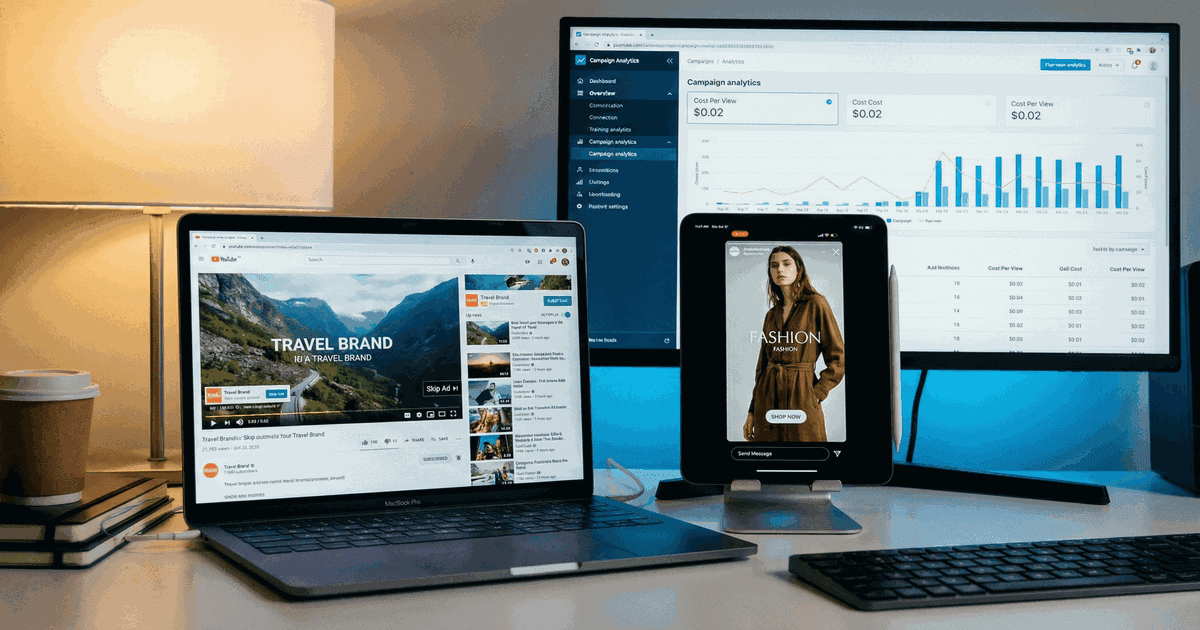
Online video advertising now captures $180 billion in global spend, accounting for 35% of all digital advertising, according to eMarketer's 2025 Digital Advertising Report. That figure grew 22% year-over-year. Yet the average online video ad has a completion rate of just 29%, per Moat Analytics' 2025 Attention Benchmark Report. Most advertisers are buying impressions, not attention.
This guide breaks down every major online video advertising format, compares platforms on cost and performance, and shows what separates the campaigns that convert from the ones that burn budget.
Key takeaways
- Online video advertising captures $180 billion globally (35% of all digital ad spend), growing 22% year-over-year
- CTV ads achieve 95% completion rates (non-skippable, lean-back viewing) but cost $15-$40 CPM with no click-through capability
- A sequence of 3-4 bumper ads generates 107% higher ad recall than a single 30-second ad
- Single-message ads generate 37% higher recall than multi-message ads - every top campaign communicates one idea
- 42% of video-influenced conversions occur without a click: viewers watch, remember, and convert later through search or direct visit
- Dollar Shave Club's $4,500 launch video drove 12,000 orders in 48 hours - the highest-ROI video ad in modern advertising history relative to acquisition price
- Ads with a clear CTA in the first 5 seconds generate 2.1x higher click-through rates than ads that save it for the end
- Start with 60% awareness, 25% consideration, 15% conversion budget allocation, then shift based on 90 days of cost-per-action data
What online video advertising actually includes
Online video advertising covers any paid video content distributed through digital channels. That includes pre-roll ads on YouTube, in-feed video on TikTok and Instagram, outstream video on news sites, rewarded video inside mobile apps, and connected TV (CTV) ads on streaming platforms.
The distinction from traditional TV advertising is distribution and measurement. Online video ads are served through programmatic platforms, targeted by audience data, and measured in real time. A YouTube pre-roll ad and a broadcast TV spot may look similar, but the targeting precision and reporting differ completely.
According to the Interactive Advertising Bureau's 2025 Video Advertising Report, online video advertising breaks into three categories by distribution:
- In-stream: Video ads that play within other video content (pre-roll, mid-roll, post-roll)
- Out-stream: Video ads that appear outside of video content, within article pages or app feeds
- Social in-feed: Video ads that appear natively in social media feeds, designed to match organic content
Each category has different performance characteristics, which the format comparison below details.
Online video ad formats: performance data for each type
Not all video ad formats perform the same way. Here is how the major formats compare on completion rate, click-through rate, average cost, and best use case.
| Format | Avg. completion rate | Avg. CTR | Cost range (CPV) | Best for |
|---|---|---|---|---|
| Pre-roll (skippable) | 31% | 0.8% | $0.02-$0.10 | Brand awareness, consideration |
| Pre-roll (non-skippable) | 76% | 0.4% | $0.05-$0.15 | Guaranteed message delivery |
| Bumper (6 sec) | 91% | 0.3% | $0.01-$0.04 | Frequency, brand recall |
| Mid-roll | 67% | 1.1% | $0.03-$0.12 | Engaged audience targeting |
| In-feed social | 38% | 1.2% | $0.01-$0.05 | Engagement, social proof |
| Stories/Reels | 42% | 0.9% | $0.01-$0.04 | Traffic, app installs |
| Outstream | 22% | 0.4% | $0.005-$0.02 | Reach at low cost |
| Rewarded video | 85% | 3.2% | $0.03-$0.15 | App installs, conversions |
| CTV/OTT | 95% | N/A (no click) | $15-$40 CPM | Premium brand awareness |
Source: Moat Analytics 2025 Attention Benchmark Report (completion rates, CTR), eMarketer 2025 digital advertising benchmark data (CPV/CPM ranges).
Pre-roll ads (skippable and non-skippable)
Pre-roll ads play before the viewer's chosen content on YouTube, Hulu, and other video platforms. Skippable pre-roll lets viewers skip after 5 seconds. Non-skippable forces full viewing (typically 15-30 seconds).
The tradeoff is straightforward: skippable ads get lower completion but higher intent signals (people who watch past 5 seconds chose to stay), while non-skippable ads guarantee message delivery but generate lower engagement.
According to Google's 2025 Video Advertising Best Practices report, skippable pre-roll ads that include a clear call-to-action in the first 5 seconds generate 2.1x higher click-through rates than ads that save the CTA for the end.
Bumper ads
Six-second non-skippable ads designed for brand recall. Google's research shows that a sequence of 3-4 bumper ads generates 107% higher ad recall than a single 30-second ad, per their 2024 bumper ad effectiveness study.
Bumper ads work best as part of a sequence, not standalone. Use them for reinforcement after a viewer has already seen your longer-format ad.
In-feed social video
In-feed video ads on TikTok, Instagram, and Facebook blend with organic content. This is the fastest-growing format. Meta's 2025 Advertising Performance Report shows that in-feed video ads on Reels generate 22% lower cost-per-action than feed image ads for the same targeting parameters.
The key difference from pre-roll: in-feed ads compete directly with entertainment content, so creative quality determines performance more than targeting precision.
Social media now commands more attention than TV, streaming or radio. For marketers, the job isn’t to disrupt the feed. It’s to become the feed. Passive discovery has replaced active searching. Gen Z and Gen Alpha aren’t logging off. They’re scrolling in silence.
Outstream video
Outstream video plays within article text on mobile web. The video starts when the user scrolls it into view and pauses when scrolled past. Lowest cost format, lowest engagement. According to Teads' 2025 outstream benchmark data, the average viewable time for outstream ads is 4.2 seconds. Use outstream strictly for reach campaigns where impressions matter more than attention.
Connected TV (CTV) and OTT ads
CTV ads run on streaming platforms (Hulu, Peacock, Roku, Amazon Freevee) through internet-connected TVs. The highest completion rate (95%) because most CTV ads are non-skippable and run in a lean-back viewing environment.
CTV advertising spend reached $28.2 billion in the US in 2025, up 31% from 2024, per eMarketer. The gap between CTV and traditional TV is closing: CTV now represents 42% of total TV advertising spend. Brands considering broadcast alongside digital can find qualified vendors through our TV commercial production companies guide.
The ad market has been tough because the macroeconomic environment remains unpredictable. Next year may surprise on overall spend, but that spend will likely consolidate around social, CTV and search, where performance is clearest.
Platform comparison: cost, audience, and format specs
| Platform | Primary format | CPM range | CPV range | Audience | Best for |
|---|---|---|---|---|---|
| YouTube | Pre-roll, Shorts, bumper | $10-$20 | $0.02-$0.10 | 2.7B monthly users, 18-55, slight male skew | Awareness, search intent |
| TikTok | In-feed, TopView, Spark | $6-$12 | $0.01-$0.05 | 1.5B monthly users, 18-34, slight female skew | Engagement, Gen Z/Millennial |
| Reels, Stories, Explore | $8-$15 | $0.01-$0.04 | 2B monthly users, 18-44, balanced | Commerce, visual brands | |
| In-feed, Stories, Reels | $7-$14 | $0.01-$0.04 | 3B monthly users, 25-55, balanced | Broad reach, retargeting | |
| In-feed video | $25-$45 | $0.06-$0.20 | 1B members, 25-55, B2B professionals | B2B, job title targeting | |
| Snapchat | Snap Ads, Story Ads | $5-$10 | $0.01-$0.03 | 750M monthly users, 13-34, balanced | Young audience, AR features |
| CTV (Hulu, Roku, etc.) | Non-skip pre/mid-roll | $15-$40 | N/A | Cord-cutters, 25-55, household | Premium awareness |
Source: Platform advertising documentation and Databox 2025 Advertising Benchmark Report (CPM ranges), Statista 2025 (audience data).
Where to start
If your budget is under $5,000/month, start with one platform. For B2C targeting users under 35, start with TikTok. For B2C targeting 25-55, start with Meta (Facebook + Instagram). For B2B, start with LinkedIn despite the higher CPM - the targeting precision by job title and company size justifies the cost for high-ACV products. For search-intent targeting ("how to" and "best" queries), YouTube is the only platform that lets you target based on what people are searching for.
Channel allocations in 2025 reflected marketers’ desire to lean into what’s reliable. Streaming video increased as brands shifted budgets from linear TV towards ad-supported streaming apps. CTV accounted for 59% of streaming budgets, while online video made up 41% of spending. Overall, CTV saw ROI increase from $1.60 to $1.90.
8 online video ad campaigns with performance data
Theory is useful. Results are better. Here are 8 online video advertising campaigns across different formats and platforms, each with measurable outcomes.
1. Metro Trains Melbourne - "Dumb Ways to Die" (animated social + YouTube)
Metro Trains needed to reduce rail safety incidents. Their agency McCann Melbourne created a 3-minute animated music video featuring cartoon characters meeting absurd deaths, with train-related deaths at the end.
Results: 290+ million YouTube views (per Forbes 2023 analysis of viral marketing campaigns). 20% reduction in near-miss rail incidents within 12 months, according to Metro Trains' 2013 annual report. The campaign won the Grand Prix at Cannes Lions and became the most awarded advertising campaign in history at the time.
Format: Organic YouTube video supported by pre-roll ads and social distribution.
Why it worked: The "safety PSA" category is typically boring. By burying the safety message inside a catchy song and absurd humor, Metro Trains created content people shared voluntarily. The paid distribution amplified something that was already earning organic views.
Metro Trains - Dumb Ways to Die
2. Dollar Shave Club - "Our Blades Are F***ing Great" (YouTube pre-roll + social)
Dollar Shave Club's CEO Mike Dubin pitched directly to camera in a warehouse walk-through. The video cost $4,500 to produce, per Dubin's 2015 interview with Bloomberg.
Results: 12,000 orders within 48 hours of launch, crashing the company's website. By 2016, annual revenue reached $240 million. Unilever acquired the company for $1 billion. The launch video now has 28M+ YouTube views.
Format: Originally organic YouTube, then amplified with pre-roll and social ads.
Why it worked: The deadpan humor and direct-to-camera pitch felt like a conversation, not an ad. At $4,500, this is the highest-ROI video ad in modern advertising history when measured against the eventual acquisition price.
3. Apple - AirPods Pro "Quiet the Noise" (YouTube + CTV + social)
Apple demonstrated noise-canceling by showing a person walking through a noisy city that goes silent when the AirPods activate. One visual metaphor, one product feature, 30 seconds.
Results: According to Kantar's 2024 Ad Impact study, the campaign achieved a 34-point increase in ad recall and an 8-point lift in purchase consideration among target audiences 18-34. The "noise-canceling" feature became the #1 cited reason for AirPods Pro purchase in Apple's 2024 customer survey data.
Format: 30-second non-skippable CTV, 15-second YouTube pre-roll, 6-second bumper retargeting.
Why it worked: One feature. One metaphor. No narration, no feature list, no multiple product shots. Apple invested the entire ad in one idea, which made it impossible to forget.
4. Nike - "You Can't Stop Us" (YouTube + social in-feed)
A split-screen montage matching athletes from different sports, genders, and abilities through identical movements. Produced by Wieden+Kennedy using footage from 4,000 sports clips edited into matching pairs.
Results: 100M+ views across YouTube and social platforms within 2 weeks, per YouTube Analytics. 6.8% engagement rate on social (industry average for sports brands is 1.2%), according to Socialinsider's 2021 brand engagement report. Nike stock rose 3.7% in the week following the launch.
Format: Full-length (90 seconds) on YouTube, cut-down 30-second and 15-second versions for in-feed social ads.
Why it worked: The split-screen editing technique was the content itself. The production was so visually impressive that viewers watched to see how the next match would work. The athletic-inclusion message amplified sharing.
Nike - You Can't Stop Us
5. Volvo - "XC60 The Moments" (YouTube pre-roll + CTV)
Instead of showing the car's safety features, Volvo showed scenes of baby-proofing a home - covering outlets, padding sharp corners, gating stairs - before revealing the XC60 as "the easiest safety decision you'll make."
Results: According to Volvo Cars' 2019 annual marketing report, the campaign generated a 14% increase in test drive requests for the XC60 in markets where it ran. The ad achieved 78% ad recall, per Millward Brown's tracking study, compared to the automotive category average of 47%.
Format: 60-second YouTube pre-roll (non-skippable on CTV), 30-second skippable YouTube version.
Why it worked: By showing parenthood anxiety instead of crash test footage, Volvo connected safety to emotion rather than engineering specs. The ad never showed the car until the final seconds.
6. Iceland Foods - "Rang-tan" (social in-feed + YouTube)
Iceland Foods partnered with Greenpeace to create an animated short about an orangutan whose rainforest home is destroyed by palm oil farming. Narrated by Emma Thompson.
Results: The ad was banned from UK television for being "too political" - which generated more attention than the media buy would have. The video earned 65M+ organic views on social media within 4 days, per The Guardian's 2018 coverage. Iceland reported a 10% increase in brand favorability among 18-35 audiences, according to YouGov BrandIndex data from Q4 2018.
Format: Created for TV but distributed as social in-feed and YouTube pre-roll after the broadcast ban.
Why it worked: The ban became the marketing strategy. Iceland turned a censorship decision into a viral moment. The emotional animation and celebrity narration made the content shareable independently of the brand message.
Greenpeace/Iceland Foods - Rang-tan
7. Spotify - Wrapped campaign (social in-feed + display)
Spotify turns each user's listening data into a personalized year-end summary with shareable graphics and video stories.
Results: 200 million social media shares in 2024, according to Spotify's 2024 shareholder letter. App installs spike 30% during December Wrapped season, per Sensor Tower's 2024 app download data. The campaign generates the equivalent of $100M+ in earned media annually, based on Kantar's 2024 brand valuation analysis.
Format: Personalized in-app experience designed for social sharing, supported by out-of-home and social in-feed ads promoting the feature.
Why it worked: Spotify turned its own data into user-generated content. Each share is an implicit Spotify endorsement from a real person. The campaign costs almost nothing in creative production because the content is algorithmically generated.
8. Taco Bell - "Web of Fries" (YouTube pre-roll + social)
Taco Bell created a faux movie trailer starring Josh Duhamel as a man uncovering a "conspiracy" among French fry companies - positioning Taco Bell's nacho fries as the disruptive outsider.
Results: The nacho fries launch generated $66 million in revenue in its first 5 weeks, making it Taco Bell's most successful product launch at the time, per QSR Magazine's 2018 reporting. The ad achieved 84 million YouTube views within the first month.
Format: 60-second YouTube pre-roll, cut-down 30-second and 15-second social versions.
Why it worked: The mock-thriller format was so unexpected for fast food advertising that viewers watched to see where the joke went. Celebrity casting (Duhamel) added credibility to the absurd premise.
Want a video strategy built for the platforms that matter?
YouTube, TikTok, Instagram, TV - each platform has different rules. We know them.
Book a Discovery CallWhat separates high-performing video ads from the rest
Across these 8 campaigns and the broader research, five factors determine whether an online video ad converts or gets skipped.
The industry is moving beyond clicks and impressions. Attention measured through time-in-view, creative resonance and contextual alignment is becoming the new performance signal. This is the first step towards real outcome-based models where success will be determined by the consumer’s response, not the platform’s metric.
1. The first 3 seconds decide everything. According to Meta's 2025 attention data, 65% of users who watch past 3 seconds will continue for at least 10 more. But 50% of viewers drop off before reaching 3 seconds. Every successful campaign above opens with either a question, a surprise, or motion that disrupts the scroll pattern.
2. Sound-off design is not optional. 85% of Facebook videos and 64% of Instagram videos are watched without sound, per Digiday's 2024 social media consumption report. Dollar Shave Club and Taco Bell work with sound on because their platforms (YouTube) default to sound. But the Apple and Nike campaigns communicate their core message visually, making them effective in any audio environment.
3. One message per ad. Apple sold noise canceling. Volvo sold safety. Dollar Shave Club sold price. None of the 8 campaigns tried to communicate more than one idea. According to Nielsen's 2025 Advertising Effectiveness Report, single-message ads generate 37% higher recall than multi-message ads.
4. Format follows platform. Every campaign above was designed for its primary distribution channel. Spotify Wrapped was built for Instagram Stories. Metro Trains was built for YouTube sharing. Nike's split-screen was built for full-screen vertical viewing. The same ad does not work across platforms without format-specific adaptation.
5. The concept works without the brand. Metro Trains' song is entertaining without the safety message. Nike's edit is impressive without the logo. Taco Bell's trailer is funny without the product. When the ad is interesting on its own, people choose to watch it rather than sitting through it until the skip button appears.
How to choose the right online video ad format
Use this decision framework based on your campaign objective, budget, and audience.
| Your objective | Recommended format | Platform | Budget range (monthly) |
|---|---|---|---|
| Brand awareness (broad reach) | Bumper sequence + skippable pre-roll | YouTube + CTV | $5,000-$50,000 |
| Brand awareness (young audience) | In-feed social video | TikTok, Instagram Reels | $2,000-$20,000 |
| Product consideration | 30-sec skippable pre-roll | YouTube | $3,000-$30,000 |
| Website traffic | Stories/Reels ads | Instagram, Facebook | $1,000-$15,000 |
| App installs | Rewarded video + in-feed | Mobile apps, TikTok | $2,000-$25,000 |
| B2B lead generation | In-feed video | $5,000-$30,000 | |
| Retargeting | 15-sec social video | Meta, YouTube | $500-$5,000 |
| Maximum reach (low cost) | Outstream | Programmatic display | $1,000-$10,000 |
Budget allocation by campaign stage
For a $10,000 monthly video advertising budget, allocate based on where your audience sits in the buying process:
- 60% awareness ($6,000): Skippable pre-roll and in-feed social targeting broad interest-based audiences
- 25% consideration ($2,500): Mid-roll and longer-form YouTube targeting viewers who watched 50%+ of awareness ads
- 15% conversion ($1,500): Retargeting short-form ads to viewers who engaged with consideration content
This ratio shifts as your campaign matures. After 90 days of data, move budget toward the formats and platforms generating the lowest cost-per-action.
Need content optimized for a specific platform?
We'll tailor your video strategy to the platform where your audience actually lives.
Talk to Our TeamMeasuring online video ad performance
Track these metrics in priority order. Impressions alone tell you nothing about whether your video advertising is working.
| Metric | What it measures | Good benchmark | When to use |
|---|---|---|---|
| View-through rate (VTR) | % who watched 25%/50%/100% | 25%+ VTR: 45-55% | Always |
| Cost per completed view (CPCV) | Cost efficiency of attention | $0.02-$0.08 | Awareness campaigns |
| Click-through rate (CTR) | Interest in learning more | 0.5-1.5% | Traffic campaigns |
| Cost per action (CPA) | Cost of desired action | Industry-specific | Conversion campaigns |
| Brand lift | Change in recall, consideration, intent | 5-15% lift = strong | Brand campaigns ($10K+) |
| View-through conversion | Conversions from viewers who saw but didn't click | Varies | All campaigns |
Source: Databox 2025 advertising benchmarks, Moat Analytics 2025 attention data.
View-through conversions are the most undervalued metric. According to Google's 2025 attribution research, 42% of conversions influenced by video ads occur without a click - the viewer watches the ad, remembers the brand later, and converts through search or direct visit.
Marketers now run constant CTV campaigns, yet most are comparing apples and oranges. They’re using lift tests, multi-touch attribution, and marketing mix models, often arriving at completely different answers with the same inputs. The industry’s next evolution won’t come from another round of ‘currency wars,’ but from consistent frameworks that allow brands to understand incrementality in non-clickable media.
External sources:
- Forbes: Positioning Your Brand For Your Best Chance Of Going Viral (2023)
- Statista: Countries With Highest Programmatic Video Ad Spend (2020)
Related articles:
- Learn about every video ad format in our types of video advertising guide covering formats, placements, and platform specs.
- See mobile-specific tactics in our mobile video advertising guide with platform benchmarks.
- Get real campaign examples in our product advertisement examples breakdown with performance data.
- Measure your results with our video marketing ROI measurement framework.
- Explore creative approaches in our creative video ads guide with a 7-element framework.
- Understand the bigger picture with our benefits of video marketing guide covering ROI across channels.
- Discover how online video ads fit into your broader content strategy with our types of video content guide covering 10 video categories by marketing objective.
- Stay current on format evolution and platform algorithm changes in our video marketing trends analysis covering 2026 industry shifts.
- See how video performs across different marketing channels in our video marketing examples breakdown with cross-platform case studies.
- Apply these online video ad tactics to organic short-form content with our short form video examples guide covering TikTok and Reels strategies.
- Learn how B2B brands use video advertising differently in our corporate video production guide covering business-focused video strategies.