
TV commercials still account for 24.7% of total US advertising spend in 2025, according to eMarketer's annual forecast. That is $78.5 billion flowing through an industry where a single 30-second spot can cost anywhere from $1,500 to $7 million depending on production tier and airtime placement.
The production side of that equation is where most brands make their first mistake. A 2025 Association of National Advertisers (ANA) survey found that 43% of brands that produced their first TV commercial hired a production company without understanding the difference between digital video production and broadcast-spec production. The result: 31% needed partial or complete reshoots due to technical non-compliance.
AI will be the engine behind smarter monetization, especially unlocking commerce-driven capabilities for small and medium-sized marketers.
This guide covers what makes TV commercial production different from other video production, how the production process works, what each tier costs, and how to evaluate production companies before signing a contract.
What makes TV commercial production different
TV commercial production operates under constraints that web and social video production does not face. Understanding these differences prevents the most expensive mistakes in the process.
Broadcast technical specifications
Every television network requires specific technical delivery specs. These are not suggestions. A spot that does not meet specs gets rejected.
| Specification | Broadcast standard | Digital video standard |
|---|---|---|
| Frame rate | 23.976, 29.97, or 59.94 fps (interlaced) | 24, 30, or 60 fps (progressive) |
| Color space | Rec. 709 (SDR) or Rec. 2020 (HDR) | sRGB or Rec. 709 |
| Audio levels | -24 LKFS (CALM Act compliant) | -14 to -16 LUFS (streaming) |
| File format | ProRes 422 HQ or DNxHR HQX | H.264/H.265 MP4 |
| Closed captions | Required (CEA-608/708) | Optional (SRT/VTT) |
| Aspect ratio | 16:9 (letterbox for 4:3 stations) | 16:9, 9:16, 1:1, 4:5 |
| Delivery method | Extreme Reach, Comcast Spotlight, or network portal | Direct upload |
Source: NAB 2025 Broadcast Technical Standards Guide.
A production company that primarily makes YouTube videos or social content may not have the post-production pipeline to deliver broadcast-compliant files. This is the single most common reason first-time TV advertisers face delivery rejections.
Compliance and legal review
TV commercials face regulatory scrutiny that digital ads largely avoid.
FTC requirements: All claims must be substantiated. "Best in class" requires comparative testing data. "#1 rated" requires a qualifying study. Testimonials need "results not typical" disclosures. The FTC processed 2,847 advertising complaints related to TV commercials in 2024, with deceptive claims and missing disclosures as the top two categories, per the FTC's 2024 Annual Report.
FCC regulations: Content standards for language, imagery, and product categories (alcohol, pharmaceuticals, financial services) vary by time slot. Pre-watershed (before 10 PM) restrictions apply to content, volume levels, and frequency of ad breaks.
Network standards and practices (S&P): Each network maintains its own acceptability department. NBC, CBS, ABC, and Fox each review commercials before accepting them for broadcast. S&P review can take 5-10 business days and may require edits.
Industry-specific compliance: Pharmaceutical commercials require FDA-compliant fair balance disclosures. Financial services commercials need FINRA or SEC review. Alcohol commercials must follow the Distilled Spirits Council (DISCUS) voluntary code or Beer Institute guidelines.
A production company experienced in TV commercial work builds compliance review into the production timeline. Companies that treat it as an afterthought create cascading delays.
Media buying integration
The production and media buying processes should run in parallel, not sequentially. A 2025 MediaPost analysis of 1,200 TV ad campaigns found that campaigns where the production company and media agency coordinated from the start achieved 22% lower cost-per-GRP (gross rating point) than campaigns where production was completed before media planning began.
Coordination matters because:
- Target audience demographics determine creative approach (a spot targeting 18-34 during late-night programming requires different creative than one targeting 55+ during morning news)
- Airtime slot dictates technical requirements (some stations still require 4:3 safe area framing)
- Media plan informs production budget (a $500,000 media buy justifies different production investment than a $10,000 local cable buy)
- Multi-market campaigns may need market-specific versions (local dealer tags, regional offers, language variants)
TV commercial production process: 13 stages
The production process follows a defined sequence. Skipping or compressing stages creates problems that cost more to fix later than they cost to do correctly the first time.
Pre-production (stages 1-6, typically 3-6 weeks)
Stage 1: Creative brief and strategy. Define the commercial's objective, target audience, key message, tone, competitive positioning, and success metrics. A strong creative brief is typically 2-3 pages. It should answer: what is the single thing we want viewers to remember?
Stage 2: Concept development. Generate 3-5 creative concepts that address the brief. Each concept includes a one-paragraph description, visual references, tone description, and estimated production complexity. Present concepts to stakeholders for selection.
Stage 3: Script and storyboard. Write the final script (dialogue, voiceover, on-screen text, music direction) and create a visual storyboard showing each shot, camera angle, and transition. For a 30-second commercial, the script should be 60-75 words. Storyboards typically contain 8-15 frames.
Stage 4: Casting. Select on-screen talent through auditions or talent agency submissions. SAG-AFTRA rates apply for union talent: $735.65 per day for a session fee (2025 rate), plus usage fees based on market size, run length, and media type. Non-union talent costs $200-1,000 per day but cannot appear on network broadcast in some markets.
Stage 5: Location scouting and permits. Identify filming locations, secure permits, and arrange access. Location permits in major markets cost $500-5,000 per day. Studio rental costs $2,000-15,000 per day depending on the market and facility. New York and Los Angeles are the most expensive markets; Atlanta, Austin, and New Orleans offer significant cost savings with production tax incentives of 20-30%, per the Association of Film Commissioners International (AFCI) 2025 incentive guide.
Stage 6: Production planning. Finalize the shooting schedule, crew assignments, equipment list, catering, transportation, and insurance. A standard production insurance policy for a TV commercial shoot costs $1,500-5,000 and covers general liability, equipment, workers' comp, and errors and omissions.
Production (stages 7-8, typically 1-3 days)
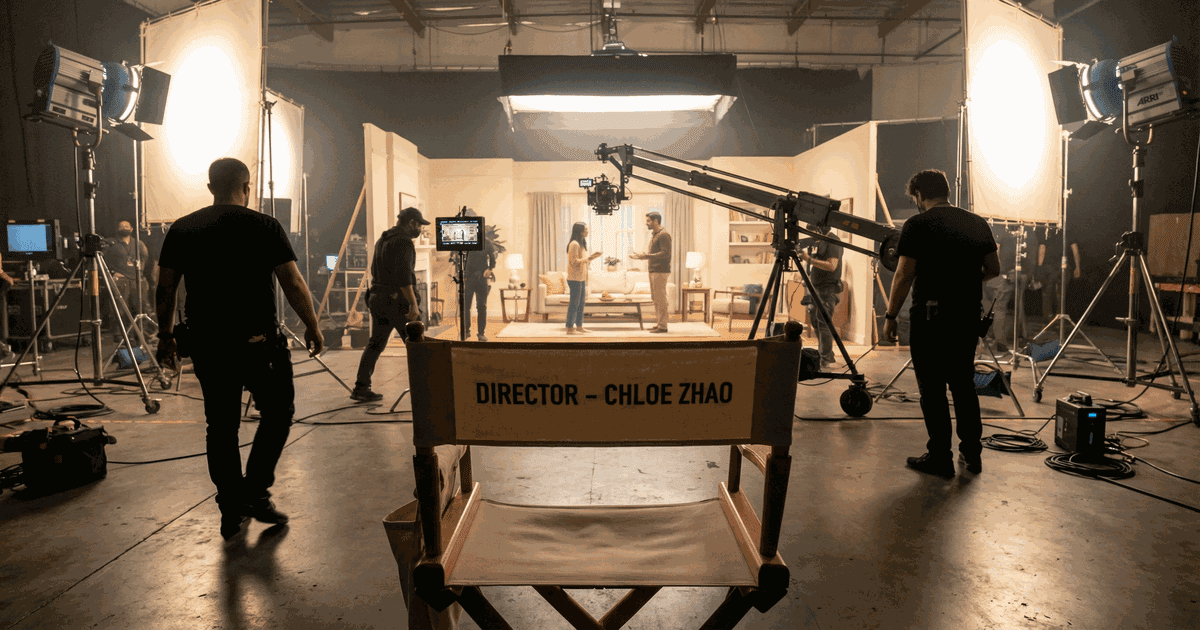
Stage 7: Filming. Execute the shoot according to the storyboard and shot list. A standard TV commercial crew includes 15-30 people: director, director of photography, gaffer, key grip, sound mixer, hair/makeup, wardrobe, production assistants, and craft services. The average shoot day runs 10-12 hours.
Stage 8: On-set review. Review footage on set (called "video village" review) to confirm each shot meets creative and technical requirements before wrapping. Re-shoots after the crew disperses cost 2-5x the original shoot day.
Post-production (stages 9-13, typically 2-4 weeks)
Stage 9: Rough cut edit. Assemble selected takes into a first draft. The rough cut shows timing, pacing, and basic structure without color correction, graphics, or final audio.
Stage 10: Graphics and visual effects. Add motion graphics, title cards, product shots, legal disclaimers, and any visual effects. Graphics work for a typical 30-second commercial takes 20-40 hours.
Stage 11: Color correction and sound design. Grade the footage for broadcast color space compliance, mix audio to CALM Act levels (-24 LKFS), and integrate music and sound effects. Licensed music for broadcast use costs $5,000-50,000+ depending on the track and usage term. Production music libraries offer broadcast-licensed tracks for $500-3,000.
Stage 12: Compliance review. Submit the near-final cut to the legal team, FTC/regulatory reviewers (if applicable), and network S&P departments. Allow 5-10 business days for review. Budget for 1-2 revision rounds based on compliance feedback.
Stage 13: Final delivery and trafficking. Export the final master in broadcast-spec format and deliver through the designated trafficking system (typically Extreme Reach). Create additional versions as needed: 15-second cutdowns, Spanish-language versions, digital adaptations, social media edits.
Production cost tiers
TV commercial production costs vary by an order of magnitude depending on the production scale. The AICP 2025 Production Cost Survey provides the following benchmarks.
| Tier | Total production cost | Typical use case | Crew size | Shoot days |
|---|---|---|---|---|
| Local/basic | $1,500-10,000 | Local cable, small business, single-market | 3-8 | 0.5-1 |
| Regional | $10,000-50,000 | Regional broadcast, multi-market cable, DTC brands | 8-15 | 1-2 |
| National (mid) | $50,000-200,000 | National cable, streaming pre-roll, emerging brands | 15-30 | 2-3 |
| National (premium) | $200,000-500,000 | Major network, established brands, multi-spot campaigns | 25-50 | 2-5 |
| Super premium | $500,000-2,000,000+ | Super Bowl, tentpole events, global campaigns | 40-100+ | 3-10 |
These figures cover production only. Media buying (airtime), talent usage fees, and music licensing are additional costs.
Cost is a key factor when considering a video project, and it’s important to be transparent. 30-second TV ad costs range from $10,000 to $50,000 or more, depending on key factors like production quality, talent fees, and distribution strategy.
Where the budget goes
A typical national mid-tier production ($100,000 total) breaks down approximately as follows:
| Line item | Percentage | Dollar amount |
|---|---|---|
| Pre-production (creative, scripting, planning) | 15-20% | $15,000-20,000 |
| Talent (on-screen, voiceover) | 10-15% | $10,000-15,000 |
| Crew and equipment | 25-30% | $25,000-30,000 |
| Location/studio | 8-12% | $8,000-12,000 |
| Post-production (edit, color, audio, graphics) | 20-25% | $20,000-25,000 |
| Music and licensing | 5-8% | $5,000-8,000 |
| Insurance, permits, contingency | 5-10% | $5,000-10,000 |
Source: AICP 2025 Production Cost Survey, cross-referenced with Simulmedia 2025 advertising production benchmarks.
CTV remains a true lean-back, highly engaged environment, but it’s under-monetized relative to time spent. In 2026, that gap in spend will likely narrow as outcome measurement improves and AI reduces production costs, expanding access to this high-quality inventory.
"The biggest misconception brands bring to their first TV commercial is that production cost equals production value. A $30,000 commercial with a strong concept and tight script outperforms a $200,000 commercial with a weak idea every time. The money amplifies the creative. It does not replace it," says Linda Yaccarino, former Chairman of Global Advertising and Partnerships at NBCUniversal, in a 2024 interview with AdAge.
Want a video strategy built for the platforms that matter?
YouTube, TikTok, Instagram, TV - each platform has different rules. We know them.
Book a Discovery CallHow to evaluate TV commercial production companies
Not all video production companies produce TV commercials. And not all companies that claim to produce TV commercials have recent broadcast delivery experience. Here is how to separate qualified companies from those that will create problems.
Five evaluation criteria
1. Broadcast delivery track record. Ask for examples of commercials they have delivered to broadcast networks in the past 12 months. Request the trafficking confirmation (Extreme Reach delivery receipt) if possible. A company that last delivered to broadcast in 2021 may not know current spec requirements.
2. Compliance process. Ask how they handle FTC substantiation, network S&P review, and industry-specific regulatory requirements. Companies experienced in TV production have a standard compliance workflow and can estimate the review timeline for your industry. Companies new to broadcast may not know that compliance review exists.
3. SAG-AFTRA and union experience. If your commercial airs on network television, union talent is often required or strongly preferred. Ask whether they have produced SAG-AFTRA signatory productions. Non-signatory companies may not understand session fees, usage calculations, pension and health contributions, or re-use obligations. The 2025 SAG-AFTRA Commercials Contract includes specific rate structures that affect your total talent cost by 30-60% beyond the session fee.
4. Post-production capabilities. Broadcast-spec post-production requires specific equipment and expertise: broadcast color grading monitors (calibrated to Rec. 709), audio mixing to CALM Act specifications, closed captioning integration, and trafficking system access. Ask what monitoring equipment they use and whether post-production is done in-house or outsourced.
5. Media agency coordination. Ask whether they have worked with media agencies on previous campaigns and can provide a production timeline that aligns with your media plan. Companies that have never coordinated with a media buyer may not understand traffic deadlines, make-good scheduling, or multi-market versioning requirements.
Red flags specific to TV production
- No broadcast reel. A company whose portfolio contains only web videos, social content, or corporate videos has not demonstrated broadcast production capability. Beautiful YouTube content does not prove they can deliver a CALM Act-compliant, CEA-708 captioned, Rec. 709 color-graded ProRes file through Extreme Reach.
- "We can figure it out." Broadcast specs and compliance are not things production companies should figure out on your budget. If they cannot explain the delivery workflow in specific technical terms during the sales process, they will learn on your project, at your expense.
- No discussion of talent usage fees. Talent session fees are the beginning of the cost. Usage fees (based on market, medium, run length, and exclusivity) frequently equal or exceed the session fee. A production company that quotes talent cost as a flat number without discussing usage is either inexperienced with broadcast talent or building a surprise into your invoice.
- Timeline under 4 weeks for a broadcast spot. From brief to delivery, a standard broadcast commercial takes 4-8 weeks. A company promising delivery in 2 weeks for anything other than a simple local cable spot is either skipping compliance review, compressing pre-production, or does not understand the process.
Types of TV commercial production companies
The market includes several distinct company types, each suited to different project scopes.
| Company type | Team size | Typical budget range | Best for | Limitations |
|---|---|---|---|---|
| Local production houses | 3-10 | $1,500-15,000 | Local cable, single-market spots, simple format | Limited post-production, no S&P experience |
| Boutique commercial shops | 10-25 | $15,000-75,000 | Regional broadcast, direct-response, DTC brands | May outsource specialized post, limited multi-market capability |
| Full-service commercial agencies | 25-75 | $50,000-300,000 | National campaigns, multi-spot packages, brand campaigns | Higher minimums, longer timelines |
| Major production companies | 75-200+ | $200,000-2,000,000+ | Network premieres, Super Bowl, tentpole events, celebrity-driven | Premium pricing, competitive scheduling |
| Integrated agency/production | Varies | $25,000-500,000 | Brands wanting strategy + production from one vendor | May prioritize strategy over production craft |
Choosing the right type for your project
First-time TV advertiser with $10,000-25,000 budget: Start with a boutique commercial shop with verified broadcast delivery experience in your market. Request their last 3 trafficking confirmations.
Established brand expanding from digital to broadcast: Use a full-service commercial agency that has produced both digital and broadcast campaigns. They can create multi-format packages (one shoot, multiple deliverables) that spread production cost across channels.
National brand with $100,000+ budget: Use a full-service agency or major production company with a director whose reel matches your creative ambition. At this budget level, the director's creative vision and track record matter more than the production company's brand name.
Direct-response advertiser: Use a boutique shop or specialized DR production company. Direct-response commercials (with phone numbers, URLs, QR codes, and specific CTAs) have different creative requirements than brand spots. DR-experienced companies understand response rate optimization, lower-thirds placement, and call-to-action timing that affects conversion.
For decades, sophisticated media planning was the domain of the few, meaning large brands with big budgets and specialist teams. AI has leveled that playing field. Today, a small brand can describe its campaign goals in plain language and receive a multi-screen, data-informed media plan in seconds. AI’s greatest impact won’t be job replacement but idea acceleration.
External sources:
- Investopedia: How Tv Advertising Industry Works
- Forbes: Why Video Plays A Key Role In Todays Marketing Scene (2022)
- Nielsen: Ad Intel - Competitive Advertising Intelligence
- Statista: TV Advertising Spending in the United States
Related articles:
- Understand what each second of airtime costs with our 30-second commercial cost breakdown covering production tiers, media buying, and line-item budgets.
- See where TV advertising fits among all video ad formats with our types of video advertising guide covering every format from pre-roll to CTV.
- Learn the terminology behind broadcast advertising with our TVC explainer covering the production process and format specifications.
- Compare different video ad approaches with our online video advertising guide covering digital-first formats and platforms.