
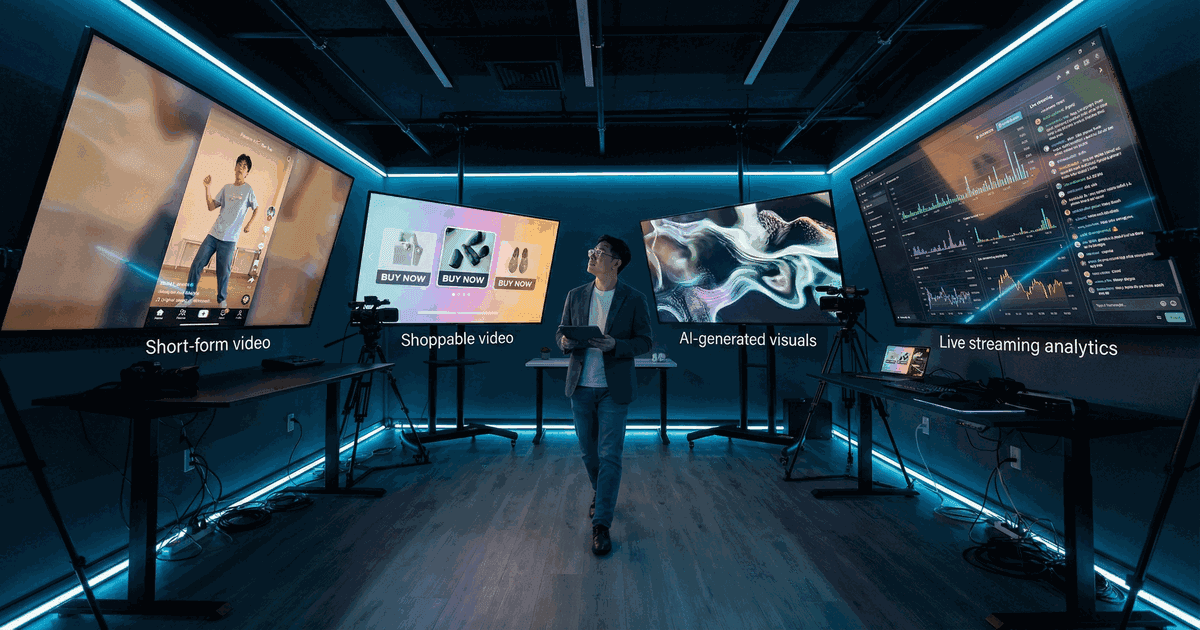
Every year, the video marketing trends conversation follows the same pattern. Someone lists 20 trends, includes AR/VR for the fourth year running, and calls it a guide. None of it helps you make better decisions about where to spend money.
This is a different kind of trends article. Every trend here is measured, not predicted. We include adoption rates, performance data, and specific guidance on whether a trend deserves your budget right now or is still too early.
According to Wyzowl's 2025 State of Video Marketing report, 91% of businesses now use video as a marketing tool. The question is no longer "should we do video?" It is "which video formats and strategies will deliver the best return in the next 12 months?" For brands looking to see how these trends translate into real campaigns with measurable outcomes, our content marketing examples guide covers 10 programs - including video-led strategies from Dollar Shave Club, Wistia, and Ahrefs - with specific ROI data.
1. AI-assisted video production goes mainstream
AI video tools have moved from novelty to necessity. According to HubSpot's 2025 Marketing Industry Trends Report, 41% of marketing teams now use AI tools in their video production workflow. That figure was 14% in 2024.
The shift is driven by cost reduction. AI tools like Runway ML, Pika, and Descript reduce video editing time by 40-60% on tasks like captioning, background removal, and clip assembly, according to Frame.io's 2025 post-production survey. For teams producing more than 10 videos per month, the time savings translates to $3,000-8,000 monthly.
But the trend comes with a warning. TikTok, YouTube, and Meta all now require AI content labels. According to Sprout Social's Q1 2026 data, AI-labeled content averages 1.9% engagement rate on TikTok compared to 3.4% for non-labeled content. The audience penalizes obvious AI generation.
Now we are far past testing AI for video outputs - we're using it with intent, as part of a thoughtful creative process that enhances pacing, structure and meaning.
"AI is the best thing that happened to video production budgets and the worst thing that happened to video production quality. The tools are incredible. The average output is terrible. The gap between good and bad AI video is wider than the gap between good and bad traditional video," says Joe Pulizzi, founder of Content Marketing Institute and the Content Entrepreneur newsletter.
AI video adoption by use case (2025-2026):
| Use case | Adoption rate | Performance impact | Maturity |
|---|---|---|---|
| Automated captioning | 78% | +38% engagement on social | Mature |
| Background removal/replacement | 52% | Neutral | Mature |
| AI-generated B-roll | 34% | -15% to +10% depending on quality | Growing |
| Script generation | 41% | Varies widely | Growing |
| Full AI video generation | 12% | -44% engagement vs human | Early |
| Voice cloning/dubbing | 23% | +60% for localization | Growing |
Source: HubSpot 2025, Frame.io 2025, Sprout Social Q1 2026.
AI is moving from a productivity tool that makes content creation faster to an orchestration system that will transform workflows and ensure every piece of content is on-brand and powered by customer insights.
2. Short-form vertical video dominates every platform
Short-form vertical video is not a trend anymore. It is the default format for social media consumption.
According to Cisco's 2025 Visual Networking Index, vertical video under 60 seconds now accounts for 73% of all social media video views. YouTube Shorts alone reached 70 billion daily views in Q4 2025, according to Alphabet's earnings report. TikTok reports 34 minutes of average daily usage per user globally.
Short-form video continues to be a crucial video marketing tool, and I don't see it going anywhere. Even YouTube, which for the longest time was known for its long-form content, has seen success with its Shorts feature. I think we'll see even more brands utilizing short-form video across their marketing channels in 2026.
The format shift has changed what "video marketing" means. Five years ago, video marketing was a polished 2-minute brand film. In 2026, video marketing is a stream of 15-45 second vertical clips designed for thumb-stopping scroll environments.
Platform performance comparison (short-form):
| Platform | Avg engagement rate | Avg view count (10K followers) | Best posting frequency |
|---|---|---|---|
| TikTok | 3.4% | 2,800 views | 4-7 per week |
| Instagram Reels | 1.9% | 1,200 views | 3-5 per week |
| YouTube Shorts | 1.1% | 3,400 views | 3-5 per week |
| LinkedIn Video | 2.8% | 800 views | 2-3 per week |
Source: Dash Hudson 2025 Social Media Benchmark, Later Social 2025, Hootsuite 2025.
"The brands that are winning on social media right now are the ones that stopped thinking about video as a production project and started thinking about it as a publishing cadence. One excellent video per month loses to four good videos per week every single time," says Brendan Kane, digital strategist and author of "Hook Point."
3. Silent-first design becomes the standard
Most social video is watched without sound. Designing for sound-off viewing is no longer optional.
According to Verizon Media's 2025 look at mobile behavior, 92% of consumers watch video on mobile with the sound off at least some of the time. On Facebook, the figure is 85%, according to Digiday's 2025 social media consumption report.
The performance impact is measurable. Videos designed for silent viewing (burned-in captions, visual storytelling, text overlays) receive 38% higher engagement than audio-dependent videos on Instagram and Facebook, according to Later Social's 2025 benchmark data.
This trend affects production workflow. The text overlay, caption style, and visual pacing must be designed before the audio track. The audio becomes supplementary, not primary.
Want to calculate the real ROI of video for your brand?
We'll walk you through the numbers with real data, not projections.
Book a Strategy Call4. Video podcasts bridge audio and video audiences
Video podcasting has exploded. According to Edison Research's 2025 Podcast Consumer Report, 46% of podcast consumers now watch video versions of podcasts at least once per week, up from 28% in 2023. YouTube is the number one podcast consumption platform in the US, surpassing Spotify and Apple Podcasts.
For marketers, video podcasts solve a production efficiency problem. A single 30-minute podcast recording produces: the full episode, 10-15 short-form clips, 5-8 quote graphics, and 2-3 blog posts worth of content. The cost-per-content-unit drops dramatically.
According to Spotify's 2025 Wrapped data, video podcast consumption grew 280% between 2023 and 2025. Brands like HubSpot, Drift, and Gong have built significant audience reach through podcast-to-video content pipelines.
"The smartest marketers I know are not creating separate video content, podcast content, and social content. They are recording one long-form conversation and breaking it into everything else. The podcast is the factory. The short clips are the products," says Amanda Natividad, VP of Marketing at SparkToro.
5. Personalized video in B2B sales breaks through
Personalized video outreach has moved from experimental to standard practice in B2B sales.
According to Vidyard's 2025 Video in Business Benchmark, sales representatives using personalized video outreach see 3x higher response rates compared to text-only email. That is up from 2x in 2023, suggesting the format is becoming more effective as buyers get more comfortable with it rather than fatigued by it.
The tooling has matured. Platforms like Vidyard, Loom, and Sendspark now offer one-click recording, automatic CRM integration, and viewer analytics (who watched, how much, and what they did next). This reduces the production friction that kept personalized video from scaling.
Personalized video performance in sales (2025):
| Metric | Text email | Video email | Lift |
|---|---|---|---|
| Open rate | 21% | 38% | +81% |
| Response rate | 3.2% | 9.6% | +200% |
| Meeting booked rate | 1.1% | 3.4% | +209% |
| Pipeline influenced | Baseline | 2.7x | +170% |
Source: Vidyard 2025 Video in Business Benchmark.
6. Shoppable video closes the buy-now gap
Shoppable video is no longer a feature demo. It is a conversion channel.
According to Shopify's 2025 Commerce Trends report, shoppable video increases conversion rates by 30% compared to standard product video. The format works because it eliminates the step between "I want this" and "I can buy this."
TikTok Shop processed $20 billion in merchandise volume in 2024, according to Bloomberg reporting. Instagram Shopping and YouTube's product tagging feature have driven similar commerce integration across platforms.
The shoppable video market is growing at a compound annual growth rate of 21% from 2024 to 2029, according to Grand View Research.
"Shoppable video is the most underrated trend in video marketing. Everyone talks about AI and short-form, but shoppable video is the one that directly moves revenue. It turns video from a brand awareness tool into a sales channel with measurable ROAS," says Nik Sharma, DTC advisor and author of the Nik Sharma newsletter (100,000+ subscribers).
Ready to invest in video that pays for itself?
Let's build a video strategy with measurable returns.
Get Your Custom Plan7. Employee-generated content outperforms brand content
Employee-generated video content (EGVC) delivers higher trust and engagement than brand-produced content.
According to LinkedIn's 2025 Workforce Content Report, posts from employees receive 8x more engagement than posts from the company page. When those employee posts include video, the engagement multiplier increases to 12x.
The trend reflects a broader audience shift toward human-centric content. Viewers trust people more than logos. An engineer explaining a product feature on camera is more credible than a polished corporate video saying the same thing.
A lot more companies are going to be doing founder brands, and I think that executives are gonna be doing a lot more video content. It really helps LLMs to have consistent and fresh content. 2026 is the year of the founder brand.
According to iCIMS' 2025 Talent Acquisition Report, companies using EGVC in recruitment see 37% longer time-on-site from candidates and 34% higher application completion rates.
8. Video SEO becomes a standalone discipline
Video SEO has expanded beyond "add a video to your blog post." It is now a distinct traffic acquisition channel.
According to Semrush's 2025 SERP Features Study, video carousels appear in 62% of Google search results. YouTube videos rank in the top 10 organic results for 38% of informational queries. Brands that produce optimized video content can capture search positions that text-only competitors cannot reach.
Google's March 2025 Helpful Content Update gave additional ranking weight to pages with embedded video that users watch (measured by engagement signals). According to BrightEdge's 2025 research, pages with video see 41% higher click-through rates from search results than pages without video thumbnails.
"Video SEO is where organic search was ten years ago. Most companies are ignoring it, a few early movers are capturing massive traffic, and within three years everyone will be fighting for the same positions. If you start now, you have a structural advantage that compounds," says Rand Fishkin, CEO of SparkToro.
Video SEO checklist for 2026:
| Element | Impact | Effort |
|---|---|---|
| Keyword-optimized title and description | High | Low |
| Closed captions/transcript | High | Low (AI-generated) |
| Custom thumbnail | High | Low |
| Video schema markup (VideoObject) | Medium | Medium |
| YouTube chapter markers | Medium | Low |
| Embed on relevant blog post | High | Low |
| Video sitemap | Medium | Medium |
9. Interactive video moves from gimmick to conversion tool
Interactive video has struggled with adoption for years. In 2026, the format is finally delivering on its promise.
According to Wistia's 2025 Interactive Content Report, interactive videos (with clickable elements, branching paths, or embedded forms) see 4.3x higher conversion rates than linear video. The engagement data is equally strong: interactive videos generate 3x the average watch time of standard video.
The difference now versus five years ago is tooling. Platforms like Tolstoy, Spott, and Wistia's native interactive features allow marketers to add interactivity to existing videos without developer support. The production overhead dropped from weeks to hours.
Interactive video performance by type:
| Interactive element | Conversion lift | Best use case |
|---|---|---|
| Clickable product tags | +30% | E-commerce product discovery |
| Branching paths (choose your own) | +52% | Product recommendation |
| Embedded lead capture forms | +4.3x | B2B lead generation |
| In-video polls/quizzes | +3x engagement | Audience research |
| Hotspots (clickable areas) | +27% | Real estate, travel, education |
Source: Wistia 2025, Tolstoy 2025, Shopify 2025.
Need help building a business case for video?
We'll show you the numbers - ROI, timeline, and expected results.
Book a Discovery Call10. Authenticity metrics outweigh production value
The production quality arms race is over. The authenticity arms race has begun.
According to Stackla's 2025 Consumer Content Report (now Nosto), 88% of consumers say authenticity is important when deciding which brands they support. More critically, 56% say user-generated content and informal brand content is more trustworthy than polished production.
A lot of the output is trending toward the median. It's about pulling against the median.
This does not mean production quality is irrelevant. It means that production polish without human presence and honest messaging is now a liability. Audiences can spot corporate production designed to look authentic, and they reject it.
The performance data supports this. Dash Hudson's 2025 benchmark found that UGC-style brand content generates 4.2x higher engagement than polished brand content across Instagram and TikTok. On LinkedIn, the gap is smaller but still significant at 2.1x.
"The highest-performing brand video in 2026 looks like it was filmed by a human with a point of view, not by a production company with a budget. That is the hardest thing for marketing teams to accept because they spent years building the opposite capability," says Ann Handley, Chief Content Officer at MarketingProfs.
Video marketing trends to deprioritize in 2026
Not every trend deserves investment. Here is what to pull back from.
| Trend | Why to deprioritize | Redirect budget to |
|---|---|---|
| VR/360 video marketing | Consumer hardware adoption still under 5% (Statista 2025) | Standard short-form video |
| Long-form brand documentaries | Average completion rate dropped to 18% (Wistia 2025) | Episodic short series |
| Celebrity influencer partnerships | Cost per engagement up 140% since 2023 (Dash Hudson) | Employee content + micro-influencers |
| Live streaming (non-event) | Avg concurrent viewers down 31% YoY (StreamElements 2025) | Pre-recorded + community response |
| Branded AR filters | Usage dropped 47% since 2023 (Snapchat Lens Studio data) | Interactive video |
How to build a 2026 video strategy using these trends
Step 1: Audit your current output. Count your videos from the past 90 days. Categorize them by format (short-form, long-form, sales, social, educational). Identify which formats drove measurable results.
Step 2: Choose 3 trends to invest in. You cannot chase all 10. Pick the three most relevant to your business goals. If you sell B2B, prioritize personalized video, video SEO, and employee content. If you sell DTC, prioritize shoppable video, short-form, and authenticity.
Step 3: Set production cadence. Based on Hootsuite's 2025 data, the minimum effective posting frequency for video on social media is 3 videos per week. Plan your production workflow to sustain that cadence without burnout.
Step 4: Measure what matters. Move beyond vanity metrics. Track pipeline influence (B2B), conversion rate lift (DTC), search visibility (SEO), and cost per content unit (production efficiency). Wyzowl's 2025 data shows that 92% of video marketers report positive ROI when measuring against business outcomes rather than view counts.
External sources:
- Wyzowl 2025 State of Video Marketing
- HubSpot 2025 Marketing Industry Trends Report
- Vidyard 2025 Video in Business Benchmark
- Dash Hudson 2025 Social Media Benchmark
- Forbes: Content Marketing Statistics
- Investopedia: Seo For Small Businesses 8584627
- Statista: Ar Vr
Related articles:
- Understand the broader business case with our benefits of video marketing guide - PILLAR article covering 12 data-backed benefits with expert quotes, comparison tables, and ROI benchmarks.
- Measure the business impact with our video marketing ROI measurement framework - 5-step methodology with attribution models, KPI mapping, formulas, industry benchmarks, and stakeholder reporting templates.
- Dive deeper into platform-specific trends with our TikTok trends 2026 analysis - 8 TikTok trends with performance data, algorithm breakdown, 72-hour adoption framework, and anti-patterns table.
- Quantify the SEO benefits with our complete video SEO statistics guide - 30 named stats organized by category (rankings, engagement, conversions, platform data) with source links and methodology notes.