
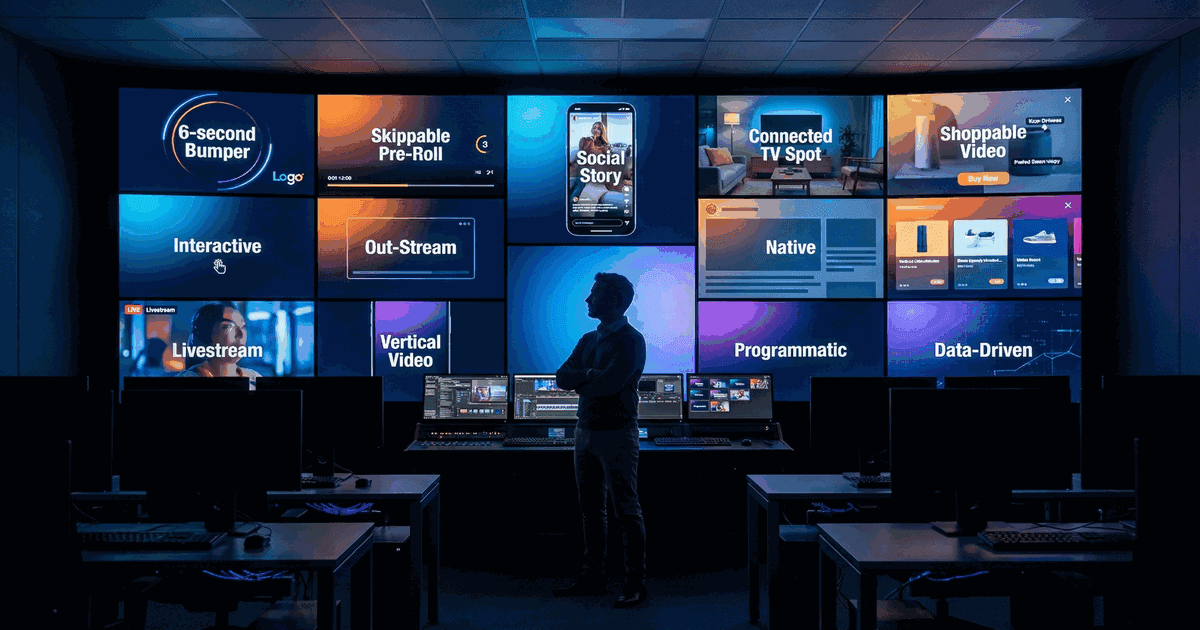
Video advertising now accounts for 35% of total digital ad spend worldwide, according to eMarketer's 2025 Digital Advertising Report. That is $180 billion flowing into video ads across platforms, placements, and formats. The problem is not whether to use video advertising. The problem is knowing which type to use, where to run it, and what performance to expect.
This guide covers every major type of video advertising: the creative formats (what the ad looks like), the placement types (where it runs), and the platform-specific variations (how each platform handles video ads differently). For each type, you get performance benchmarks, production cost ranges, and the campaign objectives it serves best. Whether you are running online video advertising campaigns on social platforms or investing in traditional TV commercials for broadcast, understanding the full range of video ad types is essential for allocating budget effectively. For a broader view of why video delivers stronger returns than other media formats, see our benefits of video marketing breakdown.
Key takeaways
- Video advertising accounts for 35% of total digital ad spend worldwide - $180 billion in 2025 (eMarketer)
- Short-form video ads (under 15 seconds) generate 72% higher completion rates than 30-second ads (Google 2025)
- UGC-style ads achieve 2.8x higher engagement and 15-20% lower CPMs than polished brand ads on Instagram and TikTok (Dash Hudson, Meta 2025)
- Interactive video ads generate 4.7x higher engagement rates with 34 seconds average time spent versus 12 seconds for passive video (Innovid 2025)
- CTV ad spend reached $32 billion in 2025 (up 29% YoY), with 95%+ completion rates and access to the 38% of viewers who never watch linear TV
- Direct response video ads deliver 28% lower CPA than display campaigns on Google (Google Ads 2025)
- In-feed ads that hook within the first 2 seconds achieve 5x higher completion rates than those with slow openings (Meta 2025)
- Production costs span $500 (UGC-style) to $50,000+ (broadcast brand films) - align format to campaign objective, not budget
68% of advertisers now identify CTV as the most critical channel in their media mix, signaling a shift in how brands define performance and allocate budgets. CTV has evolved from a branding-first medium to a performance channel where audience attention and measurable outcomes matter as much as reach.
Video advertising creative formats
Creative formats define what the ad communicates and how it is structured. The format you choose determines production cost, audience response, and which funnel stage the ad serves.
Brand story ads
Brand story ads tell a narrative that connects the viewer to the company's mission, values, or origin story. These are awareness-focused ads that prioritize emotional resonance over direct response.
Performance data: According to Nielsen's 2025 Total Ad Ratings Benchmark, brand story video ads generate 23% higher brand recall than product-focused ads. However, they produce lower immediate click-through rates (average 0.4% CTR versus 1.2% for direct response ads) because the goal is memory, not clicks.
Best for: Top-of-funnel awareness campaigns, brand launches, repositioning efforts. Companies with a strong founder story or mission-driven positioning get the most value from this format.
Production cost: $10,000-50,000+ depending on production quality. These are the most expensive video ad type because they rely on cinematography, narrative structure, and often professional talent.
Example: Apple's "Shot on iPhone" campaign featured real users' footage framed as cinematic storytelling. Nike's "You Can't Stop Us" used split-screen documentary footage to create emotional narrative without a single product shot.
Nike - You Can't Stop Us
Product demonstration ads
Product demonstration ads show the product in use, focusing on features, benefits, and real-world application. The viewer sees what the product does rather than hearing a brand claim about it.
Performance data: Wyzowl's 2025 Video Marketing Statistics Report found that 89% of consumers said watching a video convinced them to buy a product or service. Product demo ads specifically generate the highest purchase intent among all video ad types: a 2025 Wistia benchmark study found that demo videos watched to 75% completion correlate with a 64% conversion rate on landing pages.
Best for: Consideration-stage campaigns, product launches, retargeting audiences who have visited a product page. Software and SaaS companies see the strongest results because the product experience is difficult to communicate with static images.
Production cost: $2,000-15,000. Screen recording with voiceover is the most common format for software products ($2,000-5,000). Physical products requiring studio filming cost more ($8,000-15,000).
2026 will be the year data dominates TV advertising. As marketers become more comfortable with AI and machine learning in their daily workflows, the focus shifts from the tools themselves to the quality of the data powering them. Ecosystem players with large, scaled first-party data will hold a decisive advantage.
Customer testimonial ads
Customer testimonial ads feature real customers sharing their experience with the product or service. The trust signal comes from peer endorsement rather than brand messaging.
Performance data: Stackla's 2025 Consumer Content Report found that testimonial ads generate 4x higher click-through rates and 50% lower cost-per-acquisition than brand-produced creative. BrightLocal's 2025 Consumer Review Survey found that 84% of consumers trust online reviews as much as personal recommendations.
Best for: Mid-to-bottom funnel campaigns, retargeting, and building trust for high-consideration purchases. B2B companies and service businesses see the strongest returns because trust is the primary purchase barrier.
Production cost: $500-15,000. Ranges from $500 for repurposed UGC testimonials reformatted as ads to $15,000 for professionally filmed multi-customer testimonial compilations. See our testimonial advertising guide for detailed format breakdowns.
Direct response ads
Direct response ads are designed to drive immediate action: a click, a signup, a purchase. Every creative element (hook, body, CTA) is optimized for a specific conversion event.
Performance data: According to Meta's 2025 Performance Marketing Report, direct response video ads generate an average 1.2% CTR on Facebook and Instagram, compared to 0.4% for awareness-optimized video. Google Ads' 2025 Video Campaign Data shows that direct response video campaigns on YouTube deliver an average cost-per-acquisition 28% lower than display campaigns.
Best for: Bottom-of-funnel campaigns with a clear conversion event (purchase, signup, download). E-commerce, SaaS free trials, and app installs are the strongest use cases.
Production cost: $1,000-8,000. These ads prioritize message clarity over production polish. Many top-performing direct response ads use phone-shot footage because it feels authentic and patterns-matches to organic social content.
Explainer and educational ads
Explainer ads break down a concept, product, or process in a concise, visual format. Educational ads provide genuine value (teaching something) while positioning the brand as an authority.
Performance data: Sprout Social's 2025 Social Media Trends Report found that educational video content generates 3.2x more saves than non-educational content. Saves correlate with long-term algorithmic distribution on platforms like Instagram and TikTok. HubSpot's 2025 State of Marketing report found that educational video ads have a 12% higher completion rate than non-educational video ads of the same length.
Best for: Awareness and consideration campaigns for complex products, emerging categories, or audiences that need education before they are ready to buy. Financial services, healthcare, and B2B technology brands benefit most.
Production cost: $3,000-20,000. Animated explainers cost $5,000-20,000 depending on animation quality. Live-action educational content costs $3,000-10,000.
UGC-style ads
User-generated content (UGC) style ads are produced to look like organic social media content rather than traditional advertisements. They may feature actual customers, paid creators, or internal team members, but the production style mimics authentic, phone-shot content.
Performance data: Dash Hudson's 2025 Social Media Benchmark Report found that UGC-style ads achieve 2.8x higher engagement rates than polished brand ads on Instagram and TikTok. Meta's 2025 internal data shows that ads classified as "native-feeling" by their machine learning model receive a 15-20% lower CPM.
Best for: Social media advertising on TikTok, Instagram Reels, and Facebook. Consumer products, DTC brands, and any company targeting audiences under 35. The format works because it reduces the "this is an ad" signal that triggers skipping.
Production cost: $500-3,000 per ad. The low cost is a major advantage: brands can produce and test 10-20 UGC variations for the same budget as one polished brand ad.
Creative format comparison
| Format | Avg CTR | Avg CPA | Best funnel stage | Production cost | Best platform |
|---|---|---|---|---|---|
| Brand story | 0.4% | High | Awareness | $10,000-50,000 | YouTube, CTV |
| Product demo | 0.8% | Medium | Consideration | $2,000-15,000 | YouTube, website |
| Testimonial | 1.0% | Low | Trust/conversion | $500-15,000 | Facebook, LinkedIn |
| Direct response | 1.2% | Low | Conversion | $1,000-8,000 | Meta, Google |
| Explainer | 0.6% | Medium | Education | $3,000-20,000 | YouTube, LinkedIn |
| UGC-style | 0.9% | Low | Awareness/conversion | $500-3,000 | TikTok, Reels |
Source: Compiled from Meta 2025 Performance Marketing Report, Google Ads 2025 Video Campaign Data, Wyzowl 2025, Dash Hudson 2025.
Video ad placement types
Placement types define where in the viewer's experience the ad appears. The same creative can perform differently depending on placement because viewer attention, skip behavior, and cost structure vary by position.
Pre-roll ads
Pre-roll ads play before the content the viewer selected. YouTube pre-roll is the most common example. The viewer must watch the ad (or at least 5 seconds of it) before accessing their chosen content.
Performance data: According to Google's 2025 YouTube Advertising Benchmark, skippable pre-roll ads achieve 65-85% completion rates for 6-second bumper ads and 25-35% completion rates for 15-30 second skippable formats. Non-skippable 15-second pre-roll ads achieve 95%+ completion (forced viewing) but generate 38% higher negative brand sentiment than skippable formats, per a 2025 Kantar AdReaction study.
Cost: YouTube pre-roll CPV (cost per view) averages $0.02-0.06. A "view" counts after 30 seconds or completion of shorter ads.
Mid-roll ads
Mid-roll ads play during content, similar to a commercial break. YouTube inserts mid-rolls in videos over 8 minutes. These ads catch viewers who are already engaged with content.
Performance data: YouTube's 2025 Creator Economy Report shows that mid-roll completion rates average 75-90% because viewers have already committed to the content and are more tolerant of interruptions. However, excessive mid-roll density (more than 1 per 5 minutes) increases video abandonment by 22%.
Cost: Similar CPV to pre-roll ($0.02-0.06) but often slightly higher completion rates.
In-feed video ads
In-feed ads appear within the user's content feed on social platforms (Facebook News Feed, Instagram Feed, TikTok For You Page, LinkedIn Feed). They autoplay silently as the user scrolls past.
Performance data: Meta's 2025 Ad Performance Report shows that in-feed video ads achieve 1.5-2.5 seconds of average watch time before users scroll past. Ads that hook within the first 2 seconds achieve 5x higher completion rates than those with slow openings. LinkedIn's 2025 B2B Advertising Benchmark found that in-feed video ads generate 3.2x higher engagement than static image ads on the platform.
Cost: Facebook/Instagram in-feed CPM averages $8-15. TikTok in-feed CPM averages $6-12. LinkedIn in-feed CPM averages $30-60 (higher because of B2B targeting precision).
In-stream overlay ads
Overlay ads appear on top of video content without interrupting playback. YouTube display overlay ads appear at the bottom of the video player. These are less intrusive but also less attention-grabbing.
Performance data: Google's 2025 Display Benchmark shows that video overlay ads achieve 0.3-0.5% CTR, lower than pre-roll but at significantly lower CPM ($2-5). They work best for retargeting campaigns where the brand is already familiar to the viewer.
Outstream video ads
Outstream ads play in non-video environments: between paragraphs of articles, in app feeds, or in dedicated ad units on publisher websites. They autoplay when scrolled into view and pause when scrolled away.
Performance data: IAB's 2025 Digital Video Advertising Report found that outstream ads achieve 70% viewability rates (defined as 50% of pixels in view for 2+ seconds). The format is growing: outstream ad spend increased 42% year-over-year in 2025. Average CPM ranges from $5-12.
Interactive video ads
Interactive ads include clickable elements within the video itself: product carousels, polls, branching paths, or shoppable hotspots. YouTube, TikTok, and Meta all offer interactive ad formats.
Performance data: According to Innovid's 2025 Interactive Video Benchmark, interactive video ads generate 4.7x higher engagement rates than passive video ads. Time spent with the ad averages 34 seconds for interactive formats versus 12 seconds for non-interactive. However, production costs are 2-3x higher because interactive elements require additional creative and technical development.
2026 will see the widespread adoption of the Smart TV Home Screen as a premium advertising surface. Formats will become more interactive, shoppable, and personalised, incorporating overlays, voice and AI features, and direct-commerce actions that shorten the path from inspiration to conversion.
Connected TV (CTV) ads
CTV ads run on streaming platforms viewed through smart TVs, Roku, Apple TV, Fire TV, and similar devices. These are the digital equivalent of traditional TV commercials but with addressable targeting.
Performance data: eMarketer's 2025 CTV Advertising Report shows CTV ad spend reached $32 billion in 2025, growing 29% year-over-year. CTV ads achieve 95%+ completion rates (most are non-skippable) and reach audiences that traditional TV advertising misses: 38% of CTV viewers are cord-cutters who do not watch linear TV, according to Nielsen's 2025 Streaming Audience Report.
Cost: CTV CPM averages $25-45, higher than social media video but with larger screen impact and forced completion.
With ad-supported TV viewing on CTV and streaming already exceeding 40% in 2025, 2026 is likely to be yet another year of accelerating expansion, attracting approximately 20% of the global video ad spend. This growth will be largely fuelled by the wider adoption of new, highly engaging ad units, especially interactive shoppable ads and pause ads.
Placement type comparison
| Placement | Avg completion rate | Avg CPM | Skip option | Best for |
|---|---|---|---|---|
| Pre-roll (skippable) | 25-35% | $10-20 | After 5 sec | Awareness at scale |
| Pre-roll (non-skip) | 95%+ | $15-25 | None | Guaranteed message delivery |
| Mid-roll | 75-90% | $10-20 | Varies | Engaged audience |
| In-feed (social) | Varies by hook | $6-15 | Scroll past | Social campaigns |
| Overlay | N/A (runs during) | $2-5 | Always visible | Retargeting |
| Outstream | 70% viewability | $5-12 | Scroll away | Reach extension |
| Interactive | 85%+ engagement | $15-30 | Optional | Product discovery |
| CTV | 95%+ | $25-45 | None | Premium awareness |
Source: Compiled from Google 2025, IAB 2025, eMarketer 2025, Meta 2025, Innovid 2025.
Want a video strategy built for the platforms that matter?
YouTube, TikTok, Instagram, TV - each platform has different rules. We know them.
Book a Discovery CallHow to choose the right video ad type
The decision comes down to three variables: your campaign objective, your target platform, and your budget.
Objective: brand awareness. Use brand story creative in pre-roll or CTV placement. These formats prioritize reach and memory over immediate action. Budget at least $10,000 for production and $5,000+ for media spend to see meaningful reach.
Objective: consideration and education. Use explainer or product demo creative in mid-roll or in-feed placement. The viewer needs to learn something before they are ready to convert. LinkedIn in-feed works well for B2B; YouTube mid-roll works for consumer products.
Objective: direct conversion. Use direct response or testimonial creative in in-feed placement on Meta or Google. These formats drive immediate action. Budget $1,000-5,000 for production and test 5-10 creative variations to find the winner.
Objective: engagement and virality. Use UGC-style creative in TikTok in-feed or Instagram Reels placement. The goal is not conversion but shares, saves, and algorithmic distribution. Budget $500-3,000 per creative variation and produce multiple versions.
"The biggest mistake in video advertising is choosing the format first and the objective second. A beautiful brand film running as a direct response ad on Facebook will fail. A phone-shot testimonial running as a CTV ad will fail. The format must match the objective and the placement. All three have to align," says Shama Hyder, CEO of Zen Media and author of "The Zen of Social Media Marketing."
The CTV market is experiencing a supply surplus, creating a need to rethink what qualifies as ‘premium.’ As advertisers crowd around a few household-name apps, valuable audiences across FAST and mid-tier platforms are being overlooked. In 2026, education around quality and engagement, not price point or paywall, will reshape how premium is defined.
Platform-specific video ad specs
| Platform | Max length | Recommended length | Aspect ratio | Sound default | Auto-caption |
|---|---|---|---|---|---|
| YouTube (pre-roll) | 6 min | 15-30 sec | 16:9 | Sound on | No |
| TikTok (in-feed) | 10 min | 9-15 sec | 9:16 | Sound on | Yes |
| Instagram Reels | 90 sec | 15-30 sec | 9:16 | Sound on | Yes |
| Facebook Feed | 240 min | 15-60 sec | 1:1 or 4:5 | Sound off | Yes |
| LinkedIn Feed | 10 min | 15-30 sec | 1:1 or 16:9 | Sound off | No |
| CTV (general) | 60 sec | 15-30 sec | 16:9 | Sound on | No |
Source: Platform ad specs as of January 2026.
Need content optimized for a specific platform?
We'll tailor your video strategy to the platform where your audience actually lives.
Talk to Our TeamFrequently asked questions
What are the main types of video advertising?
Video advertising includes two categories: creative formats and placement types. The six main creative formats are brand story ads, product demonstrations, customer testimonials, direct response ads, explainer/educational ads, and UGC-style ads. The major placement types are pre-roll, mid-roll, in-feed, outstream, interactive, overlay, and connected TV (CTV). Each serves different campaign objectives and performs differently by platform.
Which type of video ad has the highest conversion rate?
Direct response video ads generate the highest immediate conversion rates, with an average 1.2% CTR on Meta platforms and 28% lower cost-per-acquisition than display campaigns on Google, according to 2025 platform data. Customer testimonial ads are close behind with 4x higher CTR than brand-produced creative. However, "highest conversion" depends on funnel stage: brand story ads drive the highest long-term brand lift, while direct response drives the highest immediate action.
How much does video advertising cost?
Production costs range from $500 for UGC-style ads to $50,000+ for broadcast-quality brand commercials. Media costs vary by platform: TikTok in-feed CPM averages $6-12, Facebook/Instagram averages $8-15, YouTube pre-roll CPV averages $0.02-0.06, LinkedIn averages $30-60, and CTV averages $25-45. A minimum viable video ad campaign (production plus media) starts at approximately $2,000-5,000 for social platforms. For a detailed line-item breakdown of broadcast commercial budgets, see our 30-second commercial cost guide.
Are short video ads or long video ads more effective?
Short video ads (under 15 seconds) generate 72% higher completion rates than 30-second ads, according to Google's 2025 Video Ads Report. However, longer ads (60-120 seconds) generate higher purchase intent for complex products. The optimal length depends on platform and objective: 6-15 seconds for TikTok and Instagram, 15-30 seconds for YouTube pre-roll, and 60-120 seconds for product demos and educational content.
What is the difference between instream and outstream video ads?
Instream video ads play within existing video content (before, during, or after a video the viewer chose to watch). They include pre-roll, mid-roll, and post-roll formats. Outstream video ads play in non-video environments like article pages, app feeds, or dedicated ad units. Outstream ads autoplay when scrolled into view and pause when scrolled away. Instream ads achieve higher completion rates because the viewer is already in video-watching mode. Outstream ads offer wider reach because they are not limited to video content inventory.
External sources:
- Wyzowl 2025 Video Marketing Statistics Report
- HubSpot 2025 State of Marketing Report
- Forbes: How To 10x Views Of Your Videos In 90 Days (2020)
- Investopedia: Call Action Cta
Related articles:
- See how testimonial ads specifically drive conversions with our testimonial advertising guide covering five distinct strategies with measured outcomes.
- Apply video advertising to paid campaigns with our creative video ads framework covering platform-specific thumb-stopping creative strategies.
- Learn which video formats generate the highest organic reach in our short-form video examples guide analyzing what makes top-performing content spread.
- Measure the ROI of your video ad campaigns with our video marketing ROI measurement framework covering attribution models and platform-specific benchmarks.
- Understand platform algorithms that affect video ad distribution in our TikTok trends guide covering algorithm signals and format performance data.
- Find the right production partner for broadcast campaigns with our TV commercial production companies guide covering evaluation criteria and cost tiers.
- Compare video sharing websites to determine the best distribution platforms for your video ad content, or see our detailed Vimeo vs YouTube comparison for hosting decisions.