
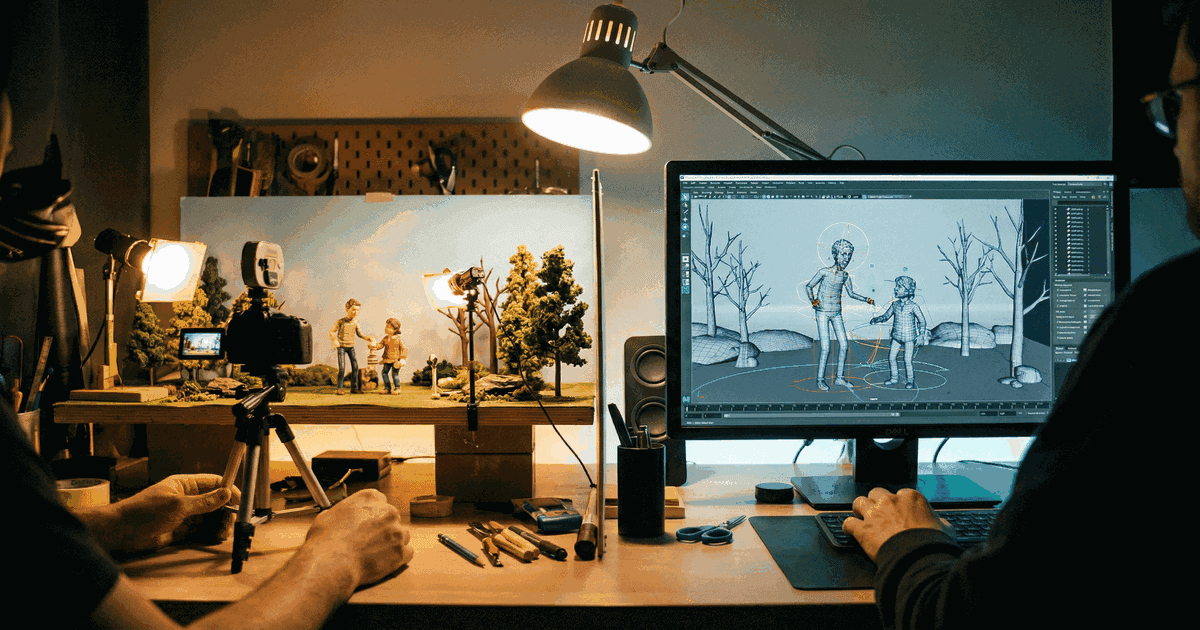
The answer is almost never "one is better than the other." It is always "one is better for this specific project, this audience, and this budget."
Both formats have measurable strengths. Live action outperforms animation for trust signals and emotional connection. Animation outperforms live action for concept explanation and scalability. The wrong choice costs you 2-8 weeks of production time and thousands of dollars on a format that works against your message.
This article gives you the data to make the right call: cost comparisons, timeline breakdowns, audience preference research, and a use case matrix covering 10 common video types.
The core difference in 30 seconds
Live action records real people, places, and objects with a camera. The audience sees actual humans in actual environments. Trust is the default response.
Animation creates images, characters, and environments digitally. The audience sees concepts made visible. Clarity is the default response.
That distinction - trust vs. clarity - drives every decision in this framework.
Cost comparison: live action vs animation
Production costs vary widely within each format, but the patterns are consistent. According to Clutch's 2025 Video Production Pricing Survey of 500 production companies, here are median costs per finished minute:
| Format | Low range (per minute) | Mid range (per minute) | High range (per minute) |
|---|---|---|---|
| Live action (1 camera, basic) | $1,500 | $5,000 | $15,000 |
| Live action (multi-camera, studio) | $5,000 | $15,000 | $50,000+ |
| 2D animation (simple) | $2,000 | $6,000 | $12,000 |
| 2D animation (character-driven) | $5,000 | $10,000 | $25,000 |
| 3D animation | $8,000 | $20,000 | $50,000+ |
| Motion graphics | $1,500 | $4,000 | $10,000 |
| Whiteboard animation | $800 | $2,000 | $5,000 |
Hidden cost factors most people miss:
Live action has variable costs that are hard to predict before production. Talent fees, location permits, weather delays, wardrobe, and catering can push a $5,000 budget to $8,000. Animation costs are more predictable because every element is digital - no weather, no location fees, no food for a crew.
But animation has a different hidden cost: revisions. According to Wistia's 2025 production benchmark, the average animated video goes through 3.2 rounds of revisions, compared to 2.1 rounds for live action. Each animation revision is cheaper than reshooting live action, but the cumulative revision cost can add 20-40% to the original estimate.
Timeline comparison
Time from approved brief to final delivery:
| Format | Pre-production | Production | Post-production | Total |
|---|---|---|---|---|
| Live action (basic) | 1-2 weeks | 1-2 days | 2-3 weeks | 4-6 weeks |
| Live action (full production) | 2-4 weeks | 2-5 days | 3-6 weeks | 7-12 weeks |
| 2D animation (simple) | 1-2 weeks | 2-4 weeks | 1-2 weeks | 4-8 weeks |
| 2D animation (complex) | 2-3 weeks | 4-8 weeks | 2-3 weeks | 8-14 weeks |
| 3D animation | 2-4 weeks | 6-12 weeks | 2-4 weeks | 10-20 weeks |
| Motion graphics | 1 week | 1-3 weeks | 1 week | 3-5 weeks |
Source: Vidyard 2025 Video in Business Report median timelines.
The timeline inversion that surprises most buyers: Simple live action is faster than simple animation. But complex live action (multiple locations, large cast, elaborate sets) takes longer than complex animation because of logistics. Once you pass the $15,000 budget threshold, animation often delivers faster because there are no physical constraints.
Curious which animation style fits your brand?
From 2D to motion graphics - we'll match the format to your goals and budget.
Book a Discovery CallWhen to choose live action
Live action is the better choice when your project relies on any of these four factors.
Factor 1: You need the audience to trust a real person
Testimonials, CEO messages, investor updates, recruitment videos, and any content where a specific named human speaks to camera. A 2025 study by the USC Annenberg School for Communication found that viewers trust real human faces 2.1x more than animated characters for product recommendations.
Live action mandatory for:
- Customer testimonials and case study interviews
- Founder or CEO thought leadership
- Employee culture and recruitment
- Investor relations and earnings communications
- Crisis communications
Factor 2: Your product is physical
If the audience needs to see the product in a real environment - food, fashion, consumer electronics, real estate, automotive - live action creates the sensory connection that drives purchase decisions. According to Shopify's 2025 Commerce Trends report, product videos with real footage of the product in use convert at 1.8x the rate of animated product explanations.
Factor 3: Emotional connection is the primary goal
Brand films, cause marketing, emotional storytelling - these formats depend on human faces and body language to trigger empathy. Mirror neurons (the neurological mechanism behind empathy) activate more strongly in response to real human expressions than to animated ones, according to a 2023 meta-analysis published in Neuroscience & Biobehavioral Reviews.
Factor 4: Your brand identity relies on "real"
Outdoor brands, healthcare providers, food companies, fitness brands - industries where authenticity and physical reality are core to the brand promise. Using animation in these contexts can feel disconnected from what the brand represents.
When to choose animation
Animation wins when your project requires one of these four conditions.
There used to be more hesitancy and, frankly, concern because production companies weren’t familiar with the platform or the audience. But now that they can track their own performance, producers are far more optimistic about how YouTube can build - and not cannibalize - the wider ecosystem.
Factor 1: The concept is abstract or invisible
Software workflows, data flows, internal processes, scientific concepts, financial mechanisms - anything the audience cannot physically see. Animation makes the invisible visible. According to a 2024 study published in the Journal of Educational Psychology, animated explanations of abstract concepts improved comprehension by 42% compared to text-based explanations and 28% compared to live-action demonstrations using physical props.
Animation preferred for:
- SaaS product explainers and onboarding
- Data visualization and infographics
- Scientific or medical concepts
- Process documentation and workflows
- Financial product explanations
Factor 2: You need to update the content frequently
Animation can be re-rendered with new screens, updated data, and revised scripts without a reshoot. Live action requires bringing back the crew, talent, and location. For content that changes quarterly (product demos, feature updates, seasonal promotions), animation costs 60-80% less to update than live action, according to Wistia's 2025 benchmark data.
Factor 3: Your budget is under $3,000 for a polished result
Below $3,000, live action looks like what it is: cheap. A single camera, poor lighting, and amateur talent are visible to the audience. At the same budget, motion graphics or simple 2D animation can look professional because the quality bar is set by design skill, not by physical equipment.
Factor 4: You need many variations or translations
Animation scales. Changing text overlays, color schemes, language, and character appearances costs a fraction of reshooting. For campaigns that need 10+ variations (different markets, A/B testing, platform-specific cuts), animation is the only format where marginal cost per variation approaches zero.
The use case matrix: 10 common video types
| Video type | Recommended format | Why | Budget range |
|---|---|---|---|
| Explainer video (SaaS/tech) | Animation | Abstract concepts need visual metaphors | $3,000-$15,000 |
| Customer testimonial | Live action | Trust requires real faces | $2,000-$8,000 |
| Product demo (physical) | Live action | Audience needs to see the real product | $3,000-$10,000 |
| Product demo (software) | Animation/screen recording | UI walkthroughs work better animated | $2,000-$8,000 |
| Brand film | Live action | Emotional connection needs real humans | $10,000-$50,000+ |
| Social media ad (short-form) | Either (depends on product) | Platform norms vary; test both | $500-$5,000 |
| Training/onboarding | Animation | Easy to update, consistent quality | $2,000-$10,000 |
| Event promo | Live action | Atmosphere and energy need real footage | $2,000-$8,000 |
| Data/research visualization | Animation (motion graphics) | Numbers need visual representation | $1,500-$6,000 |
| Recruitment/culture | Live action | Candidates want to see real people and office | $3,000-$12,000 |
Want to see what animation can do for your brand?
We'll walk you through styles, timelines, and what to expect.
Talk to Our TeamThe hybrid approach: combining both formats
The binary choice between live action and animation is a false one. According to a 2025 Wyzowl survey, 37% of businesses now use hybrid videos that combine live action footage with animated elements. Hybrid production often delivers better results than either format alone.
Common hybrid patterns
Pattern 1: Live action talent + animated data overlays. Film a person explaining a concept, then layer animated charts, diagrams, and callouts over the footage. This gives you the trust of a real face plus the clarity of animation for data points.
Pattern 2: Live action B-roll + animated product demo. Show the real-world context (office, factory, store) with live footage, then transition into an animated sequence that explains how the product works. Apple uses this pattern extensively in their product launch videos.
Pattern 3: Animated explainer + live action testimonial insert. Start with an animated overview of the problem and solution, then cut to a real customer describing their experience. The animation educates; the live footage validates.
Hybrid cost and timeline
Hybrid videos typically cost 20-30% more than a single-format video of the same length because they require two production workflows. Timeline adds 1-2 weeks over the longer of the two individual formats. But the performance improvement often justifies the extra investment.
According to Vidyard's 2025 data, hybrid videos have a 23% higher completion rate than single-format videos of the same length, suggesting that format variety keeps viewers engaged.
AR animations bridge the gap between digital marketing and physical products, creating memorable brand interactions that traditional media simply cannot achieve.
Audience preferences by demographic
Who watches your video should influence the format you choose.
According to the 2025 HubSpot State of Marketing Report and Morning Consult's media consumption survey:
| Audience segment | Preferred format | Notes |
|---|---|---|
| Gen Z (18-26) | Animation/hybrid | Grew up with animated content; comfortable with stylized visuals |
| Millennials (27-42) | Hybrid | Value both authenticity and visual clarity |
| Gen X (43-58) | Live action | Stronger preference for "real" content |
| Boomers (59+) | Live action | Highest trust in real footage; lower comfort with animation |
| B2B decision-makers | Hybrid | Want data clarity (animation) plus credibility (live action) |
| Technical audiences | Animation | Prefer visual explanations of complex concepts |
| Healthcare/finance audiences | Live action | Regulated industries favor authenticity |
These are tendencies, not rules. Test both formats with your specific audience before committing your full budget.
Kids are leading the digital shift. They’re the first to drift away from traditional broadcasting, becoming increasingly independent in their choices. The industry is scrambling to find ways to attract and retain viewers in a fragmented and dispersed market.
The decision flowchart
Answer these questions in order. Stop at the first definitive answer.
- Does a specific real person need to appear on camera? Yes = Live action
- Is the concept abstract, invisible, or process-based? Yes = Animation
- Will the content need frequent updates (quarterly or more)? Yes = Animation
- Is the budget under $3,000? Yes = Animation (motion graphics or 2D)
- Is emotional connection the primary goal? Yes = Live action
- Do you need 5+ variations for testing or localization? Yes = Animation
- Is the product physical and needs to be shown in use? Yes = Live action
- None of the above? Default to hybrid
Need animated content that actually drives results?
Animation isn't just for explainers. Let's find the right format for your goals.
Book a Strategy CallHow AI is changing the equation in 2026
AI video generation tools are adding a third option to the live action vs. animation decision. Tools like Runway Gen-4, Kling 2.0, and Google Veo 2 can generate both live-action-style and animated footage from text prompts.
For now, AI video works best as a supplement, not a replacement. AI-generated footage fills specific gaps:
- Concept visualization during pre-production (before committing to live or animated)
- Background footage and environmental shots
- Rapid prototype videos for testing concepts before full production
- Variation generation for A/B testing
According to a 2025 Forrester survey, 67% of marketing teams use AI video for at least one content type, but only 12% use it for primary brand campaigns. The quality gap between AI-generated and professionally produced video is closing, but it has not closed yet for most use cases.
We have to make this the future. Whatever the barriers or challenges, whether different financing structures, legislation, or tax incentives, we need to start dismantling them. We have to make it work, and together we have to find a way forward.
"The best production companies in 2026 do not choose between live action and animation. They choose the right tool for each shot. Some shots need a camera. Some need an animator. Some need an AI generator. The output is what matters, not the input method." - Andrew Davis, author of Brandscaping
Frequently asked questions
What is the difference between live action and animation?
Live action records real people, places, and objects using a camera. Animation creates images, characters, and environments digitally using software. Live action produces authenticity and trust. Animation produces clarity and creative freedom. The choice depends on your project goals, budget, and audience.
Is animation cheaper than live action video?
It depends on the complexity. Simple motion graphics ($1,500-$4,000 per minute) are cheaper than most live action ($3,000-$15,000 per minute). But complex 3D animation ($8,000-$50,000+ per minute) can cost as much or more than high-end live action. Animation has more predictable costs and cheaper revisions. Live action has more variable costs but produces usable B-roll and outtakes for repurposing.
Which takes longer to produce - live action or animation?
Simple live action (4-6 weeks) is faster than simple animation (4-8 weeks). Complex live action (7-12 weeks) and complex animation (8-14+ weeks) take similar time. Motion graphics (3-5 weeks) is the fastest format overall. 3D animation (10-20 weeks) is the slowest.
When should you use live action instead of animation?
Use live action when: a real person needs to appear on camera (testimonials, CEO messages), the product is physical and needs to be shown in use, emotional connection is the primary goal, or your audience skews older (Gen X and Boomers prefer live footage). Live action builds trust faster than animation for purchase decisions involving real products.
Can you combine live action and animation in one video?
Yes. 37% of businesses now use hybrid videos combining live footage with animated elements, according to a 2025 Wyzowl survey. Common patterns include live action talent with animated data overlays, live action B-roll with animated product demos, and animated explainers with live action testimonial inserts. Hybrid videos have 23% higher completion rates than single-format videos.
Does animation or live action perform better on social media?
Neither format consistently outperforms the other on social media. Performance depends on the platform, audience, and content type. TikTok and Instagram Reels favor authentic, phone-shot live action or bold animated visuals. LinkedIn favors talking-head live action for thought leadership and animated graphics for data visualization. YouTube performs well with both formats when the content is strong. Test both with your specific audience.
Make the right call for your next project
The format decision is a project decision, not a philosophy. Some projects need cameras. Some need animators. Most benefit from a combination.
Now more than ever, companies need to join forces if they want to produce quality content at lower costs. Collaboration isn’t just beneficial - it’s becoming essential for the industry’s survival.
Start with the flowchart above. If the answer is still unclear, produce a 30-second test version in both formats and measure which one your audience engages with more. A $1,000 test beats a $10,000 guess.
External sources:
- Wyzowl 2025 State of Video Marketing Survey
- Chief Marketer: Animation vs Live Action Video - Which Is Right for Your Business?
- 45 Video Marketing Statistics for 2025 [New Data]
Related articles:
- Apply animation to training content with our animated training videos guide - when animation outperforms live instruction, production costs, and L&D-specific formats.
- See animation in action for advertising with our animation ads analysis - brand examples, performance data, and when to choose animation over live action for paid campaigns.
- Explore motion graphics techniques in our motion graphics examples collection - style breakdowns, software workflows, and when motion graphics outperform other animation formats.
- Understand animation format options in our types of animation guide - 2D, 3D, motion graphics, whiteboard, and hybrid approaches with cost and timeline comparisons.
- Map broader video format decisions with our types of video content overview - explainer, testimonial, demo, brand film, and 15+ formats with use case recommendations.
- Navigate the AI video decision with our AI video vs real footage framework - quality thresholds, audience perception data, and the hybrid AI-assisted approach.
- Apply format decisions to corporate video with our corporate video production guide - planning, production, distribution, and format selection for internal and external corporate content.