
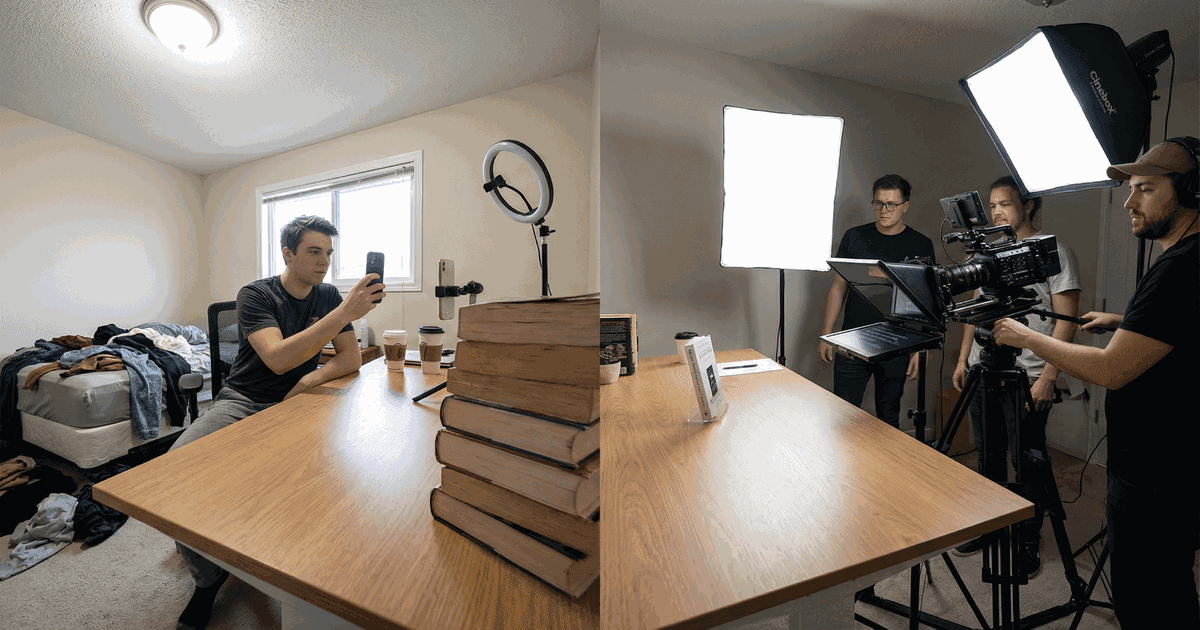
A $500 video shot on an iPhone in someone's kitchen outperformed a $50,000 brand film on Instagram. It happens. It also happens that a $50,000 brand film generates 40x more revenue than 100 UGC clips combined. Both statements are true, which is exactly why the "UGC vs professional video" debate produces so much confusion.
The answer is not one or the other. The answer depends on which metric matters most for your specific campaign, which platform you are publishing on, and where the viewer sits in the buying process.
This article compares UGC and professional video across six performance metrics using 2024-2025 benchmark data. No opinions about authenticity or production values. Just numbers, context for those numbers, and a framework for deciding where to spend your production budget.
Key takeaways
- UGC outperforms professional video on engagement by 2.4x on TikTok, 1.8x on Instagram Reels, and 1.5x on Facebook
- Professional video wins on landing page conversion: 4.7% vs 3.2% for UGC (Unbounce 2025)
- UGC costs $150-$500 per video vs $3,000-$8,000 for professional social video - producing 5-10x more content per dollar
- Trust splits along the B2C/B2B line: 86% of consumers find UGC authentic, but 71% of B2B decision-makers rate professional video as more credible
- The credibility gap scales with price: UGC wins 3:1 for products under $50, but professional video wins 2:1 for products over $500
- For B2C brands under $500 ACV, start with 70% UGC / 30% professional and adjust after 90 days of performance data
- Ad sets mixing UGC and professional creative achieve 22% lower CPA than single-style ad sets (Meta 2025)
- UGC enables 8-20 videos per month vs 2-4 for professional - critical for algorithmic momentum on social platforms
Definitions: what counts as UGC vs professional
Before comparing, the categories need clear boundaries.
UGC (user-generated content) video is footage created by customers, fans, employees, or paid creators who are not professional production teams. It is typically shot on phones, uses natural lighting, and has minimal post-production. The creator appears as themselves, not as a scripted talent. UGC includes unpaid organic reviews, paid creator partnerships (sometimes called "UGC-style" content), and employee-generated content.
Professional video is footage produced by a production company or in-house team with dedicated equipment, scripted narratives, professional lighting, directed talent, and structured post-production (color grading, sound mixing, motion graphics). This category includes brand films, product commercials, corporate videos, and studio-produced social content.
The middle ground gets blurry. A creator shooting a scripted brand message on a phone is technically professional content styled to look like UGC. For this comparison, the distinction is production infrastructure: if it required a production team, storyboard, and structured post-production workflow, it counts as professional.
Metric 1: engagement rate
Engagement rate is the primary metric where UGC outperforms professional video by a wide margin.
| Metric | UGC video | Professional video | Source |
|---|---|---|---|
| Average engagement rate (all platforms) | 6.9% | 2.1% | Stackla 2024 Consumer Content Report |
| Instagram Reels engagement rate | 4.7% | 1.8% | Dash Hudson 2025 Social Media Benchmarks |
| TikTok engagement rate | 8.3% | 3.5% | Socialinsider 2025 TikTok Benchmark Report |
| YouTube Shorts engagement rate | 3.2% | 2.4% | Tubular Labs Q4 2024 Brand Intelligence |
| Facebook video engagement rate | 3.1% | 1.4% | Emplifi 2025 Social Media Benchmark Report |
The gap is largest on TikTok (2.4x) and smallest on YouTube Shorts (1.3x). TikTok's algorithm actively suppresses content that looks like traditional advertising. Its Creative Center 2025 Performance Insights report found that "native-looking content" received 47% more distribution than "studio-lit, scripted" content.
Why the gap exists. Platform algorithms measure early engagement signals (watch time, likes, comments, shares) to decide distribution. UGC generates more comments because viewers perceive it as a conversation rather than a broadcast. Stackla's 2024 research found that consumers are 2.4x more likely to say UGC is authentic compared to brand-produced content, and authentic-feeling content generates more interaction.
Where professional video closes the gap. YouTube long-form content is the exception. Wistia's 2025 State of Video Report found that professional videos longer than 5 minutes had 18% higher completion rates than amateur-looking content of the same length. Viewers expect production quality when they commit time to longer content.
56% of Gen Zs and 43% of millennials report that social media content is more relevant to them than traditional content like TV shows and movies. Gen Zs spend 54% more time on social platforms and watching UGC than the average consumer per day.
Metric 2: conversion rate
Conversion rate tells a different story than engagement. The gap narrows, and in some contexts reverses.
| Conversion scenario | UGC video | Professional video | Source |
|---|---|---|---|
| Product page conversion lift (vs no video) | +29% | +34% | Bazaarvoice 2025 Shopper Experience Index |
| Ad click-through rate (social) | 4.1% | 2.8% | Meta Business 2025 Creative Insights Report |
| Landing page conversion rate | 3.2% | 4.7% | Unbounce 2025 Conversion Benchmark Report |
| Purchase intent lift (after viewing) | +33% | +42% | Nielsen 2024 Brand Impact Study |
| Email click-through rate (embedded video) | 2.8% | 3.4% | Vidyard 2025 Video in Business Report |
UGC wins on social ad click-through because it blends into the feed. Users click before recognizing it as an ad. But professional video wins on landing pages and in email because once someone has clicked through, they expect polish. The Unbounce 2025 data showed that landing pages with professional video had 47% higher conversion rates than those with UGC-style video.
The funnel split. Bazaarvoice's 2025 analysis of 1,800 e-commerce brands found a clear pattern: UGC converts better at the top and middle of the funnel (awareness and consideration), while professional video converts better at the bottom (purchase decision). The crossover point is roughly the moment a buyer starts evaluating specific products rather than browsing a category.
Nielsen's 2024 Brand Impact Study measured purchase intent after a single video exposure. Professional video produced 27% higher purchase intent among viewers already familiar with the brand. UGC produced 19% higher purchase intent among viewers unfamiliar with the brand. First impressions favor authenticity. Repeat impressions favor production quality.
Need video content built for your specific use case?
Corporate, demo, testimonial, product - we'll match the format to your goals.
Book a Discovery CallMetric 3: cost per video
This is where UGC has an overwhelming advantage.
| Production type | Median cost per video | Range | Source |
|---|---|---|---|
| Organic UGC (unpaid customer reviews) | $0 | $0 | N/A |
| Paid UGC creators (per video) | $150-$500 | $50-$2,500 | Influencer Marketing Hub 2025 UGC Creator Pricing |
| UGC at scale (agency-managed) | $300-$800 | $200-$1,500 | Later 2025 Creator Economy Report |
| Professional social video (15-60 sec) | $3,000-$8,000 | $1,500-$25,000 | Clutch 2025 Video Production Pricing Survey |
| Professional brand video (60-120 sec) | $15,000-$50,000 | $5,000-$150,000 | Clutch 2025 Video Production Pricing Survey |
| Professional commercial (broadcast) | $50,000-$200,000 | $20,000-$500,000+ | AICP 2024 Production Cost Survey |
The cost-per-engagement math heavily favors UGC. If a UGC video costs $300 and gets a 6.9% engagement rate, and a professional video costs $8,000 and gets a 2.1% engagement rate, the UGC costs roughly $43 per engagement point versus $3,809 per engagement point (assuming equal distribution).
But cost-per-conversion tells a different story. If that same professional video generates higher conversion rates on a landing page that receives 50,000 visits per month, the ROI calculation flips.
Cost efficiency by objective:
| Objective | More cost-efficient format | Efficiency margin | Notes |
|---|---|---|---|
| Social media reach | UGC | 5-10x | Lower cost + higher engagement rate |
| Brand awareness | UGC | 3-5x | Volume advantage, more content per dollar |
| Product consideration | Mixed | 1-2x either way | Depends on product complexity |
| Landing page conversion | Professional | 2-4x | Higher conversion rate offsets higher cost |
| Sales enablement | Professional | 3-5x | B2B buyers expect polish in sales process |
| Retargeting ads | UGC | 2-3x | Fresh creative rotates faster at lower cost |
Metric 4: trust and credibility
Trust is measurable, not just a feeling.
| Trust metric | UGC video | Professional video | Source |
|---|---|---|---|
| Consumers who find it authentic | 86% | 34% | Stackla 2024 Consumer Content Report |
| Consumers who trust it for purchase decisions | 79% | 52% | Bazaarvoice 2025 Shopper Experience Index |
| B2B buyers who find it credible | 38% | 71% | Edelman 2025 B2B Trust Barometer |
| Perception as "advertising" | 22% | 76% | Nielsen 2024 Global Trust in Advertising |
| Likelihood to share with others | 3.1x baseline | 1.4x baseline | Stackla 2024 Consumer Content Report |
The trust data splits along the B2C/B2B line. Consumer audiences trust UGC because they recognize their own purchasing behavior in it. A real person showing a product in their home carries more weight than a model in a studio. Stackla's research found that 86% of consumers say authenticity matters when choosing brands, and UGC scores highest on perceived authenticity.
B2B is the opposite. Edelman's 2025 B2B Trust Barometer found that 71% of B2B decision-makers rated professional video as more credible than UGC when evaluating enterprise purchases. In B2B, production quality signals organizational competence. A company that cannot produce a polished 90-second explainer raises questions about whether it can deliver on a six-figure contract.
The credibility gap by price point. The Bazaarvoice 2025 data showed that trust in UGC decreases as product price increases. For products under $50, UGC-driven purchase decisions outnumbered professional-video-driven decisions 3:1. For products over $500, the ratio reversed to 1:2 in favor of professional video. Higher financial risk requires higher production credibility.
What consumers increasingly value isn't technical quality but engagement quality, which is defined by authenticity, relatability and personal relevance. The parasocial aspect replaces the relatively dispersed populations that we now are.
Metric 5: production speed
Speed determines how much content you can produce per month, which directly affects platform algorithm performance.
| Production phase | UGC video | Professional video |
|---|---|---|
| Concept to brief | 0-1 days | 3-10 days |
| Production (filming) | 1-3 days | 1-5 days |
| Post-production | 0-2 days | 5-15 days |
| Revisions | 1-2 rounds, 1-3 days | 2-4 rounds, 5-15 days |
| Total timeline | 2-7 days | 14-45 days |
| Monthly volume (single creator/team) | 8-20 videos | 2-4 videos |
Source: Wyzowl 2025 State of Video Marketing, Later 2025 Creator Economy Report, internal production benchmarks from 50+ agency reports.
The speed advantage matters because platform algorithms reward posting frequency. Pentos' Q4 2025 Analytics Report found that TikTok accounts posting 5-7 times per week reached a median of 5,200 viewers per video, compared to 800 viewers per video for accounts posting 1-2 times per week. UGC enables the content volume needed to maintain algorithmic momentum.
Professional video production cannot match that cadence. Even well-funded in-house teams typically produce 2-4 polished videos per month. That output covers one platform at best. Maintaining presence across TikTok, Instagram Reels, YouTube Shorts, and LinkedIn requires 16-28 videos per month at minimum.
The hybrid production model. Brands that combine UGC for volume with professional video for key moments produce more total content without sacrificing quality where it matters. Wyzowl's 2025 data found that 67% of marketers now use a combination of UGC and professional video, up from 41% in 2023.
What would a custom video strategy look like for your company?
We'll scope your project, outline the approach, and give you a real timeline.
Get a Free ConsultationMetric 6: platform-specific reach
Each platform has a different relationship with UGC and professional content.
| Platform | UGC advantage | Professional advantage | Best format | Source |
|---|---|---|---|---|
| TikTok | 2.4x more reach | N/A | UGC always | Socialinsider 2025 TikTok Benchmark |
| Instagram Reels | 1.8x more reach | N/A | UGC for feed, pro for ads | Dash Hudson 2025 Social Media Benchmarks |
| Instagram Stories | 1.3x more reach | N/A | UGC slight edge | Dash Hudson 2025 Social Media Benchmarks |
| YouTube Shorts | 1.1x more reach | N/A | Nearly equal | Tubular Labs Q4 2024 Brand Intelligence |
| YouTube long-form | N/A | 1.4x more watch time | Professional | Wistia 2025 State of Video Report |
| N/A | 1.6x more engagement | Professional | LinkedIn 2025 B2B Marketing Benchmark | |
| Facebook Feed | 1.5x more reach | N/A | UGC | Emplifi 2025 Social Media Benchmark |
| Connected TV / OTT | N/A | 2.1x more completion rate | Professional | IAB 2025 Digital Video Report |
| Product pages | N/A | 1.2x more conversion | Mixed (UGC reviews + pro hero) | Bazaarvoice 2025 Shopper Experience Index |
The platform pattern. Short-form social platforms (TikTok, Reels, Shorts) favor UGC. Long-form and professional platforms (YouTube, LinkedIn, CTV) favor professional video. Product pages benefit from both: a professional hero video for the product overview, and UGC review videos below it for social proof.
The IAB 2025 Digital Video Report found that connected TV viewers are 2.1x more likely to watch a professional video to completion compared to UGC-style content on the same platform. The viewing context matters. Someone watching on a 55-inch TV in their living room expects television-quality production. Someone scrolling TikTok on their phone while waiting for coffee expects their friend talking to a camera.
Social video represents about one-quarter of all time spent with video in the U.S. The total creator media economy revenue was a little shy of $250 billion last year. By comparison, the combined revenues of Disney, NBCUniversal, Warner Bros. Discovery, Netflix, Paramount, Sony Pictures and Lionsgate totaled less than $150 billion.
Decision framework: where to spend your budget
The data points to a clear allocation model based on three variables: your audience (B2C or B2B), your primary platform, and your campaign objective.
Budget allocation by business type
| Business type | UGC allocation | Professional allocation | Rationale |
|---|---|---|---|
| B2C e-commerce (< $100 products) | 70-80% | 20-30% | Trust favors UGC, volume drives social reach |
| B2C e-commerce ($100-$500 products) | 50-60% | 40-50% | Split: UGC for social, professional for product pages |
| B2C e-commerce (> $500 products) | 30-40% | 60-70% | Higher price = higher credibility bar |
| B2B SaaS (< $5K ACV) | 40-50% | 50-60% | Professional for demos, UGC for testimonials |
| B2B SaaS ($5K-$50K ACV) | 20-30% | 70-80% | B2B trust demands production quality |
| B2B enterprise (> $50K ACV) | 10-20% | 80-90% | Board-level buyers expect polished content |
Budget allocation by funnel stage
| Funnel stage | UGC allocation | Professional allocation | Content types |
|---|---|---|---|
| Awareness (top) | 80% | 20% | UGC: social content, creator partnerships. Professional: brand film |
| Consideration (middle) | 50% | 50% | UGC: reviews, unboxings. Professional: explainers, demos |
| Decision (bottom) | 30% | 70% | UGC: testimonials. Professional: product demos, case study videos |
| Retention (post-purchase) | 60% | 40% | UGC: community content, tutorials. Professional: onboarding videos |
The 70/30 starter model
If you have no data on what works for your audience and need a starting point, allocate 70% of your video budget to UGC and 30% to professional production. This ratio works for most B2C brands under $500 ACV because:
- UGC gives you volume (8-20 videos per month vs 2-4)
- Volume gives you data (which formats, hooks, and messages resonate)
- Data tells you which 30% deserves professional production investment
- Professional production amplifies what already works organically
Run this model for 90 days. After 90 days, analyze which content drove the most conversions (not engagement), then adjust the ratio based on actual performance. Wyzowl's 2025 survey found that brands that started with a UGC-heavy mix and adjusted based on data achieved 23% higher overall video ROI than brands that started with an equal split.
The hybrid approach: when you need both
The best-performing video strategies in 2025 are not UGC-only or professional-only. They are intentional combinations.
Product launch sequence. Use professional video for the announcement (brand control, quality, narrative). Follow with UGC creator partnerships for first impressions (authenticity, reach). Then amplify the best-performing UGC with paid spend (efficiency). Bazaarvoice's 2025 data showed that product launches using this three-phase sequence generated 34% more revenue in the first 30 days compared to professional-only launches.
Social ad rotation. Run 3-5 UGC variations alongside 1-2 professional variations in the same ad set. UGC typically wins on click-through rate. Professional typically wins on conversion rate for higher-priced items. Let the algorithm allocate spend based on your optimization objective. Meta's 2025 Creative Insights Report found that ad sets mixing UGC and professional creative achieved 22% lower cost per acquisition than single-style ad sets.
Website video strategy. Professional hero video on the product page (controlled messaging, quality close-ups, feature demonstration). UGC review videos below it in a gallery or carousel (social proof, authenticity, volume). Bazaarvoice found that product pages with both formats had 41% higher conversion rates than pages with only one format.
Ready to start your next video project?
From brief to final cut - we'll handle production so you can focus on your business.
Get StartedCommon mistakes that waste video budget
Producing professional video for TikTok. The platform's algorithm penalizes polished content. If you are spending $5,000+ per TikTok video, you are paying more to reach fewer people.
Using UGC for B2B sales materials. A VP of procurement evaluating a $200,000 software contract does not want to watch someone film themselves on their phone. B2B sales video needs production quality that matches the price point.
Choosing based on personal preference instead of data. Marketing directors often prefer professional video because they view it as more "on brand." The data shows that what looks best internally often performs worst externally on social platforms. Test both. Measure results. Allocate budget based on performance, not aesthetics.
Treating UGC as free. Organic UGC from customers costs nothing to produce but costs time and systems to collect, curate, obtain permissions, and distribute. Paid UGC creators cost $150-$500 per video and require briefing, management, and quality control. Budget for the operational cost, not just the production cost.
Ignoring the hybrid middle. Some brands go all-in on UGC because it is cheap, then wonder why their brand perception suffers. Others spend exclusively on professional production, then wonder why their social reach is declining. The data consistently supports a mixed approach.
External sources:
- User-Generated Content vs Professionally Generated Content
- IAB 2025 Digital Video Ad Spend and Strategy Report
Related articles:
- Compare all video formats in our types of video content guide with cost and performance data.
- Measure video ROI with our video marketing ROI framework.
- See production approaches in our corporate video production guide.
- Get creator content ideas in our short video content ideas guide.
- Learn what makes content spread in our viral marketing videos guide.