
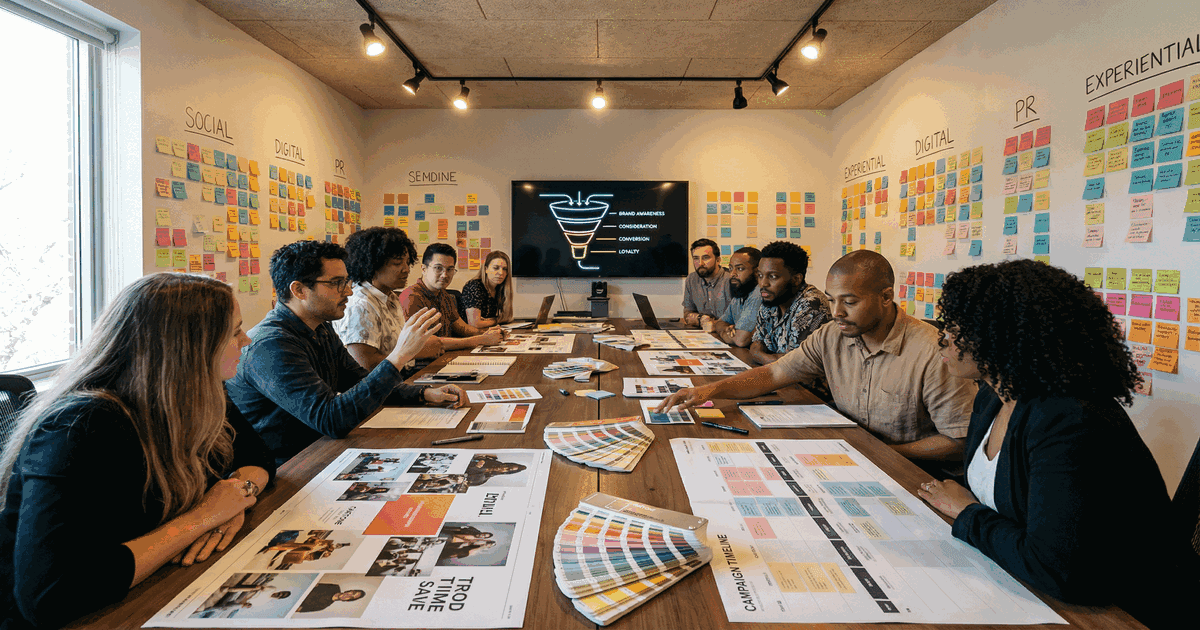
A brand awareness campaign is a structured marketing effort designed to increase how many people recognize your brand and what they associate it with. The goal is not immediate sales. It is moving your brand from unknown to familiar within a defined audience.
According to Kantar's 2025 BrandZ Global Report, brands with high awareness scores grew revenue 2.5x faster over five years than brands with low awareness. Nielsen's 2025 Annual Marketing Report found that brand awareness campaigns deliver a long-term return on investment 60% higher than performance marketing campaigns when measured over a three-year period. Yet the Interactive Advertising Bureau (IAB) 2025 Ad Spend Report found that 72% of digital ad budgets still go to direct response, with only 28% allocated to brand building.
The gap between what works long-term and what companies actually spend on creates an opportunity. This article breaks down 10 brand awareness campaigns that produced measurable results, organized by the strategy each one used. Each example includes specific outcomes, approximate budget ranges, and a framework you can apply to your own campaigns. For the formats that support awareness campaigns and when each fits, see our guide to the types of video content.
What makes a brand awareness campaign different from other marketing
Brand awareness campaigns differ from demand generation, lead generation, and direct response campaigns in their primary objective and measurement timeline.
A demand generation campaign measures success by pipeline created within 30-90 days. A brand awareness campaign measures success by unaided recall, aided recall, brand consideration scores, and branded search volume over 6-24 months. According to the Ehrenberg-Bass Institute's 2025 research on brand growth, brands must achieve mental availability (being thought of in a buying situation) before they can achieve physical availability (being easy to find and buy).
Today, brands are by default suspicious. Messages from brands coming from corporations are suspicious messages.
"Most marketing departments treat brand awareness as the thing they do after the performance budget is set. That is backwards. Without mental availability, your performance campaigns are fighting gravity. You are paying to convince people who have never heard of you, which costs five to ten times more per conversion than selling to people who already know your name," says Mark Ritson, marketing professor and brand consultant.
| Campaign type | Primary metric | Measurement timeline | Typical budget allocation |
|---|---|---|---|
| Brand awareness | Unaided recall, branded search volume | 6-24 months | 28% of ad budgets (IAB 2025 average) |
| Demand generation | Marketing-qualified leads, pipeline | 30-90 days | 35% of ad budgets |
| Direct response | Conversions, cost per acquisition | 1-30 days | 37% of ad budgets |
Source: IAB 2025 Ad Spend Report, Gartner 2025 CMO Spend Survey.
Strategy 1: Viral social campaigns
Viral social campaigns aim to generate massive organic reach by creating content designed to be shared. The strategy depends on emotional triggers (humor, surprise, outrage, inspiration) and platform-native formats that audiences want to pass along.
According to Sprout Social's 2025 Content Benchmark Report, branded content that generates organic sharing reaches 5.4x more people per dollar spent than paid-only distribution. The risk: viral is not a strategy you can guarantee. But you can design for shareability. Our video marketing examples guide breaks down 12 campaigns by the strategy pattern that made each one work, including emotional narrative, UGC integration, and humor-led disruption.
Spotify Wrapped
Spotify's annual Wrapped campaign turns each user's listening data into a personalized, shareable year-in-review. The 2024 edition generated over 225 million shares across social platforms in the first week, according to Spotify's Q4 2024 earnings call (Spotify Technology S.A.). The campaign cost Spotify an estimated $15-25 million in production and marketing, according to industry estimates published by AdAge.
Why it produced results: Wrapped works because users do the distribution. Every share is a personal endorsement and a brand impression for Spotify. The campaign generated a 21% increase in app downloads during the two-week Wrapped period compared to the same period the prior year, according to Sensor Tower's December 2024 app data.
Replication framework: Personalize data your product already collects into a shareable format. The content must be about the user, not about your brand. The brand presence comes from the format itself, not from messaging within it.
Duolingo on TikTok
Duolingo's TikTok account (9.8 million followers as of January 2026) built brand awareness through an unhinged green owl mascot character that comments on pop culture, threatens users who miss lessons, and creates absurdist comedy sketches. According to Duolingo's Q3 2025 earnings report, 40% of new user signups cited social media as their discovery source, up from 26% in 2023.
Why it produced results: The mascot character created a distinctive brand asset that is instantly recognizable without any text or logo. According to Social Blade tracking data, Duolingo's TikTok videos averaged 2.1 million views in 2025, with production costs estimated at $2,000-5,000 per video (one in-house social media team of four people).
Replication framework: Build a recurring character or format that becomes associated with your brand. Post three to five times per week. The content should be 80% entertainment and 20% product relevance. The brand builds through consistency and character recognition, not through product messaging.
The algorithms are still prioritizing great content, it's prioritizing that over followers.
Dropbox explainer video (2009)
Dropbox launched with a single two-minute explainer video that demonstrated how the product worked through an animated story. According to Drew Houston's Y Combinator presentation data (cited in Wistia's 2025 retrospective on viral video), the video drove signups from 5,000 to 75,000 overnight. Dropbox attributed $48 million in incremental revenue to the video over its first year.
Why it produced results: The video explained a new product category (cloud file sync) in language anyone could understand, using a relatable character scenario. In 2009, this format was novel. The shareability came from utility: people shared it because it explained something their friends needed to understand.
Replication framework: If you are creating a new product category, invest in a single piece of content that explains the concept to a general audience in under three minutes. Prioritize clarity over production value.
Dropbox - Original Explainer Video
Strategy 2: Content-led authority building
Content-led brand awareness campaigns position a brand as the authoritative source on a topic. Instead of reaching millions once, these campaigns build steady exposure over months or years through educational content that ranks in search, gets cited in industry conversations, and becomes the reference material for a category.
According to the Content Marketing Institute's 2025 B2B Content Marketing Report, 67% of B2B marketers said content marketing was their most effective brand awareness channel, ahead of paid social (54%) and events (49%).
HubSpot's Inbound Marketing methodology
HubSpot did not just sell marketing software. The company invented a term ("inbound marketing"), published a book, created a certification program, and built an annual conference (INBOUND) around the concept. According to HubSpot's 2025 annual report, 6.3 million people have completed HubSpot Academy certifications. The company's blog receives 13 million monthly visits, according to Semrush's January 2026 traffic estimates.
Why it produced results: HubSpot became synonymous with inbound marketing. Brand awareness for HubSpot reached 89% among B2B marketers in North America, according to a 2025 Demand Gen Report survey. The content operates as a self-reinforcing system: educational content attracts new audiences, certifications create advocates, and the conference generates media coverage.
Replication framework: Choose a methodology or framework that aligns with your product category. Name it. Build educational content around it. Create a free certification or training program. This strategy takes 2-5 years to reach full effect but creates durable brand awareness that paid campaigns cannot match.
Calendly's scheduling etiquette content
Calendly built brand awareness by publishing content about meeting culture and scheduling etiquette, topics that their target audience (professionals who schedule meetings) actively searches for. According to Calendly's 2025 brand tracking study (cited in their investor presentation), unaided brand recall among professionals increased from 23% to 47% between 2022 and 2025.
Why it produced results: Calendly inserted its brand into everyday workplace vocabulary. "Send me your Calendly" became a common phrase, similar to "Google it" or "Slack me." According to Ahrefs data from January 2026, Calendly.com receives 4.2 million monthly organic visits from blog and resource content alone.
Replication framework: Identify the everyday behavior your product enables. Create content around that behavior, not around your product features. Own the vocabulary of the workflow your tool supports.
Want to calculate the real ROI of video for your brand?
We'll walk you through the numbers with real data, not projections.
Book a Strategy CallStrategy 3: Experiential and event-based activation
Experiential brand awareness campaigns create physical or digital events that generate media coverage, social sharing, and word-of-mouth. These campaigns typically have the highest per-impression cost but also the highest emotional impact and recall rates.
According to EventTrack's 2025 Experiential Marketing Benchmark Study, 91% of consumers said they had more positive feelings about a brand after participating in an experiential event. Brand recall for experiential campaigns averaged 72% at 30 days, compared to 31% for display advertising and 44% for social media advertising.
Companies have become really risk averse. I think consumers are really thirsty for brands to do things that are interesting.
Red Bull Stratos (space jump)
In 2012, Red Bull sponsored Felix Baumgartner's jump from the edge of space, 127,852 feet above Earth. The live stream attracted 8 million concurrent viewers on YouTube, a record at the time. According to Millward Brown's post-campaign analysis, Red Bull's brand awareness increased 7% globally, and purchase intent increased 13% in the six months following the event. The estimated campaign cost was $30 million.
Why it produced results: The event was inherently newsworthy. Every media outlet covered it. Red Bull did not need to pay for distribution because the content was the news. The brand association (extreme achievement, pushing boundaries) was embedded in the event itself, not attached through advertising.
Replication framework: Sponsor or create an event that is newsworthy independent of your brand. The event must be genuinely remarkable, not a manufactured stunt. Budget: $500,000 minimum for regional impact, $5 million or more for national or global coverage.
Red Bull - Stratos Space Jump
Airbnb "Night At" series
Airbnb created a campaign series offering overnight stays at unusual locations: the Louvre museum, a floating house on the Thames, a Barbie Dreamhouse, and a shark tank at the Paris Aquarium. Each activation generated millions of earned media impressions and thousands of social posts from participants and spectators. According to Airbnb's 2025 brand health report, the "Night At" series contributed to a 15% increase in unaided brand awareness in markets where activations ran.
Why it produced results: The activations were both experiential (for a small number of winners) and social (for the millions who saw the content). Each event produced photo and video content that was inherently shareable. The cost per activation was estimated at $200,000-500,000, with earned media value exceeding $10 million per event, according to WARC 2025 effectiveness data.
Replication framework: Create an experience that is visually distinctive and limited in access. Scarcity (only a few people can participate) drives desire. The experience must photograph well for social media. Document it thoroughly for content repurposing.
Strategy 4: B2B thought leadership and category creation
B2B brand awareness campaigns face a specific challenge: the audience is smaller, the purchase cycle is longer, and the decision involves multiple stakeholders. Thought leadership campaigns address this by positioning the brand as the most knowledgeable voice in a category.
According to Edelman and LinkedIn's 2025 B2B Thought Leadership Impact Study, 64% of B2B buyers said thought leadership content was a better basis for assessing a vendor's capabilities than traditional marketing materials. And 48% of decision-makers said they awarded business to an organization because of its thought leadership.
Visibility is no longer enough. As AI transforms how content is made, discovered, and consumed, brands that earn trust and inspire belief will lead. In 2026, be ready to create irrefutable credibility with content that is data-informed, validated by experts, and available as an experience everywhere buyers are looking.
Salesforce's State of Marketing report
Salesforce publishes an annual State of Marketing report based on surveys of thousands of marketing professionals globally. The report is cited in industry publications, used as a reference in analyst reports, and downloaded hundreds of thousands of times. According to Salesforce's 2025 content marketing metrics (cited at Dreamforce 2025), the State of Marketing report generates 340,000 downloads annually and is cited in 1,200 or more third-party articles per year.
Why it produced results: The report positions Salesforce as the authority on marketing trends, which directly supports their marketing automation and CRM product lines. Every citation is a brand impression. Every download is a lead. The report costs an estimated $200,000-400,000 to produce (research, design, distribution), but the earned media value and lead generation far exceed that investment.
Replication framework: Commission original research in your industry vertical. Survey 500 or more professionals. Publish annual findings with clear data visualizations. Make the data freely available. Promote through industry partnerships and media outreach.
Gong's Revenue Intelligence category
Gong did not just build a call recording tool. The company coined "Revenue Intelligence" as a new category and built an entire content ecosystem around it. According to Gong's 2025 brand awareness metrics (cited in their Series E announcement), unaided awareness among VP-level and above sales leaders increased from 8% to 52% between 2020 and 2025.
Why it produced results: Category creation allows a brand to define the rules of the market it competes in. Gong invested in a podcast (Reveal: The Revenue Intelligence Podcast), a research lab publishing original sales data, and a conference (Celebrate). According to G2's 2025 category data, "Revenue Intelligence" grew from a nonexistent category to one with 47 vendors in five years, with Gong holding 61% brand awareness share.
Replication framework: Identify an unmet need that existing category labels do not adequately describe. Name the new category. Build the educational content that defines it. This strategy requires significant commitment (two to four years) and works best for companies willing to invest in content and community before the category reaches mainstream adoption.
Brand awareness campaign comparison by strategy
| Strategy | Best for | Budget range | Timeline to results | Primary metric | Risk level |
|---|---|---|---|---|---|
| Viral social | Consumer brands, B2C SaaS | $5,000-$500,000 per campaign | 1-4 weeks per campaign | Organic reach, shares, branded search | High (unpredictable) |
| Content-led authority | B2B, SaaS, professional services | $50,000-$500,000 per year | 6-24 months | Organic traffic, unaided recall, citations | Low (predictable) |
| Experiential activation | Consumer brands, lifestyle brands | $200,000-$5,000,000+ per event | 1-6 months per activation | Earned media, brand recall, social mentions | Medium (execution-dependent) |
| B2B thought leadership | Enterprise software, B2B services | $100,000-$500,000 per year | 12-36 months | Share of voice, unaided recall, pipeline influence | Low (long commitment) |
Ready to invest in video that pays for itself?
Let's build a video strategy with measurable returns.
Get Your Custom PlanHow to measure brand awareness campaign results
Brand awareness is harder to measure than direct response, but it is not unmeasurable. The best campaigns use a combination of survey-based metrics and behavioral signals.
Survey-based metrics:
- Unaided recall: "What brands come to mind when you think of [category]?" Measured pre- and post-campaign. The gold standard for awareness measurement, according to the Market Research Society's 2025 guidelines.
- Aided recall: "Have you heard of [brand]?" Measured pre- and post-campaign.
- Brand consideration: "Would you consider [brand] when making a purchase in [category]?" The step between awareness and purchase intent.
Behavioral signals:
- Branded search volume: Track Google searches for your brand name using Google Trends and Google Search Console. According to Les Binet and Peter Field's 2025 update to "The Long and the Short of It," branded search volume is the single strongest leading indicator of long-term brand health.
- Share of voice: Your brand's percentage of total media mentions in your category. Measured through media monitoring tools (Meltwater, Brandwatch, Sprout Social).
- Direct and organic traffic: Increases in direct website visits and branded organic searches signal growing awareness.
"Brand awareness measurement does not need to be expensive or complicated. Track branded search volume weekly. Run a quarterly brand tracking survey with 200-400 respondents in your target market. Compare share of voice against your top three competitors. Those three numbers tell you 80% of what you need to know about whether your awareness campaigns are working," says Jenni Romaniuk, Research Professor at the Ehrenberg-Bass Institute and author of "Building Distinctive Brand Assets."
External sources:
- Kantar 2025 BrandZ Global Report
- Forbes: What's the ROI on Brand Awareness?
- HBR: Do Your Marketing Metrics Show You the Full Picture?
Related articles:
- Measure the long-term revenue impact of your awareness campaigns with our video marketing ROI measurement framework covering attribution models and benchmark data.
- See how awareness campaigns translate to measurable business outcomes in our benefits of video marketing guide with data on brand recall, consideration, and conversion lift.
- Build awareness through content marketing with our content marketing examples guide covering formats that drive organic discovery and audience growth.
- Track competitive shifts for your awareness campaigns with our video marketing trends report covering platform changes and format performance data.