
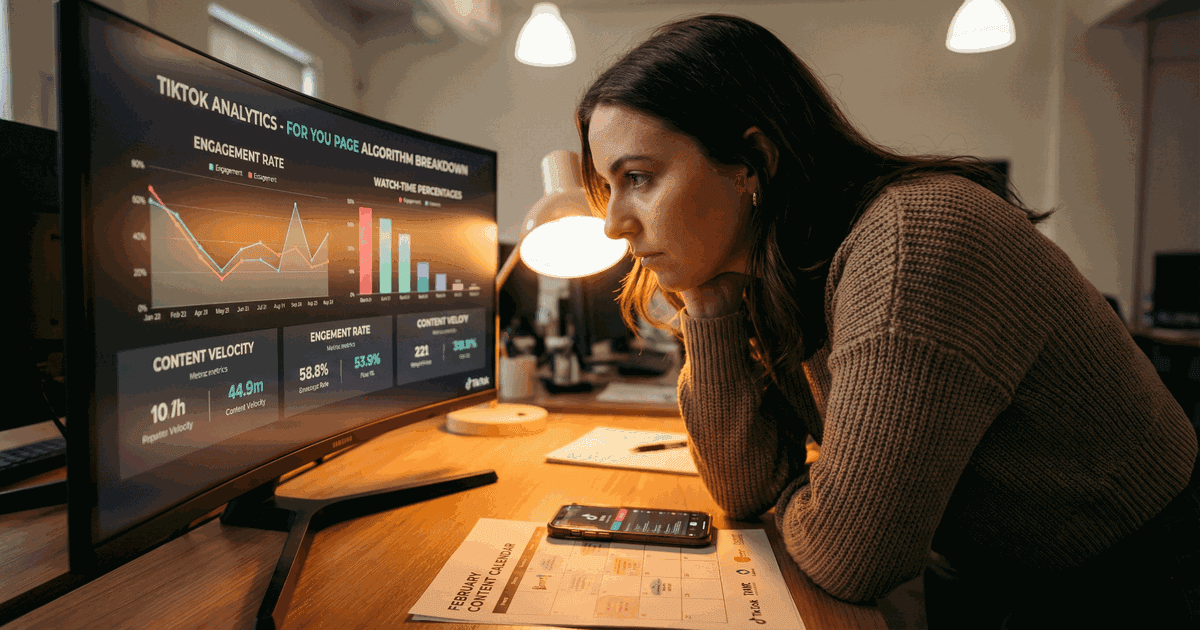
TikTok's recommendation algorithm does not care about your follower count, your production budget, or your brand name. It cares about whether people watch your video to the end, watch it again, and send it to someone else.
That is both the opportunity and the problem for brands on TikTok. The algorithm evaluates every video independently, which means a brand account with 500 followers can reach 5 million people if the content performs. It also means a brand account with 5 million followers can post a video that reaches 2,000 people if the content fails.
This guide explains how TikTok's algorithm works in 2026 specifically for brand accounts, what signals it weights most heavily, and how to build a content strategy around those signals.
How the TikTok algorithm works in 2026
TikTok's recommendation system operates in two stages: initial distribution and scaled distribution.
Stage 1: Initial distribution (the first 500-1,000 views)
When you publish a video, TikTok shows it to a small test audience of 500-1,000 users. According to TikTok's own documentation in its 2025 Transparency Report, this initial audience is selected based on:
- Content signals: Captions, sounds, hashtags, and visual elements in the video
- Account history: Topics your account has posted about previously
- User interest matching: Viewers whose behavior patterns match the content's predicted category
The algorithm measures how this test audience responds. If engagement exceeds certain thresholds, the video enters Stage 2.
Stage 2: Scaled distribution (the feed recommendation loop)
Videos that pass the initial test get pushed to progressively larger audiences. Each round of distribution is a new test. A video that performs well with 1,000 viewers gets shown to 10,000. If it performs well there, 100,000. This scaling continues until engagement drops below the platform's threshold for continued distribution.
According to TikTok's engineering team's published research at the 2024 ACM Conference on Recommender Systems, the recommendation model evaluates approximately 800 features per video, but the most heavily weighted signals fall into a small number of categories.
Social search and TikTok SEO is a huge focus for us. We want to anticipate what people are looking for and make sure that when they're looking, they find us first. Doing so gives our content longevity and helps new people find us every day, even when we aren't posting.
The 7 signals that determine reach
Not all engagement metrics carry equal weight. Here is what the algorithm prioritizes, ordered by observed impact on distribution, based on data from Socialinsider's 2025 TikTok Benchmark Report (analyzing 1.1 million TikTok videos) and independent testing by creators and brands.
| Signal | Weight (relative) | What it measures | Brand implication |
|---|---|---|---|
| Watch time / completion rate | Very high | % of video watched | Your hook must work in the first 0.5-1.5 seconds |
| Loop rate | Very high | % of viewers who rewatch | Short, surprising, or layered content loops naturally |
| Shares | High | Users sending video to others | Content must provide social currency or utility |
| Saves | High | Users bookmarking for later | Educational, tutorial, or reference content gets saved |
| Comments | Medium | Users engaging in conversation | Controversial or opinion-based content drives comments |
| Follows from video | Medium | Users following after watching | Strong CTA and profile optimization matter |
| Likes | Low-Medium | Passive approval | Easiest to get, least valuable for distribution |
Watch time is the dominant signal
Completion rate is the single most important metric for TikTok distribution. According to Dash Hudson's 2025 Social Media Benchmarks report, which analyzed 5 million TikTok videos, videos with completion rates above 50% received 6.2x more distribution than videos with completion rates below 30%.
For brand accounts specifically, the median completion rate is 32%, compared to 41% for creator accounts, according to Socialinsider's 2025 data. That gap means brands must work harder on the hook - the first 1-2 seconds - because TikTok's users are conditioned to swipe past content that looks like advertising.
Benchmark targets for brands:
| Video length | Good completion rate | Great completion rate | Exceptional |
|---|---|---|---|
| Under 15 seconds | 60%+ | 75%+ | 90%+ |
| 15-30 seconds | 45%+ | 60%+ | 75%+ |
| 30-60 seconds | 30%+ | 45%+ | 60%+ |
| 60+ seconds | 20%+ | 30%+ | 45%+ |
Source: Dash Hudson 2025 Social Media Benchmarks, Socialinsider 2025 TikTok Benchmark Report.
Loop rate is the amplifier
When someone watches a video twice (or more), TikTok interprets that as a strong quality signal. Videos that loop naturally - because they are surprising, confusing in a satisfying way, or contain details that reward rewatching - receive outsized distribution.
Pentos (TikTok analytics platform) reported in their Q3 2025 Brand Report that brand videos with a loop rate above 15% received 4.1x more impressions than brand videos with a loop rate below 5%.
How to engineer loops: Keep videos short enough that replays happen involuntarily (7-15 seconds is the sweet spot for loops). End the video mid-action or with an unexpected twist. Plant a detail in the background that viewers notice on second viewing.
Shares and saves beat likes
TikTok's algorithm treats shares and saves as high-intent engagement signals. A share means someone valued the content enough to send it to a specific person. A save means someone plans to return to it.
According to Hootsuite's 2025 Social Trends Report, TikTok videos with a save rate above 2% were 3.4x more likely to appear on the For You page than videos with similar view counts but lower save rates. The save rate benchmark for brand accounts is 1.2%, per Socialinsider's 2025 data.
Content types that drive saves: Step-by-step tutorials, comparison lists, product recommendations with specifics, before-and-after transformations, and reference content that viewers want to revisit.
Content types that drive shares: Content with social commentary, humor that references shared experiences, surprising demonstrations, and content that positions the sharer as informed or helpful.
Community will outperform virality. By 2026, success on social media will be defined less by reach and more by relationship depth. Brands and creators will focus on building smaller, highly engaged communities where conversations happen in comments, DMs, and shares.
Free swipe file
Win the first 3 seconds
The algorithm rewards videos people don't scroll past. Grab 40 hooks we use to earn that first watch. Free, instant.
Free and instant, plus the occasional email worth opening. Unsubscribe anytime.
What the algorithm penalizes
Understanding what suppresses distribution is as important as knowing what boosts it.
Hard suppression (shadow ban territory):
- Recycled content from other platforms (TikTok's detection identifies Instagram watermarks, YouTube thumbnails, and non-native aspect ratios)
- TikTok Community Guidelines violations (even minor ones throttle the entire account for 24-72 hours)
- Inauthentic engagement (purchased likes, comments, or views trigger immediate suppression)
Soft suppression (reduced distribution):
- Horizontal or square video in a vertical feed (TikTok's 2025 Creator Portal states 9:16 is "strongly recommended" and non-vertical content receives reduced For You page distribution)
- Videos with excessive text overlays that obscure the visual content
- Posting frequency below 1x per week (accounts that go dormant lose algorithmic momentum)
- Content that looks like a traditional ad (studio-lit, scripted, talent-on-set aesthetic performs 47% worse than native-looking content, per TikTok's 2025 Creative Center Performance Insights)
Ready to dominate short-form content?
TikTok, Reels, Shorts - we'll build a platform-specific strategy that works.
Book a Discovery CallBrand strategy framework: 90 days from zero to consistent reach
This framework is designed for brand accounts that are either starting fresh or resetting after poor performance. It prioritizes algorithm momentum over audience size.
Days 1-30: Establish signals
Goal: Teach the algorithm what your account is about and build initial engagement data.
Posting cadence: 5-7 times per week. Volume matters in the first 30 days because TikTok needs data to understand your content category and audience.
Content mix:
- 60% trend participation (use trending sounds and formats with brand-relevant angles)
- 30% educational or informational content (tutorials, tips, behind-the-scenes)
- 10% direct product content (but styled to look native, not produced)
Format rules:
- All videos 9:16 vertical
- 15-30 seconds for trend content
- 30-60 seconds for educational content
- Hook in first 1 second (question, surprising visual, or pattern interrupt)
- Captions on every video (TikTok's 2025 data shows captioned content receives 56% more watch time)
Measurement focus: Watch completion rate and view velocity (how quickly views accumulate in the first 2 hours). Do not focus on total views yet.
Days 31-60: Identify what works
Goal: Double down on the content formats and topics that generate the best completion rates and engagement.
Posting cadence: 4-5 times per week. Shift from volume to quality.
Content mix:
- 40% trend participation (but only trends where your brand has a credible angle)
- 40% educational/informational content (expand what performed in month 1)
- 20% product content (styled native)
Analysis at day 30: Sort all published content by completion rate. Identify the top 20%. What format, length, hook type, and topic do they share? Make more of that and less of everything else.
According to TikTok's Creator Learning Hub (updated January 2026), accounts that identify their top-performing content type within the first 30 days and increase production of that type by 50%+ see an average 3x improvement in reach over the following 60 days.
SEO in social media was already making waves, but 2026 is the year brands will fully lock it into their strategies. The platforms aren't just for scrolling, they're search engines. That means captions, titles, and even the words you speak on camera matter for discoverability.
Days 61-90: Scale and convert
Goal: Convert algorithmic reach into business outcomes (website visits, leads, sales).
Posting cadence: 3-5 times per week. Quality and strategic intent per post now matter more than raw frequency.
Content mix:
- 30% trend participation (only high-confidence trends)
- 40% proven formats from months 1-2
- 20% conversion-oriented content (product demonstrations, testimonials, limited-time offers)
- 10% experimental (test new formats, lengths, or angles)
Conversion mechanics: TikTok's in-app browser has a 35% bounce rate compared to 65% for external browser redirects, according to data from TikTok Shop's 2025 Merchant Performance Report. Use TikTok's native tools (link in bio, TikTok Shop, lead generation cards) rather than sending users to external URLs whenever possible.
Content format performance data for brands
Not all TikTok content formats perform equally for brand accounts. Here is how the major formats compare based on Socialinsider's 2025 brand-specific data (analyzing 280,000 brand TikTok videos).
| Format | Avg. engagement rate (brands) | Avg. completion rate | Best for | Production effort |
|---|---|---|---|---|
| Trend participation (sound + format) | 5.8% | 45% | Awareness, discovery | Low |
| Tutorial / how-to | 3.9% | 52% | Saves, consideration | Medium |
| Behind-the-scenes | 4.2% | 38% | Trust, brand personality | Low |
| User-generated content (reposted) | 6.1% | 41% | Social proof, awareness | Very low |
| Product demonstration | 2.8% | 34% | Conversion | Medium |
| Duet / stitch with creators | 5.4% | 43% | Reach, credibility | Low |
| Testimonial / review | 3.5% | 48% | Consideration, trust | Medium |
| Challenge / interactive | 7.2% | 37% | Awareness, virality | High |
Source: Socialinsider 2025 TikTok Benchmark Report (brand accounts data subset).
The highest-performing combination for brands: Tutorial content repackaged as trend participation. When a brand teaches something useful using a trending sound or format, the content benefits from both the algorithm boost of the trend and the high completion rates of educational content.
AI can crank out content, but it can't create context. Strategy and human editorial oversight remain important. Call it the 'human signature' that makes it unmistakably unique to that brand. AI can now recognize AI, and humans are getting better at it too. In 2026 and beyond, the standout brands will use AI for speed and scale, but recognize human expertise, and the metrics will reward them.
Brand-specific algorithm considerations
Several factors affect brand accounts differently than creator accounts.
Business accounts vs. personal accounts
TikTok Business accounts have access to analytics, ad tools, and commercial music library, but some creators report that personal accounts receive marginally better organic distribution. TikTok's official position, stated in their 2025 Business Help Center, is that account type does not affect algorithmic distribution.
Independent testing by Later's social media research team (published January 2026, analyzing 10,000 matched accounts) found no statistically significant difference in organic reach between business and personal accounts when controlling for content quality and posting frequency.
Recommendation: Use a business account for the analytics and commercial music access. The alleged distribution penalty is not supported by current data.
The paid-organic relationship
Running TikTok Ads does not directly boost your organic content. But it does indirectly affect algorithmic distribution because ads bring new viewers to your profile, and if those viewers then engage with your organic content, the algorithm receives positive signals.
According to TikTok's 2025 Brand Marketing Guide, brands that run Spark Ads (boosting organic posts) alongside regular organic posting see 28% higher organic reach than brands doing organic-only posting. The mechanism: Spark Ads introduce your best content to larger audiences, and the engagement from those audiences feeds back into organic distribution.
Content frequency thresholds
TikTok's algorithm rewards consistency more than any other platform. According to Pentos' Q4 2025 Analytics Report:
- Accounts posting 1-2x per week reach a median of 800 viewers per video
- Accounts posting 3-4x per week reach a median of 2,400 viewers per video
- Accounts posting 5-7x per week reach a median of 5,200 viewers per video
- Accounts posting 2x+ per day reach a median of 4,100 viewers per video (slight decrease from daily posting, likely due to quality dilution)
The optimal range for brand accounts is 4-7 posts per week. Posting more than once per day typically decreases average performance per video unless you have the production capacity to maintain quality.
Want a short-form content strategy built for the algorithm?
We know what each platform rewards. Let's build your playbook.
Talk to Our TeamExternal sources:
- Pew Research Center: Social Media Use in 2025
- Business of Apps: TikTok Revenue and Usage Statistics
- Statista: TikTok Global User Age and Gender Distribution (2025)
Related articles:
- See what is trending right now in our TikTok trends guide for 2026 with quarterly performance data.
- Get format ideas in our short video content ideas guide covering 12 formats.
- Compare platform advertising in our mobile video advertising guide with platform-specific benchmarks.
- Study what makes content spread in our viral marketing videos guide.
- See real brand executions in our short-form video examples breakdown.